Best Maksutov Telescopes for Planets and Moon (2026)
Updated How we research
Sky-Watcher Skymax 127mm Maksutov-Cassegrain - Large Aperture Compound-Style Reflector Telescope
Sky-Watcher Skymax 127mm Maksutov-Cassegrain, a compact compound scope prized for crisp lunar and planetary detail.
Sky-Watcher Skymax 180mm Maksutov-Cassegrain - Large Aperture Compound-Style Reflector Telescope (S11540)
Sky-Watcher Skymax 180mm Maksutov-Cassegrain, a large compound scope for serious planetary and lunar observers.
A Maksutov-Cassegrain folds a long focal length into a compact tube using a corrector lens and mirrors, which yields sharp, high-contrast planetary and lunar views. Look at aperture, usually 90mm to 150mm, and note the long focal ratio near f/12 to f/14, which favors high magnification on small, bright targets. The sealed tube resists dust and rarely needs collimation, but it cools slowly, so factor in acclimation time. A quality mount and a dew shield improve real-world results. Maksutovs suit observers focused on the Moon, planets, and double stars, plus those wanting a portable scope that holds alignment. They are less suited to wide-field deep-sky sweeps, since the narrow field frames little sky. A practical tip: set the scope outside 30 to 45 minutes before observing, because a Mak viewed before it reaches ambient temperature shows soft, unsteady images.
The short version
We compared 7 picks. Our scores range from 7.4 to 8.6 out of 10.
- Best overall:Sky-Watcher Skymax 127mm Maksutov-Cassegrain - Large Aperture Compound-Style Reflector Telescope. Highest overall score in this guide at 8.6/10.
- Also great value:Sky-Watcher Skymax 150mm Maksutov-Cassegrain - Large Aperture Compound-Style Reflector Telescope. Value score of 8/10, overall 8.6/10.
- Solid build:Sky-Watcher Skymax 180mm Maksutov-Cassegrain - Large Aperture Compound-Style Reflector Telescope (S11540). Build and materials score of 9/10, overall 8.6/10.
- Feature-rich:Celestron NexStar 4SE Computerized Telescope, 4-Inch Maksutov-Cassegrain, Automated GoTo Mount, SkyAlign. Features score of 9/10, overall 8.4/10.
Scores are our editorial assessment, not customer ratings. How we score
- 1.Sky-Watcher Skymax 127mm Maksutov-Cassegrain - Large Aperture Compound-Style Reflector Telescope8.6/10See on AmazonCheck price
- 2.Sky-Watcher Skymax 180mm Maksutov-Cassegrain - Large Aperture Compound-Style Reflector Telescope (S11540)8.6/10See on AmazonCheck price
- 3.Sky-Watcher Skymax 150mm Maksutov-Cassegrain - Large Aperture Compound-Style Reflector Telescope8.6/10See on AmazonCheck price
- 4.Celestron NexStar 4SE Computerized Telescope, 4-Inch Maksutov-Cassegrain, Automated GoTo Mount, SkyAlign8.4/10See on AmazonCheck price
- 5.Celestron NexStar 90SLT Maksutov-Cassegrain Portable Telescope for Planets7.9/10See on AmazonCheck price
- 6.Sky-Watcher Skymax 102mm Maksutov-Cassegrain - Large Aperture Compound-Style Reflector Telescope7.8/10See on AmazonCheck price
- 7.Sky-Watcher Skymax 90mm Maksutov-Cassegrain - Large Aperture Compound-Style Reflector Telescope7.4/10See on AmazonCheck price
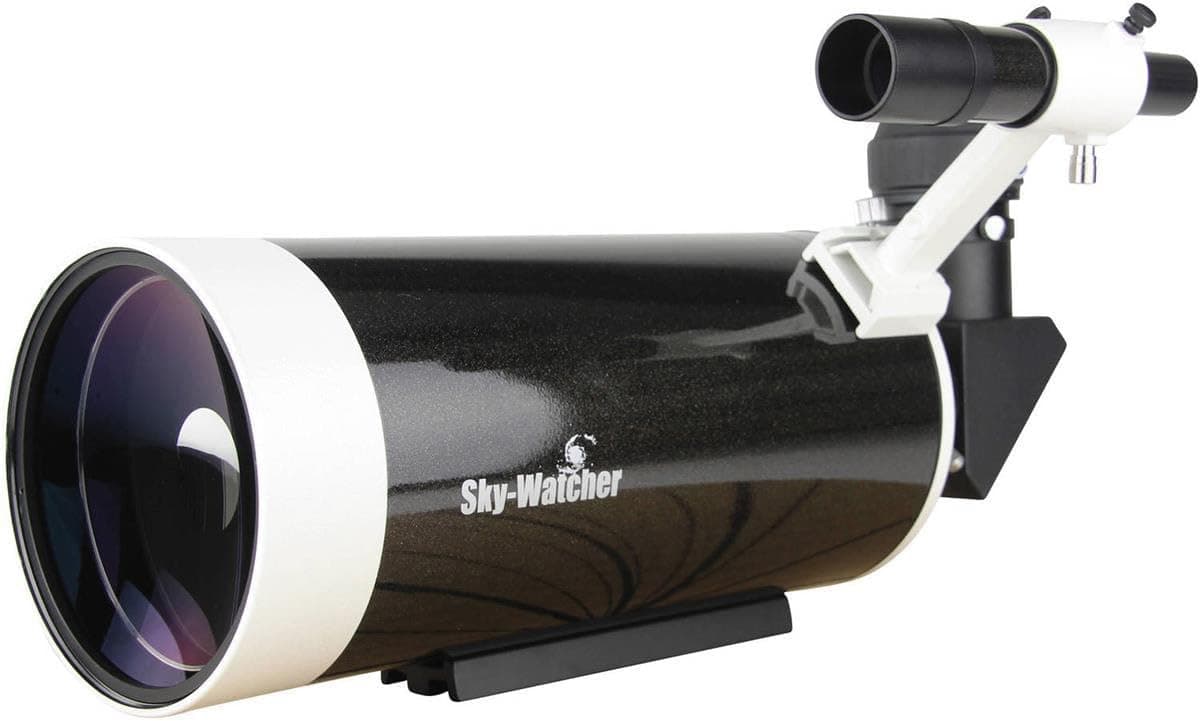 #1
Sky-Watcher Skymax 127mm Maksutov-Cassegrain, a compact compound scope prized for crisp lunar and planetary detail.
Fit for the job 9/10 · Features and specs 8/10 · Build and materials 8/10 · Value 9/10
- + 127mm aperture is a sweet spot for sharp planetary views in a short, portable tube
- + Sealed Maksutov design keeps dust off the optics and rarely needs collimation
- + Long focal length gives high magnification with ordinary eyepieces
- - Narrow field of view makes large star fields and wide nebulae hard to frame
- - Thick corrector plate needs cool-down time before views sharpen fully
 #2
Sky-Watcher Skymax 180mm Maksutov-Cassegrain, a large compound scope for serious planetary and lunar observers.
Fit for the job 9/10 · Features and specs 9/10 · Build and materials 9/10 · Value 7/10
- + 180mm aperture resolves fine planetary detail on nights of steady seeing
- + Maksutov optics deliver high contrast with no diffraction spikes from vanes
- + Closed tube protects the mirror and keeps collimation stable over time
- - Heavy tube demands a solid equatorial or GoTo mount, adding real cost
- - Long cool-down period before the large corrector reaches ambient temperature
 #3
Sky-Watcher Skymax 150mm Maksutov-Cassegrain, a mid-size compound telescope bridging portability and planetary power.
Fit for the job 9/10 · Features and specs 8/10 · Build and materials 9/10 · Value 8/10
- + 150mm aperture shows more planetary detail than smaller Skymax tubes in a still manageable tube
- + Low-maintenance sealed design suits observers who dislike collimating
- + Good choice for double stars and lunar close-ups at high magnification
- - Needs a sturdier mount than smaller Maks, so check your mount's payload capacity
- - Narrow field makes finding objects harder without a good finder scope
 #4
Celestron NexStar 4SE, a 4-inch Maksutov-Cassegrain on a computerized GoTo mount with SkyAlign for automated object finding.
Fit for the job 9/10 · Features and specs 9/10 · Build and materials 8/10 · Value 7/10
- + GoTo mount with SkyAlign finds and tracks thousands of objects after a simple alignment
- + Maksutov-Cassegrain optics give sharp, high-contrast views of the Moon and planets
- + Compact tube and single-arm mount are easy to carry and set up for city balconies
- - Small 4-inch aperture is limited on faint deep-sky targets despite the smart mount
- - Needs batteries or an external power source, which is not always convenient outdoors
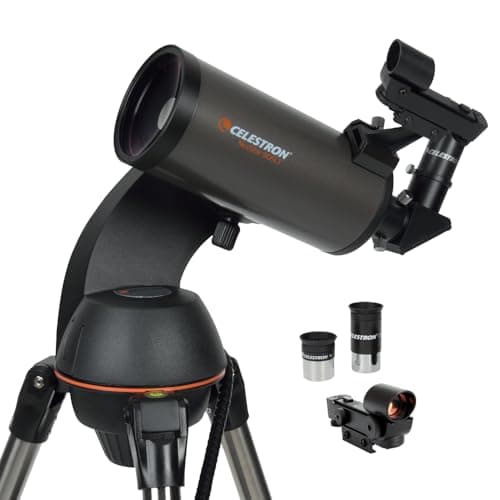 #5
A 90mm Maksutov-Cassegrain on Celestron's computerized SLT mount with a database of more than 40,000 objects. The smallest of the SLT family, aimed at the Moon and planets and easy to take to dark sites.
Fit for the job 8/10 · Features and specs 9/10 · Build and materials 7/10 · Value 7/10
- + Computerized mount locates and tracks objects from a database of more than 40,000 stars, galaxies and nebulae
- + SkyAlign setup: center any three bright objects in the eyepiece and the mount aligns itself to the night sky
- + Compact form is easy to transport and assemble, with a two-year warranty and US-based technical support
- - 90mm is the smallest aperture in the SLT family, so it gathers less light than the 127mm and larger Maksutovs here
- - The listing highlights do not cover the power supply or the included eyepieces, so check before ordering
 #6
Sky-Watcher Skymax 102mm Maksutov-Cassegrain, a small, light compound scope for travel and quick lunar or planetary looks.
Fit for the job 8/10 · Features and specs 7/10 · Build and materials 8/10 · Value 8/10
- + Light 102mm tube rides on small mounts and photo tripods with ease
- + Sealed optical tube is low maintenance, suiting casual observers
- + Sharp contrast on the Moon and planets for its compact size
- - Smaller aperture than the larger Skymax tubes, so fainter targets fade out sooner
- - Mount is not part of the title, so plan and budget for a suitable one
 #7
Sky-Watcher Skymax 90mm Maksutov-Cassegrain, an ultra-compact compound tube for travel, spotting and casual lunar views.
Fit for the job 7/10 · Features and specs 7/10 · Build and materials 8/10 · Value 8/10
- + Tiny 90mm tube fits in a backpack for trips and airline carry-on bags
- + Doubles as a sharp terrestrial spotting scope during the day
- + Sealed optics tolerate travel bumps without needing realignment
- - Small aperture limits planetary detail compared with larger Maksutovs
- - Long focal length on a short tube makes wide-field sweeping impractical
Before you buy: trade-offs we flagged
No pick is perfect. These are the main compromises we noted for the top products in this guide, so you can check they will not matter for you.
- Narrow field of view makes large star fields and wide nebulae hard to frame (Sky-Watcher Skymax 127mm Maksutov-Cassegrain...)
- Heavy tube demands a solid equatorial or GoTo mount, adding real cost (Sky-Watcher Skymax 180mm Maksutov-Cassegrain...)
- Needs a sturdier mount than smaller Maks, so check your mount's payload capacity (Sky-Watcher Skymax 150mm Maksutov-Cassegrain...)
- Small 4-inch aperture is limited on faint deep-sky targets despite the smart mount (Celestron NexStar 4SE Computerized Telescope,...)
- 90mm is the smallest aperture in the SLT family, so it gathers less light than the 127mm and larger Maksutovs here (Celestron NexStar 90SLT Maksutov-Cassegrain...)
- Smaller aperture than the larger Skymax tubes, so fainter targets fade out sooner (Sky-Watcher Skymax 102mm Maksutov-Cassegrain...)
Frequently asked questions
›What is the best choice among maksutov telescopes for planets and moon (2026)?
Sky-Watcher Skymax 127mm Maksutov-Cassegrain - Large Aperture Compound-Style Reflector Telescope is our top overall pick. Sky-Watcher Skymax 127mm Maksutov-Cassegrain, a compact compound scope prized for crisp lunar and planetary detail. It earns our score of 8.6/10, based on fit for the job, features, build and value.
›What is a good budget option?
Sky-Watcher Skymax 180mm Maksutov-Cassegrain - Large Aperture Compound-Style Reflector Telescope (S11540) is the strongest low-cost pick in this guide. Sky-Watcher Skymax 180mm Maksutov-Cassegrain, a large compound scope for serious planetary and lunar observers.
›How much should I expect to spend?
Picks in this guide span See on Amazon price bands (roughly: $ = under $30, $$ = $30 to $100, $$$ = over $100). We never display exact prices because they change constantly, so the buttons above always show Amazon's current price.
›How were these products chosen?
We shortlist products that fit the job this guide solves and compare their published specifications, such as size, capacity, materials and what is included. Each pick gets an editorial score out of 10 for fit, features, build and value, and we write the pros and cons from those details. Our score is not an Amazon customer rating. We earn a commission if you buy through our links, which never affects the ranking.
Stargazer Nest independently selects every product; we may earn a commission from links above.
Popular right now
- Best Intervalometers for Automated Astro Shots (2026)Buying guide
- Best Finder Scopes to Locate Targets Fast (2026)Buying guide
- Telescope Aperture and Magnification ChartArticle
- Best Star Diagonals for Comfortable Viewing (2026)Buying guide
- Best Red Flashlights to Protect Night Vision (2026)Buying guide
- Equatorial mount explainedGlossary
Based on the last 28 days of search and visitor data.