Sky-Watcher Skymax 150mm Maksutov-Cassegrain - Large Aperture Compound-Style Reflector Telescope Review (2026)
Updated September 14, 2026 · Research-based review
Our verdict
The Sky-Watcher Skymax 150 is a mid-size Maksutov-Cassegrain balancing real planetary detail against a tube light enough for a mid-range mount to carry. Its sealed, low-maintenance design suits observers who dislike collimating a mirror, though the narrow field makes finding faint objects harder without a good finder.
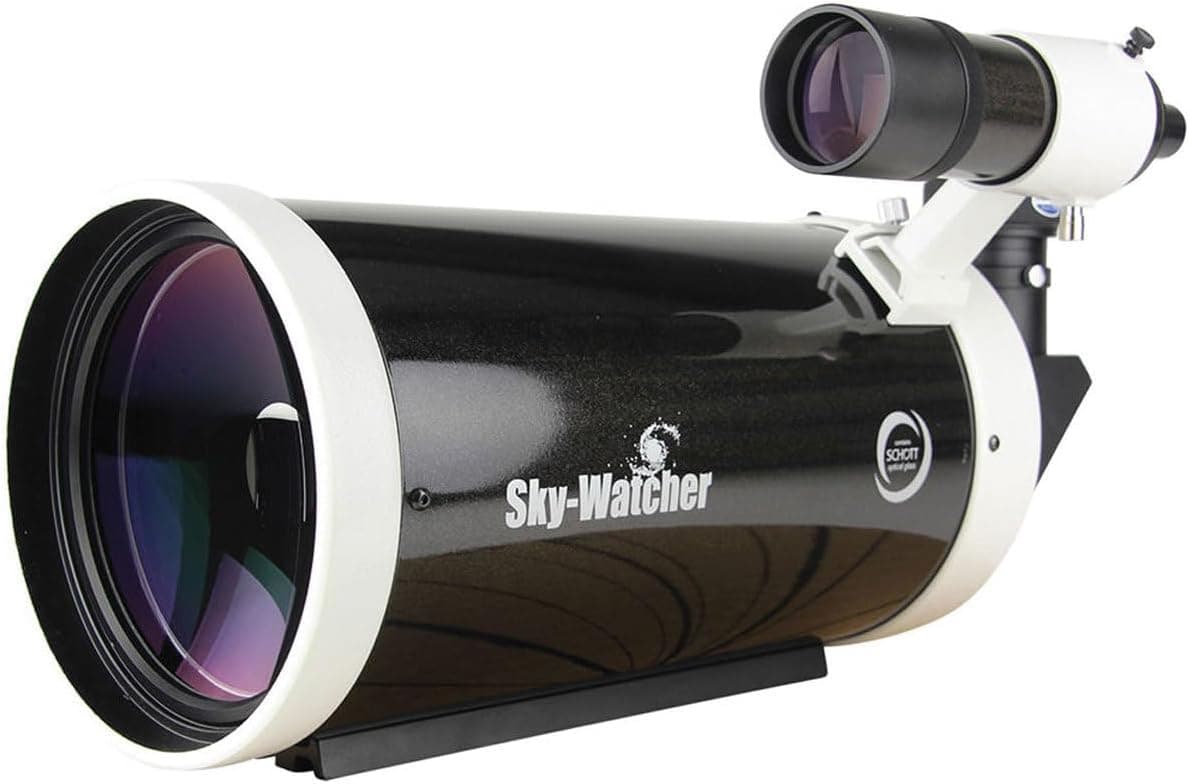
Sky-Watcher Skymax 150mm Maksutov-Cassegrain, a mid-size compound telescope bridging portability and planetary power.
Price range: See on Amazon
What we liked
- + 150mm aperture shows more planetary detail than smaller Skymax tubes in a still manageable tube
- + Low-maintenance sealed design suits observers who dislike collimating
- + Good choice for double stars and lunar close-ups at high magnification
Trade-offs
- - Needs a sturdier mount than smaller Maks, so check your mount's payload capacity
- - Narrow field makes finding objects harder without a good finder scope
Who this telescope fits
The Skymax 150 sits between Sky-Watcher's smaller 127mm and larger 180mm Maksutov-Cassegrain tubes, making it a practical choice for an observer who wants a genuine step up in planetary and lunar detail without needing the heaviest mount in the lineup. At 150mm aperture and f/12, it is built for high-magnification, narrow-field targets: Saturn's rings, Jupiter's cloud belts, lunar craters and close double stars, rather than wide sweeps of the Milky Way. Because it ships as an optical tube assembly, it suits buyers who already own or are budgeting for a mid-size equatorial or GoTo mount, not someone wanting an all-in-one beginner kit. Observers who dislike the periodic collimation that open-tube reflectors need will appreciate the Maksutov's sealed design, which holds its optical alignment well between sessions with normal handling.
Specs and design explained
The tube uses a 150mm aperture with an 1800mm focal length at f/12, built with Schott optical glass, and weighs about 14 pounds according to supplier specifications, making it noticeably lighter than the larger 180mm Skymax despite the substantial jump in resolved planetary detail over the 127mm model. Included accessories are a 2 inch 90 degree star diagonal, a 28mm 2 inch LET eyepiece for a moderate magnification wide view, and an 8x50 straight-through finderscope to help aim the narrow main field toward targets before switching eyepieces. The tube attaches to mounts through a Vixen-style dovetail plate, the standard rail used across most current telescope mounts. Like Sky-Watcher's other Skymax tubes, focusing is internal, moving the primary mirror along the optical axis with a knob on the rear cell rather than moving the entire focuser assembly.
Living with it day to day
Setup means mounting the tube on a compatible equatorial or GoTo head, attaching the included finderscope and diagonal, and allowing the tube time to reach outdoor temperature before observing, since a large glass corrector plate needs to stabilize thermally for the sharpest views. Because the design is sealed, there is little routine maintenance: no exposed mirror to dust or realign between sessions, just protecting the front corrector with its cap and avoiding temperature shock from moving the tube directly between a warm house and cold outdoor air. The narrow field of view at f/12 means star-hopping to targets by eye is slower than with a wide-field instrument, so the included 8x50 finderscope becomes an important tool, and many owners eventually pair the tube with a GoTo mount to make locating objects more efficient than manual searching.
Trade-offs and how it compares
Compared with the larger Skymax 180, the 150 gives up some resolved planetary detail but is meaningfully lighter at roughly 14 pounds versus about 17 pounds for the 180mm tube, which matters when matching the telescope to a mount that is not oversized for the rest of the setup. Against the smaller Skymax 127, the 150 gathers noticeably more light and resolves finer detail, a real difference for planetary observers, at the cost of a heavier tube and a mount with more payload capacity. Within the broader Maksutov category, this design trades the wide field and simpler maintenance of a fast reflector for narrow, high-contrast views that particularly reward planetary and lunar observing, so buyers who mainly want deep-sky wide-field views should weigh a shorter focal-length instrument instead.
Verdict and who should pick something else
For an observer who wants meaningfully more planetary detail than a small refractor without stepping up to the heaviest Skymax tube, the 150mm model is a sensible middle ground, in line with our score of 8.6 out of 10 for fit and build quality. Buyers who mainly want wide-field views of star clusters, nebulae and the Milky Way should choose a shorter focal-length reflector or refractor instead, since the Skymax 150's narrow field works against that kind of sweeping observation. Anyone without a mount already sized for a roughly 14 pound tube plus accessories should budget for that separately, and observers who want the largest possible planetary image should compare against the 180mm Skymax before deciding.
Frequently asked questions
Does the Skymax 150 come with a mount?
No, it is sold as an optical tube assembly, so it needs a separately purchased equatorial or GoTo mount rated to carry its roughly 14 pound weight plus accessories.
How does it compare to the Skymax 127 and 180 models?
It sits between them: more aperture and resolved detail than the 127mm tube, but lighter and easier to mount than the 180mm tube, making it a middle-ground choice for planetary observing.
Is this telescope good for deep-sky objects like nebulae?
It can show brighter deep-sky targets, but its narrow field of view at f/12 favors the Moon, planets and double stars over wide star clusters or large nebulae, which suit a shorter focal-length instrument better.
Does it need collimation like a reflector?
It rarely needs adjustment since the sealed Maksutov-Cassegrain design holds alignment well with normal use, unlike an open-tube Newtonian reflector that needs more frequent collimation checks.
Prices change often, so check the current price and availability on Amazon.
Check price on AmazonStargazer Nest may earn a commission from the link above.