Sky-Watcher Skymax 180mm Maksutov-Cassegrain - Large Aperture Compound-Style Reflector Telescope (S11540) Review (2026)
Updated September 14, 2026 · Research-based review
Our verdict
The Sky-Watcher Skymax 180 is a large Maksutov-Cassegrain for serious planetary and lunar observers who want detail from a tube lighter than an equivalent refractor. Its 180mm aperture and sealed design deliver sharp, high-contrast views, but the long focal length demands a sturdy mount and a real cool-down period first.
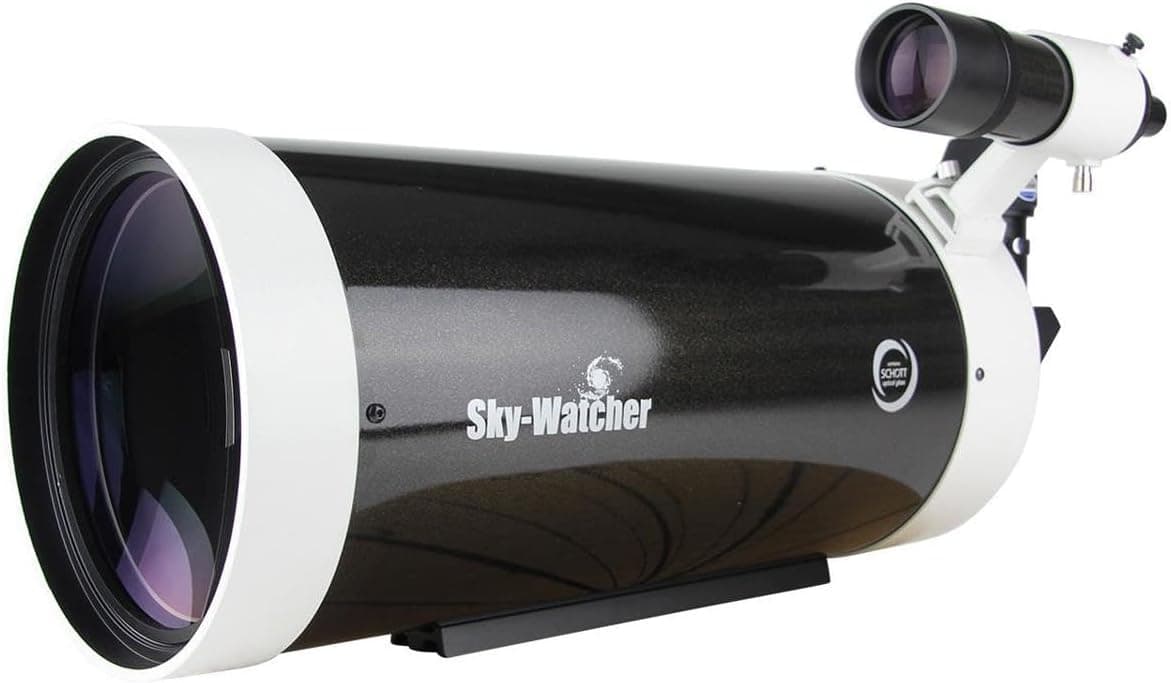
Sky-Watcher Skymax 180mm Maksutov-Cassegrain, a large compound scope for serious planetary and lunar observers.
Price range: See on Amazon
What we liked
- + 180mm aperture resolves fine planetary detail on nights of steady seeing
- + Maksutov optics deliver high contrast with no diffraction spikes from vanes
- + Closed tube protects the mirror and keeps collimation stable over time
Trade-offs
- - Heavy tube demands a solid equatorial or GoTo mount, adding real cost
- - Long cool-down period before the large corrector reaches ambient temperature
Who this telescope fits
This optical tube is built for observers who already know they mostly want to study the Moon, planets and double stars rather than sweep wide fields of faint deep-sky objects. The 180mm aperture and long 2700mm focal length produce a narrow, high-magnification view that rewards patient, detail-focused observing on nights of steady atmospheric seeing. It suits an intermediate to advanced astronomer upgrading from a smaller Maksutov or a basic reflector, since the Skymax 180 is sold as an optical tube assembly rather than a complete kit, meaning buyers need to already own or budget for a capable equatorial or GoTo mount. It is not the right choice for someone wanting their first telescope or a wide, sweeping view of the Milky Way, since the tube's narrow field of view and weight work against casual, low-commitment stargazing.
Specs and design explained
The Skymax 180 uses a 7 inch, 180mm aperture Maksutov-Cassegrain design with a 2700mm focal length at f/15, built from Schott optical glass with the corrector lens fully multi-coated on both sides. The borosilicate primary mirror carries Sky-Watcher's Radiant Aluminum Quartz coating rated at 94 percent reflectivity, and the astronomics.com listing puts the assembled optical tube with accessories at about 17.2 pounds. Focusing happens internally by moving the primary mirror back and forth with a large knob on the rear cell, and the tube attaches to mounts through a Vixen-style dovetail rail, the common standard for astronomy mounting hardware. Included accessories are a 28mm 2 inch LET eyepiece, giving roughly 96x magnification, a 2 inch 90 degree star diagonal, and an 8x50 straight-through finderscope for pointing the narrow field toward targets. Sky-Watcher backs the tube with a two-year warranty.
Living with it day to day
Because the corrector plate and mirror are enclosed in a sealed tube, this design needs far less routine maintenance than an open-truss reflector, with no exposed mirror to collect dust between sessions. The trade-off is thermal: a large glass corrector and mirror take real time to reach outdoor temperature, so setting the tube outside 30 minutes to an hour before observing, depending on the temperature swing, noticeably improves image sharpness compared with looking through it right away. The narrow field of view at f/15 also means star-hopping to targets is slower than with a wide-field instrument, so many owners pair this tube with a GoTo mount to make finding objects practical. Day-to-day care is mostly about protecting the corrector lens with its cap when not in use and avoiding temperature shock, such as moving the tube directly from a warm house into cold winter air without a cool-down period.
Trade-offs and how it compares
Against the smaller Skymax 150, the 180 resolves finer planetary detail thanks to its larger aperture, but the 150 is lighter at about 14 pounds and easier to mount on a mid-size tripod, so buyers should weigh how much extra mount capacity they are willing to add for the jump in aperture. Compared with the Skymax 127, the 180 is a significant step up in both light-gathering power and weight, better suited to an observer with an established, sturdy mount rather than someone starting out. As a tube-only purchase, the Skymax 180 also needs to be paired with a mount rated well above its own weight once a camera, finder and diagonal are added, since the listed 17.2 pound tube weight does not include the mount itself, and a mount that is only just adequate will show vibration at the high magnifications this telescope is built for.
Verdict and who should pick something else
For an observer focused on the Moon, planets and double stars who already has or is budgeting for a solid equatorial or GoTo mount, the Skymax 180 delivers real aperture and sharp optics in a manageable tube, supporting our score of 8.6 out of 10 for fit and build quality. Buyers newer to the hobby, or anyone wanting a wide field of view for star clusters and nebulae, should look at a shorter-focal-length reflector or refractor instead, since this Maksutov's narrow view and cool-down requirement work against casual, spontaneous sessions. Anyone without a mount already capable of carrying a heavier compound telescope steadily should also budget for that upgrade before buying this tube, since the mount, not the optics, is usually the limiting factor at this aperture and focal length.
Frequently asked questions
Does the Skymax 180 include a mount?
No, it is sold as an optical tube assembly, so buyers need a separate equatorial or GoTo mount rated to carry its weight along with any added accessories.
How long does it need to cool down before observing?
As a large sealed Maksutov-Cassegrain, it benefits from roughly 30 minutes to an hour outside before use, longer on nights with a big temperature difference between indoors and outdoors, to let the corrector and mirror reach ambient temperature for sharp images.
What can this telescope realistically show?
It excels at the Moon, planets and double stars thanks to its long focal length and large aperture, though its narrow field of view makes it less suited to wide star clusters or sweeping Milky Way views.
How much does the optical tube weigh?
Sky-Watcher's supplier listing puts the assembled tube with included accessories at about 17.2 pounds, not counting the mount.
Prices change often, so check the current price and availability on Amazon.
Check price on AmazonStargazer Nest may earn a commission from the link above.