Celestron NexStar 4SE Computerized Telescope, 4-Inch Maksutov-Cassegrain, Automated GoTo Mount, SkyAlign Review (2026)
Updated September 14, 2026 · Research-based review
Our verdict
The NexStar 4SE suits a buyer who wants push-button GoTo finding on a compact, tabletop-friendly telescope for the Moon and planets from a driveway or balcony. Fast SkyAlign setup is the strength, and the small 4-inch aperture is the trade-off for faint deep-sky targets.
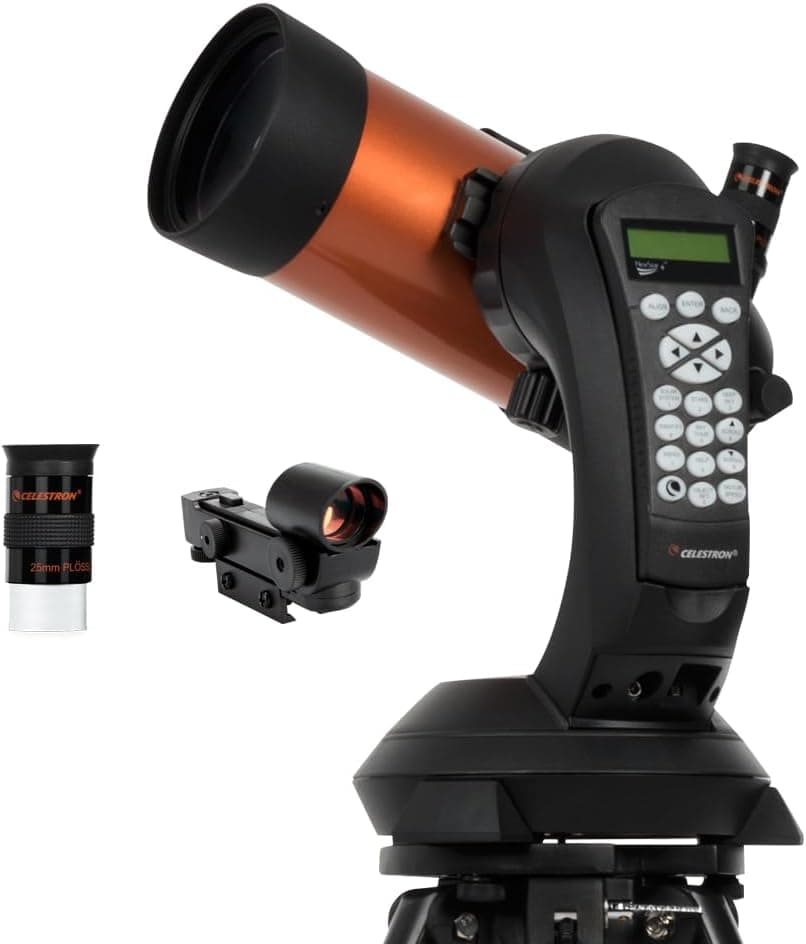
Celestron NexStar 4SE, a 4-inch Maksutov-Cassegrain on a computerized GoTo mount with SkyAlign for automated object finding.
Price range: See on Amazon
What we liked
- + GoTo mount with SkyAlign finds and tracks thousands of objects after a simple alignment
- + Maksutov-Cassegrain optics give sharp, high-contrast views of the Moon and planets
- + Compact tube and single-arm mount are easy to carry and set up for city balconies
Trade-offs
- - Small 4-inch aperture is limited on faint deep-sky targets despite the smart mount
- - Needs batteries or an external power source, which is not always convenient outdoors
Who the NexStar 4SE fits
This is a 4-inch Maksutov-Cassegrain telescope, meaning a 102mm aperture with a long 1325mm focal length folded into a short tube, mounted on a single fork arm altazimuth mount with a built-in wedge and steel tripod. It is aimed at someone who wants automated object finding without the bulk of a full-size mount, useful for city or suburban observers with limited outdoor space, such as a balcony or small yard. The long focal length and compact mirror design make it well matched to lunar and planetary viewing, where high magnification and sharp contrast matter more than raw light grasp. Buyers chasing dim galaxies and nebulae from dark skies will find the 102mm aperture limiting, since that job favors larger reflectors or Dobsonians over a compact Maksutov.
Specs and the SkyAlign system explained
The 4SE's SkyAlign process asks the observer to point the tube at three bright objects, stars or planets, of their choosing, in any order, and the hand control figures out the rest of the sky from there, avoiding the need to know constellations before starting. The hand control's database holds tens of thousands of catalog objects, letting the mount slew to and track targets once aligned. Because it is a computerized altazimuth mount rather than equatorial, tracking works fine for visual observing but introduces field rotation that limits long-exposure astrophotography compared with an equatorial design. Power comes from batteries or an external supply, since there is no permanent AC adapter built in, which means planning ahead for outdoor sessions away from a wall outlet.
Living with it night to night
Setup is quick relative to full-size GoTo rigs: extend the tripod, mount the compact single-arm optical tube, level roughly, and run SkyAlign, which typically takes a few minutes once the routine is familiar. The tube's small size and light fork arm mount make it genuinely easy to carry fully assembled from a closet to a driveway in one trip, which lowers the friction of actually using the telescope on a whim. Reviewers commonly flag battery drain as a recurring maintenance point, since the motorized mount and hand control draw down standard batteries faster than expected, making a rechargeable battery pack or AC adapter a practical add-on for regular use. Basic care is standard for a Maksutov, keeping the corrector lens capped when not in use and avoiding touching the coated glass directly.
Trade-offs against other computerized telescopes
Within Celestron's own NexStar SE line, the 4SE gives up aperture to the 5SE and 6SE, which gather notably more light for deep-sky targets at the cost of a larger, heavier tube and mount. Against the larger Sky-Watcher Skymax 127 on an equatorial mount, the 4SE offers simpler altazimuth pointing and a smaller footprint, while the 127 trades that convenience for a larger mirror and true equatorial tracking better suited to imaging. Compared with the StarSense Explorer DX 130AZ, a smartphone-guided reflector with a larger 130mm mirror, the 4SE offers push-button GoTo without needing a phone mounted on the tube, while the DX 130AZ gathers more light for the same rough price bracket.
Bottom line and who should choose differently
The NexStar 4SE earns its keep as a fast, low-fuss way to find and track the Moon and planets from a compact setup, particularly for observers short on storage space or patience for manual star-hopping. Anyone prioritizing deep-sky detail on galaxies and nebulae over convenience should look at a larger-aperture Dobsonian or one of Celestron's bigger SE models instead, since more mirror or lens diameter matters more than automation for that kind of viewing. Buyers planning serious astrophotography will also want an equatorial mount rather than this altazimuth design. Within its lane of quick, computerized planetary and lunar observing from town, the 4SE remains a straightforward pick backed by Celestron's established SkyAlign ecosystem.
Frequently asked questions
What can you see with the Celestron NexStar 4SE?
The 102mm Maksutov-Cassegrain gives sharp, high-contrast views of the Moon's craters and Saturn's rings and Jupiter's cloud bands, along with brighter deep-sky objects like star clusters, while fainter galaxies and nebulae appear dim given the moderate aperture.
Does the NexStar 4SE need batteries or a power outlet?
Yes, the motorized GoTo mount and hand control need battery power or an external DC power source, since there is no built-in rechargeable battery, and heavy battery use is a common maintenance point owners mention.
How hard is SkyAlign to learn for a beginner?
SkyAlign only requires centering three bright objects of your choosing in the eyepiece, in any order, without needing to identify them by name, which most beginners pick up within their first session or two.
Can the NexStar 4SE be used for astrophotography?
It can capture simple images of the Moon and bright planets through the eyepiece with a phone or basic camera, but its altazimuth mount causes field rotation that limits it for long-exposure deep-sky astrophotography compared with an equatorial mount.
Prices change often, so check the current price and availability on Amazon.
Check price on AmazonStargazer Nest may earn a commission from the link above.