Gskyer 80mm AZ Space Astronomical Refractor Telescope for Kids Adults Astronomy, German Technology Scope Review (2026)
Updated September 14, 2026 · Research-based review
Our verdict
The Gskyer 80mm AZ Space refractor is built for families and first-time buyers who want a simple, no-fuss telescope for the Moon and bright planets. The 80mm lens and easy altazimuth mount make aiming intuitive for kids, but the light tripod and basic eyepieces are the trade-off for the low entry price.
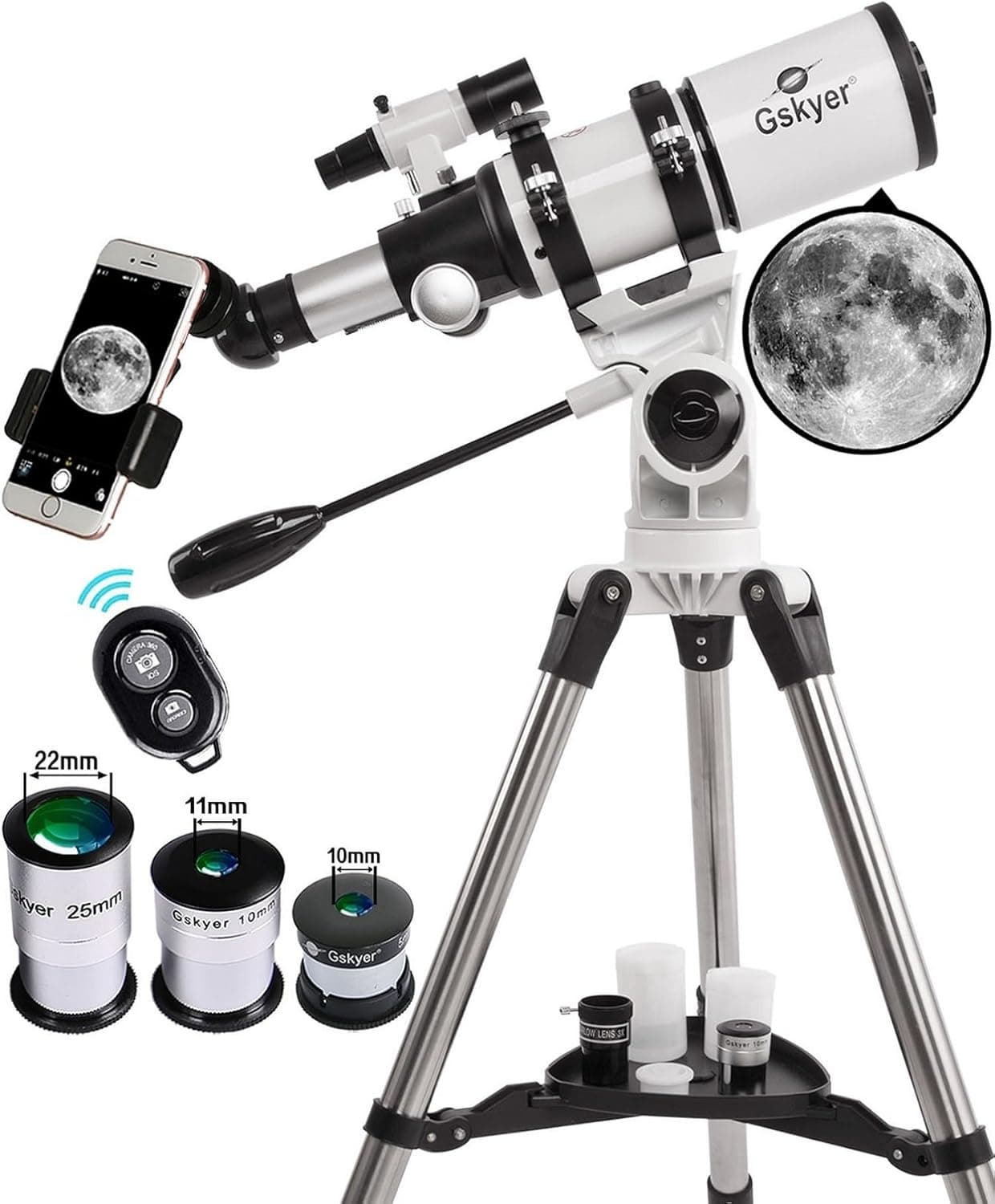
Gskyer 80mm AZ Space refractor, a kid-and-adult friendly starter telescope for lunar craters and bright planets.
Price range: See on Amazon
What we liked
- + 80mm lens is a good middle ground between small travel scopes and bigger refractors
- + Easy altazimuth mount suits children learning to track the Moon
- + No-maintenance refractor optics for families who want no fuss
Trade-offs
- - Budget tripod can wobble at high magnification, making fine focusing tricky
- - Color fringing on bright objects is typical of inexpensive achromats
Who this telescope fits
This is an entry-level 80mm achromatic refractor built around a 400mm focal length, sold as a kid-and-adult starter scope rather than a serious astrophotography tool. It suits households buying a first telescope to look at the Moon's craters, Saturn's rings and Jupiter's cloud bands from a backyard or balcony. The altazimuth mount moves up, down, left and right the same way a camera tripod does, which is easier for children to grasp than an equatorial mount that tracks the sky's rotation. Because the optical tube is a fixed-focus refractor with no mirrors to collimate, there is little maintenance between sessions. Buyers who want to photograph deep-sky objects or track targets for long exposures will outgrow it quickly, but as a way to see if a household actually uses a telescope before spending more, the 80mm Space model is a reasonable low-risk starting point.
Specs and design in plain terms
The optical tube has an 80mm aperture and 400mm focal length, an f/5 ratio that favors wide, brighter views over extreme magnification. Manufacturer listings describe three swappable eyepieces alongside a 3x Barlow lens, giving a spread of magnifications from low power for wide star fields up to higher power for the Moon and planets, plus a 6x30 finderscope for aiming. The mount is a basic altazimuth design on a stretchable stainless steel tripod, and the whole setup weighs around 8 pounds and extends to roughly 40 inches. A phone adapter and a wireless remote are included so users can attempt basic smartphone afocal photography of the Moon, though this is not comparable to a dedicated astrophotography rig. There is no motor or tracking system, so objects will drift out of the eyepiece and need to be re-centered by hand, especially at higher magnification.
Living with it day to day
Setup is meant to be quick since the tripod legs extend and lock without tools, and the optical tube attaches with a single mounting ring, which matters for a telescope aimed partly at kids and casual users. Because it is a refractor, there is no mirror alignment to worry about, so it can sit assembled between uses or be broken down for storage without recalibration. Care is mostly about keeping the objective lens and eyepieces clean with a proper lens cloth or blower rather than wiping with tissue, and storing the scope indoors to avoid dew and temperature swings on the coatings. The stretchable tripod legs and simple altazimuth head make it easy for a child to swing the tube toward a target, though fine focusing and gentle nudges to keep an object centered take a bit of practice, particularly with the higher-power eyepiece and Barlow lens combination engaged.
Trade-offs and how it compares
The honest limitation of this class of telescope is the tripod and mount, not the optics. At higher magnification, the light stainless steel tripod can transmit hand-bumps and wind as visible shake in the eyepiece, and inexpensive achromatic lenses like this one show some color fringing, a blue-purple halo, around bright edges such as the Moon's limb. Compared with the similar Gskyer 80mm AZ Space model bundled with an adjustable tripod, the core optical tube is effectively the same 80mm f/5 design, so the choice mostly comes down to accessory bundle and tripod details rather than optical performance. Against the smaller Gskyer AZ70400 in the same lineup, this 80mm version gathers more light for a brighter image, which matters when viewing dimmer targets like star clusters, though both share the same basic build-quality ceiling typical of budget achromats sold at this price point.
Verdict and who should look elsewhere
For a family wanting an approachable, low-commitment telescope to explore the Moon and the brighter planets without learning star-hopping or equatorial tracking, the Gskyer 80mm AZ Space refractor does the basic job, which supports our score of 7 out of 10 for fit and value at this level. Buyers who already know they want to view faint deep-sky objects, do serious astrophotography or need a mount solid enough for high, steady magnification should look at a larger-aperture Dobsonian or a telescope paired with a sturdier equatorial or GoTo mount instead. Anyone buying this as a first scope should also budget mentally for eventually upgrading the tripod or eyepieces, since the supplied accessories are functional starting points rather than long-term gear for a hobbyist who sticks with astronomy.
Frequently asked questions
Can this telescope see planets like Saturn's rings?
It can show Saturn as a small disk with rings visible and Jupiter's cloud bands and moons under good conditions, but the 80mm aperture and 400mm focal length mean planets appear small compared with larger telescopes, so expect a modest view rather than a magazine-quality image.
Does it need any special maintenance?
As a sealed achromatic refractor it needs no mirror collimation, just occasional lens cleaning with a proper optical cloth or blower and dry indoor storage to protect the coatings and tripod hardware.
Is the mount motorized or does it track the sky?
No, it is a manual altazimuth mount with no motor, so you nudge the tube by hand to keep objects centered as the sky moves.
What is included in the box?
Listings describe the optical tube, stainless steel tripod, multiple eyepieces, a 3x Barlow lens, a 6x30 finderscope, a smartphone adapter and a wireless remote.
Prices change often, so check the current price and availability on Amazon.
Check price on AmazonStargazer Nest may earn a commission from the link above.