Gskyer Telescope 600x90mm AZ Astronomical Refractor Telescope for Adults Astronomy, German Technology Scope Review (2026)
Updated September 14, 2026 · Research-based review
Our verdict
This Gskyer 90mm refractor is a budget telescope for adults starting out with the Moon, bright planets and daytime views, on a simple mount needing no collimation. Its strength is a larger lens than most starter refractors, its trade-off is that the advertised 600x figure is marketing, with real useful magnification far lower.
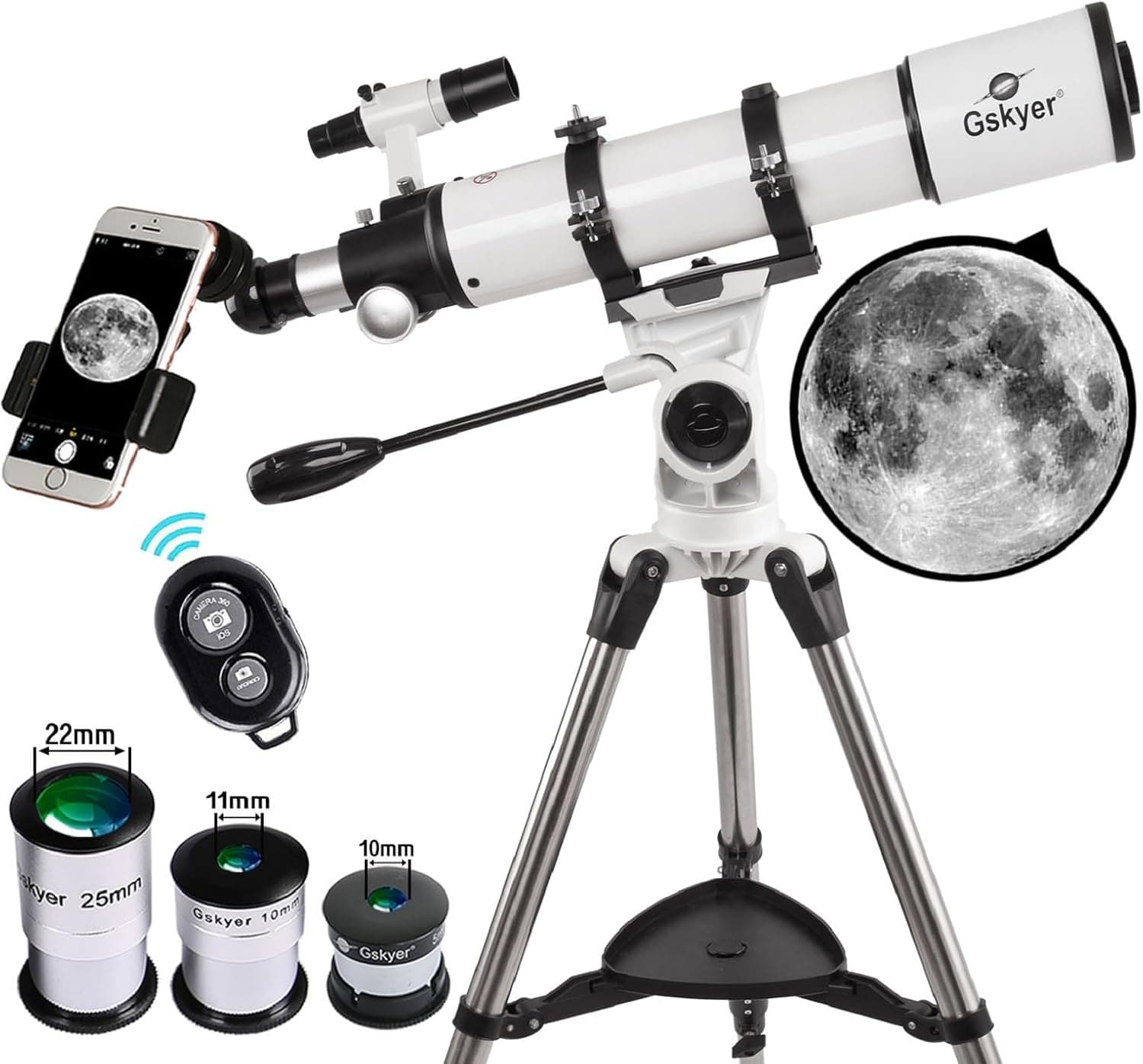
Gskyer 600x90mm AZ refractor, a budget astronomy telescope for adults starting out with the Moon and bright planets.
Price range: See on Amazon
What we liked
- + 90mm refractor lens gives more light than typical small starter refractors
- + Refractor design needs no collimation, so it is ready whenever you are
- + Altazimuth mount moves up-down and left-right in an easy, intuitive way
Trade-offs
- - Advertised magnification figures are marketing, useful power is far lower
- - Achromatic lens shows purple color fringing around bright planets
Who This Telescope Suits
This refractor targets adults and older kids who are picking up a telescope for the first time and want to look at the Moon's craters, Saturn's rings, Jupiter's moons and bright terrestrial scenery like birds or distant landscapes without a steep learning curve. The 90mm objective lens gathers noticeably more light than the 60mm to 70mm lenses common on entry telescopes at this price, which translates into brighter, slightly more detailed views of the Moon and planets. Because it is a refractor, there is no mirror alignment to maintain, so it suits someone who wants to set it up and start observing the same evening rather than spend time learning collimation. It is not aimed at serious deep-sky imaging, where a larger aperture and equatorial tracking mount matter more.
Optics, Mount And What Ships In The Box
The optical tube has a 90mm aperture and 600mm focal length, giving a focal ratio of about f/6.7, with fully coated glass optics on an altazimuth mount that moves smoothly up-down and side-to-side. The box includes three interchangeable eyepieces plus a 3x Barlow lens that triples each eyepiece's magnifying power, a 6x30 finderscope for aiming, and a 48-degree erecting BAK7 prism that puts the eyepiece at a more comfortable viewing angle than a straight-through design. The aluminum tripod adjusts from about 31.5 inches to 49 inches, and the complete setup weighs around 17.5 pounds, with a small accessory tray between the tripod legs for holding eyepieces during a session. Astronomy software for a phone or computer is also included.
Setting Up And Observing With It
Assembly is tool-free: the tripod legs lock at the chosen height, the optical tube clamps onto the altazimuth head, and the finderscope gets a quick daytime alignment on a distant object before dark. Because the mount is altazimuth rather than motorized equatorial, tracking a target as it drifts across the sky means nudging the tube by hand every minute or two, which works fine for casual Moon and planet viewing but is not built for tracking faint, moving deep-sky objects for long exposures. The eyepieces that ship in the box are serviceable for a beginner, and most owners eventually consider upgrading to sharper aftermarket eyepieces once they know what they like to observe. Keeping the objective lens capped when not in use and avoiding damp storage protects the optical coatings over time.
Honest Limits And How It Stacks Up
The 600x figure in the name is a maximum theoretical number reached only by stacking the shortest eyepiece with the Barlow lens, and in practice a 90mm refractor like this one delivers sharp, useful images well below that, typically in the range independent reviewers describe as closer to 150x to 200x before the image starts to dim and blur. As an achromatic refractor rather than an apochromatic one, it also shows some purple-blue color fringing around the Moon's edge and bright planets, a common trait at this price point rather than a defect specific to this unit. Compared with Gskyer's own smaller 80mm and 70mm models in the same lineup, this 90mm version gathers more light and generally outperforms them on planetary detail, while a similarly priced Celestron Travel Scope 70 trades aperture for a lighter, more packable kit.
Verdict For First-Time Buyers
For someone wanting an affordable, ready-to-use telescope for casual Moon and planet viewing with no maintenance headaches, this 90mm Gskyer is a reasonable starting point, reflected in our score of 7.0 out of 10 weighted toward fit for the job and value over build refinement. Buyers who care about pinpoint-sharp planetary detail without color fringing should budget for an apochromatic refractor instead, and anyone planning to track and photograph faint deep-sky objects will outgrow this altazimuth mount quickly and should look at an equatorial or GoTo mount from the start.
Frequently asked questions
Can this telescope really magnify 600 times as the name suggests?
That number is the maximum theoretical magnification using the shortest eyepiece with the included Barlow lens. Real, sharp usable magnification on a 90mm refractor is considerably lower in practice.
Does the altazimuth mount track objects automatically?
No, it is a manual altazimuth mount, so you nudge the tube by hand to follow the Moon or a planet as it moves across the sky rather than having motorized tracking.
What is included with the telescope?
It ships with three eyepieces, a 3x Barlow lens, a 6x30 finderscope, a 48-degree erecting prism, an adjustable aluminum tripod, an accessory tray, and astronomy software.
Is color fringing normal on this telescope?
Yes, as an achromatic refractor it can show some purple-blue fringing around the Moon and bright planets. This is typical for achromatic optics at this price and is not a sign of a faulty unit.
Prices change often, so check the current price and availability on Amazon.
Check price on AmazonStargazer Nest may earn a commission from the link above.