Celestron PowerSeeker 80AZS Telescope, Manual Alt-Azimuth Telescope for Beginners, Portable, 80mm Aperture Review (2026)
Updated September 14, 2026 · Research-based review
Our verdict
An 80mm short-tube refractor on a simple alt-azimuth mount, built for quick no-tool setup and bright, contrasty views of the Moon and planets. Total kit weight under 6 pounds makes it easy to carry outside on a whim, but the light mount and shorter focal length limit it for faint deep-sky targets.
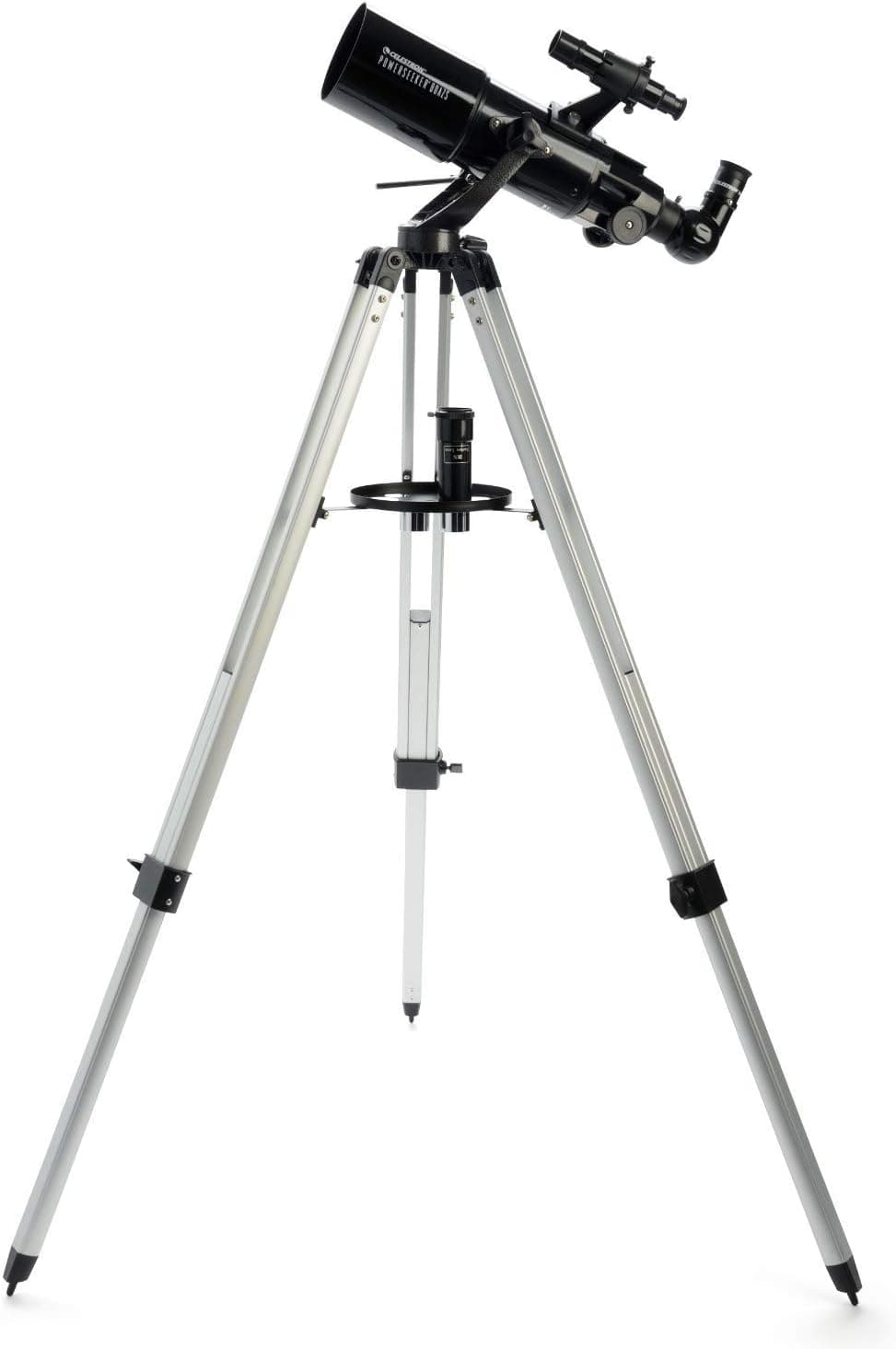
Celestron PowerSeeker 80AZS, a portable 80mm refractor on a manual alt-azimuth mount built for simple beginner use.
Price range: $ (Budget)
What we liked
- + Alt-azimuth mount is the easiest style for beginners to understand
- + 80mm refractor gives clean lunar views with no alignment needed
- + Portable build suits balconies, backyards and camping trips
Trade-offs
- - Light mount limits steady use at higher magnifications
- - Deep-sky views are limited compared with reflectors in the same guide
Who the PowerSeeker 80AZS suits
This Celestron model targets total beginners and families who want a telescope that comes out of the box and onto a tripod in the yard within a few minutes, with no star alignment procedure or equatorial wedge to learn first. The alt-azimuth mount moves simply up, down, left and right, which is the most intuitive style for a first-time user, including kids under supervision. At under 6 pounds for the full kit including the tripod, it is light enough to carry outside for a short session and back in again without much effort, which matters for actually getting used regularly rather than sitting in a closet after the first week.
What the 80mm, f/5 design delivers
The optical tube uses an 80mm aperture with a 400mm focal length at f/5, a fast, short-tube refractor design with fully coated glass optics. Celestron includes two eyepieces, a 20mm and a 4mm, along with an erect-image diagonal, a 3x Barlow lens and a 5x24 finderscope. The erect-image diagonal is a nice touch for a beginner scope since it also makes the telescope usable for daytime nature viewing, not just astronomy. The short f/5 focal ratio delivers a wider field of view and brighter images than a longer-tube design of the same aperture, which suits sweeping views of star fields and larger objects like the Moon better than high-power planetary close-ups.
Setting it up and using it regularly
Setup uses a quick, no-tool assembly with a yoke mount and a slow-motion altitude rod that helps with smooth, accurate pointing once a target is in view. The steel tripod legs adjust from about 32 to 51 inches, so it can be used standing or seated. Celestron backs the kit with a 2-year warranty and includes access to the Starry Night software and SkyPortal app to help a beginner learn the night sky and plan sessions. Because the mount is light, high magnification views will show more vibration than a heavier equatorial setup, so patience after touching the focuser and avoiding the highest-power eyepiece combination on windy nights both help image stability.
How it compares with rivals in the same guide
Within the beginner telescope comparison it sits in, the PowerSeeker 80AZS ranks in the middle of the pack, behind Celestron's own StarSense Explorer line, which adds smartphone-assisted alignment through a phone dock at a higher price point. The 130mm and 114mm StarSense Explorer Newtonian reflectors gather notably more light for deep-sky views, though they trade away the PowerSeeker's simplicity and portability. Against the manual German equatorial PowerSeeker 80EQ and 114EQ models further down the list, this AZS version's alt-azimuth mount is easier for a true beginner to grasp, even though equatorial mounts eventually track the sky more naturally for longer observing sessions.
Verdict and who should consider a bigger scope
For a first telescope meant to get a family outside quickly and reliably, the PowerSeeker 80AZS earns our score of 7.4 out of 10, backed by a real 2-year warranty and a genuinely simple mount. It handles the Moon and bright planets well and asks little of a new user beyond basic focusing. Anyone whose main interest is faint deep-sky objects like galaxies and nebulae should look at a larger-aperture reflector, including the StarSense Explorer or Dobsonian options in the same comparison, since 80mm of aperture will always be the limiting factor for dim targets regardless of mount quality.
Frequently asked questions
Does the PowerSeeker 80AZS need polar alignment?
No, it uses a simple alt-azimuth mount that just moves up, down, left and right, with no polar alignment procedure required.
What is included in the box?
The kit includes the 80mm optical tube, a 20mm and 4mm eyepiece, an erect-image diagonal, a 3x Barlow lens, a 5x24 finderscope and a steel tripod.
Is this telescope good for viewing Saturn's rings or Jupiter's moons?
Yes, the 80mm refractor shows Jupiter's moons and Saturn's rings as recognizable features, though fine planetary detail improves with a larger aperture.
How long is the warranty?
Celestron backs the PowerSeeker 80AZS with a 2-year warranty.
Prices change often, so check the current price and availability on Amazon.
Check price on AmazonStargazer Nest may earn a commission from the link above.