Celestron StarSense Explorer LT 114AZ App-Enabled Telescope, 114mm Newtonian Reflector, Smartphone Dock Review (2026)
Updated September 14, 2026 · Research-based review
Our verdict
The Celestron StarSense Explorer LT 114AZ pairs a 114mm Newtonian reflector with a smartphone dock and app that points a beginner straight to targets, easing the frustration of learning the sky alone. It is light and easy for a family to carry, though the LT tripod shakes more at high magnification than the sturdier DX version.
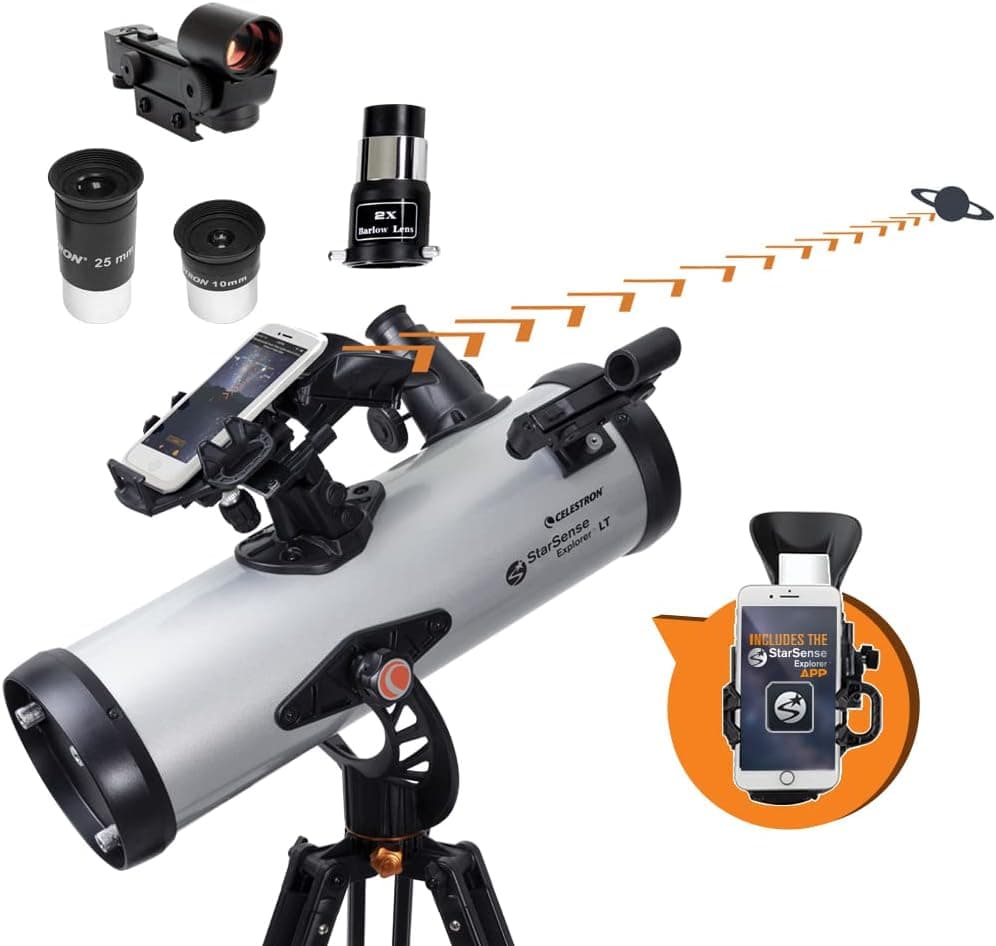
Celestron StarSense Explorer LT 114AZ, a 114mm Newtonian with smartphone dock that guides beginners to objects.
Price range: $ (Budget)
What we liked
- + Smartphone dock and app show exactly where to push the tube to find a target
- + 114mm Newtonian mirror handles planets and bright deep-sky objects nicely
- + Light LT version is easy for families to carry and set up
Trade-offs
- - LT tripod is a lighter build, so it shakes more at high magnification
- - App guidance requires a compatible phone, which should be checked first
Who this app-guided telescope is for
This telescope is aimed squarely at a beginner or family who wants help finding targets without a full manual star-hopping education, since the StarSense app uses the phone's camera to read the star field and calculate exactly where to push the tube. A 114mm Newtonian mirror is enough aperture to show real detail on the Moon, Saturn's rings and Jupiter's cloud bands, while still being light enough for the LT version's simplified, lighter mount to carry outside in one trip. It suits a household that wants quick wins on clear nights rather than a steep learning curve, since the app essentially turns finding a faint galaxy or nebula into following on-screen arrows. Buyers should have a compatible smartphone in mind before purchase, since the dock and app are central to how this telescope is meant to be used.
Specs and optical design explained
The LT 114AZ uses a 114mm, 4.5 inch aperture Newtonian reflector with a 1000mm focal length, giving a focal ratio around f/8.8 well suited to both planetary and some deep-sky viewing. Included 25mm and 10mm eyepieces provide roughly 40x and 100x magnification, and a 2x Barlow lens can double each of those figures for higher power views of the Moon and planets. The StarSense smartphone dock mounts in place of a normal finderscope and uses the phone's camera together with the free StarSense Explorer app to match the star pattern overhead against its internal database. A red dot finderscope and a full-height tripod round out the package, with the whole mount weighing under five kilograms, which keeps the complete setup portable for one person.
Setting it up and living with it
First-time setup mainly involves a one-time alignment step where the app calibrates itself against the phone's mounted position in the dock, after which pointing the tube by following on-screen arrows becomes fast and intuitive on future nights. Because the LT tripod is a lighter build than Celestron's DX version, the image can shake noticeably at the higher 100x-plus magnifications, especially in any wind, so patience and a light touch when nudging the tube pay off. There is little regular maintenance beyond occasionally checking mirror collimation, common to all Newtonian reflectors, and keeping the smartphone charged since the app is central to the finding process. Families tend to get the most out of it by starting each session with an easy bright target suggested by the app before working toward fainter objects.
Trade-offs and how it compares with rivals
Celestron's own StarSense Explorer DX 130AZ, which the site's own guide ranks higher in this beginner telescope category, uses a larger 130mm mirror and a sturdier tripod, giving brighter, steadier views for a bit more money and weight, and is worth considering for anyone who can handle the extra bulk. The StarSense Explorer 130AZ tabletop Dobsonian trades the tripod for a more stable low base while keeping the same phone-guided app experience. Compared with Celestron's older manual PowerSeeker line, which uses no app assistance at all, the StarSense system's biggest advantage is simply how much faster a beginner can find and enjoy a target on a first night out, even if the LT's lighter mount gives up some steadiness at high power.
Verdict and who should pick something else
For a family or beginner who wants app-guided help finding targets without spending on the larger DX model, the LT 114AZ is a genuinely useful entry point, and our score of 8.0/10 reflects strong ease of use held back somewhat by the lighter tripod's stability at high power. Buyers who plan to push magnification often, or who want steadier views overall, should budget for the StarSense Explorer DX 130AZ instead. Buyers without a smartphone compatible with the app, or who prefer learning traditional star-hopping without phone assistance, should look at a straightforward manual reflector rather than paying for the StarSense feature they will not use.
Frequently asked questions
Do I need a smartphone to use the StarSense Explorer LT 114AZ?
The core finding feature relies on a compatible smartphone docked in the mount, so while the telescope can technically be aimed manually, most of its ease of use depends on having a supported phone with the free app installed.
How much does the StarSense app cost?
The StarSense Explorer app is free to download, and it is required to use the smartphone-guided pointing feature that this telescope is built around.
What is the difference between the LT and DX StarSense Explorer models?
The DX version uses a larger 130mm mirror on a sturdier tripod for brighter, steadier views, while the LT uses a smaller 114mm mirror on a lighter mount that is easier to carry but shakes more at high magnification.
Can this telescope see planets like Saturn and Jupiter clearly?
Yes, the 114mm aperture and 1000mm focal length show Saturn's rings and Jupiter's cloud bands and moons with real detail, especially with the included Barlow lens for extra magnification.
Prices change often, so check the current price and availability on Amazon.
Check price on AmazonStargazer Nest may earn a commission from the link above.