Celestron StarSense Explorer DX 130AZ App-Enabled Telescope, 130mm Newtonian Reflector, Smartphone Dock Review (2026)
Updated September 14, 2026 · Research-based review
Our verdict
The StarSense Explorer DX 130AZ suits a beginner who wants a phone-guided telescope with a bigger mirror and steadier mount than Celestron's entry LT models. App-based push-to finding is the strength, and the heavier setup makes it less of a quick grab-and-go scope.
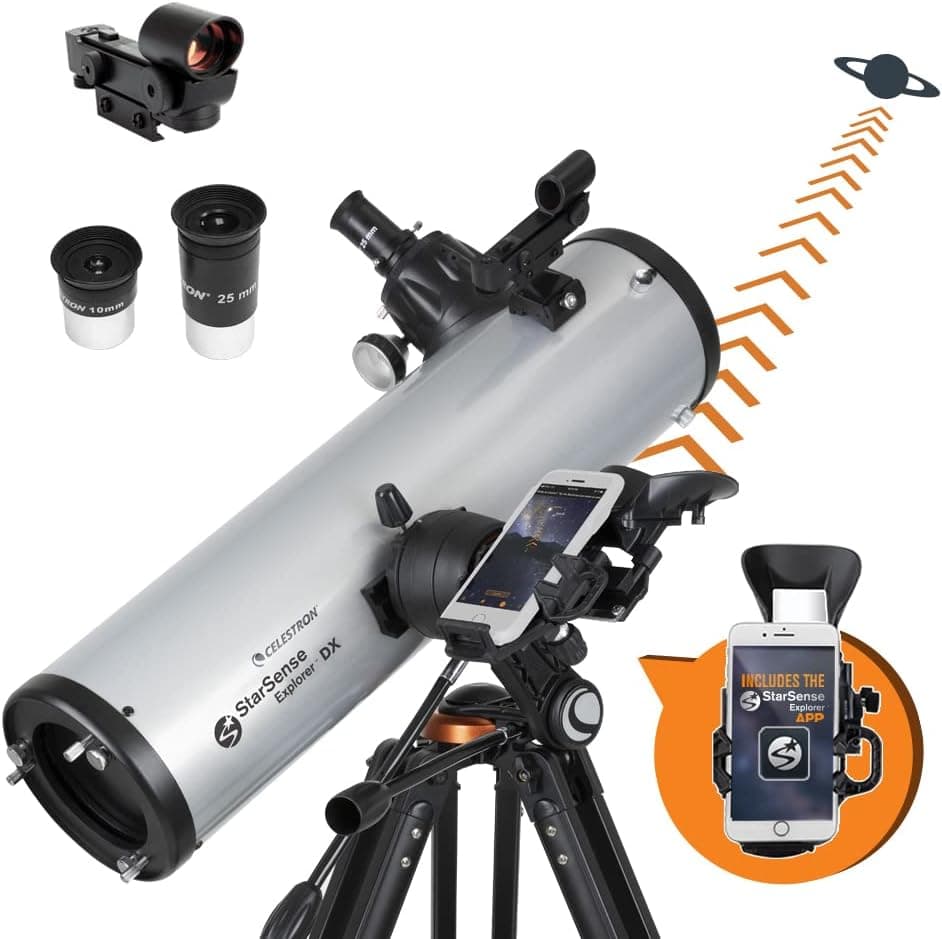
Celestron StarSense Explorer DX 130AZ, a 130mm Newtonian reflector with smartphone dock and sturdier DX mount.
Price range: $ (Budget)
What we liked
- + DX mount with slow-motion controls is steadier than the LT line
- + 130mm mirror gathers more light for galaxies and nebulae than smaller StarSense scopes
- + App-guided push-to finding turns the first nights into quick successes
Trade-offs
- - Heavier setup than the LT models, so it is less grab-and-go
- - Using a phone at night can spoil dark adaptation without careful settings
Who the DX 130AZ is built for
This is a 130mm, or 5.1-inch, Newtonian reflector with a 650mm focal length and f/5 focal ratio, sitting on a sturdier DX altazimuth mount with slow-motion controls rather than the simpler LT mount used on Celestron's smaller StarSense models. It targets a beginner or family who wants real automated help finding objects, without paying for a full GoTo motorized mount, by docking a smartphone that runs the StarSense app and displays arrows guiding the observer to point the tube at the right patch of sky. The larger 130mm mirror compared with the 114mm LT models means more light-gathering power for galaxies, nebulae, and star clusters, which matters to anyone who wants to progress past just the Moon and bright planets in their first year. Buyers who want fully automated GoTo tracking rather than manual push-to aiming should look at a motorized mount instead.
Specs and the StarSense system in plain terms
The 650mm focal length and f/5 ratio make this a fairly fast reflector well suited to wider views of star clusters and nebulae, while still giving good lunar and planetary detail with the included eyepieces, a 25mm giving about 26x and a 10mm giving about 65x. A StarPointer red dot finder is included as a backup manual aiming aid, alongside the StarSense phone dock, which uses the phone's camera to compare the sky against its own star pattern database and calculate exactly where the tube is pointing in real time. The aluminum tripod includes an accessory tray, and the mount's slow-motion controls let the observer nudge the tube smoothly once locked onto a target, which is a meaningful upgrade over the simpler point-and-shift LT mount. Because this is a reflector, the primary mirror can drift out of collimation over time and with rough handling, unlike a sealed refractor design.
Setup, first nights and care
First-time setup means installing the free StarSense app, calibrating the phone dock alignment once as instructed, then using the app's arrows to walk the tube onto a chosen target, a process reviewers describe as effective at getting beginners to their first successful deep-sky object quickly compared with star-hopping by eye. Because the system relies on a phone screen at the eyepiece, using it at full brightness late at night can spoil an observer's dark adaptation, so lowering screen brightness or using night mode settings helps preserve sensitive night vision between app checks. The DX mount and larger tube add real weight over the LT-class models, so this is better suited to a backyard setup that stays assembled between sessions than a scope carried to a new site every outing. Collimation checks and keeping the mirror capped when not in use are the main ongoing maintenance tasks for this design.
How it stacks up against nearby StarSense and beginner scopes
Against the smaller StarSense Explorer LT 114AZ, the DX 130AZ trades some portability for a meaningfully larger mirror and a steadier mount with slow-motion controls, which most beginners find worth the extra bulk once they are past their first few sessions. Compared with the tabletop StarSense Explorer 130AZ Dobsonian, which shares the same 130mm mirror on a simpler Dobsonian base, the DX version adds a full-height tripod and slow-motion controls at the cost of being less compact for storage and travel. Against Celestron's manual PowerSeeker models at similar or smaller apertures, the StarSense app-guided finding is the clear advantage for a beginner who has struggled to locate objects by eye alone.
Verdict and who should pick something else
For a beginner who wants a real step up from a toy telescope, with a usefully larger mirror and phone-guided finding that removes most of the frustration of a first year in the hobby, the DX 130AZ is a well-rounded choice backed by Celestron's mainstream support and accessory ecosystem. Anyone who wants the smallest, lightest possible travel telescope should look at the LT 114AZ or a compact refractor instead, since the DX's sturdier mount and bigger mirror add noticeable weight and bulk. Buyers who already know the night sky and do not want to depend on a phone at the eyepiece may prefer a traditional Dobsonian with a finderscope. Within its intended role as a serious first telescope for a home backyard, the DX 130AZ delivers a genuinely easier path to finding objects than a manual mount alone.
Frequently asked questions
Do you need a smartphone to use the StarSense Explorer DX 130AZ?
The phone-based StarSense app is central to the push-to finding system, since it calculates where the tube is pointed and guides the observer with on-screen arrows, though the telescope can still be aimed manually with the red dot finder if a phone is not available.
How is the DX 130AZ different from the LT models?
The DX mount is sturdier and adds slow-motion controls for smoother tracking by hand, and this model's 130mm mirror gathers more light than the 114mm mirror on the StarSense Explorer LT 114AZ, at the cost of extra weight and bulk.
Does this telescope track objects automatically once found?
No, the mount does not motorize tracking; the StarSense app helps you locate and aim at objects, and the mount's slow-motion controls let you nudge the tube by hand to keep an object centered as it drifts.
Will using a phone at the eyepiece ruin night vision?
A bright phone screen can interfere with dark adaptation, so lowering the phone's brightness or using a night mode setting while checking the StarSense app helps preserve sensitivity to faint objects between glances.
Prices change often, so check the current price and availability on Amazon.
Check price on AmazonStargazer Nest may earn a commission from the link above.