Celestron PowerSeeker 80EQ Telescope, Manual German Equatorial Telescope for Beginners, 80mm Aperture Review (2026)
Updated September 21, 2026 · Research-based review
Our verdict
An affordable 80mm refractor on a manual equatorial mount that handles the Moon and planets reasonably well, but the bundled eyepieces, Barlow lens and finderscope are the real weak point. Budget for upgraded accessories fairly soon, and treat this as an entry point rather than a long-term setup for deep-sky viewing.
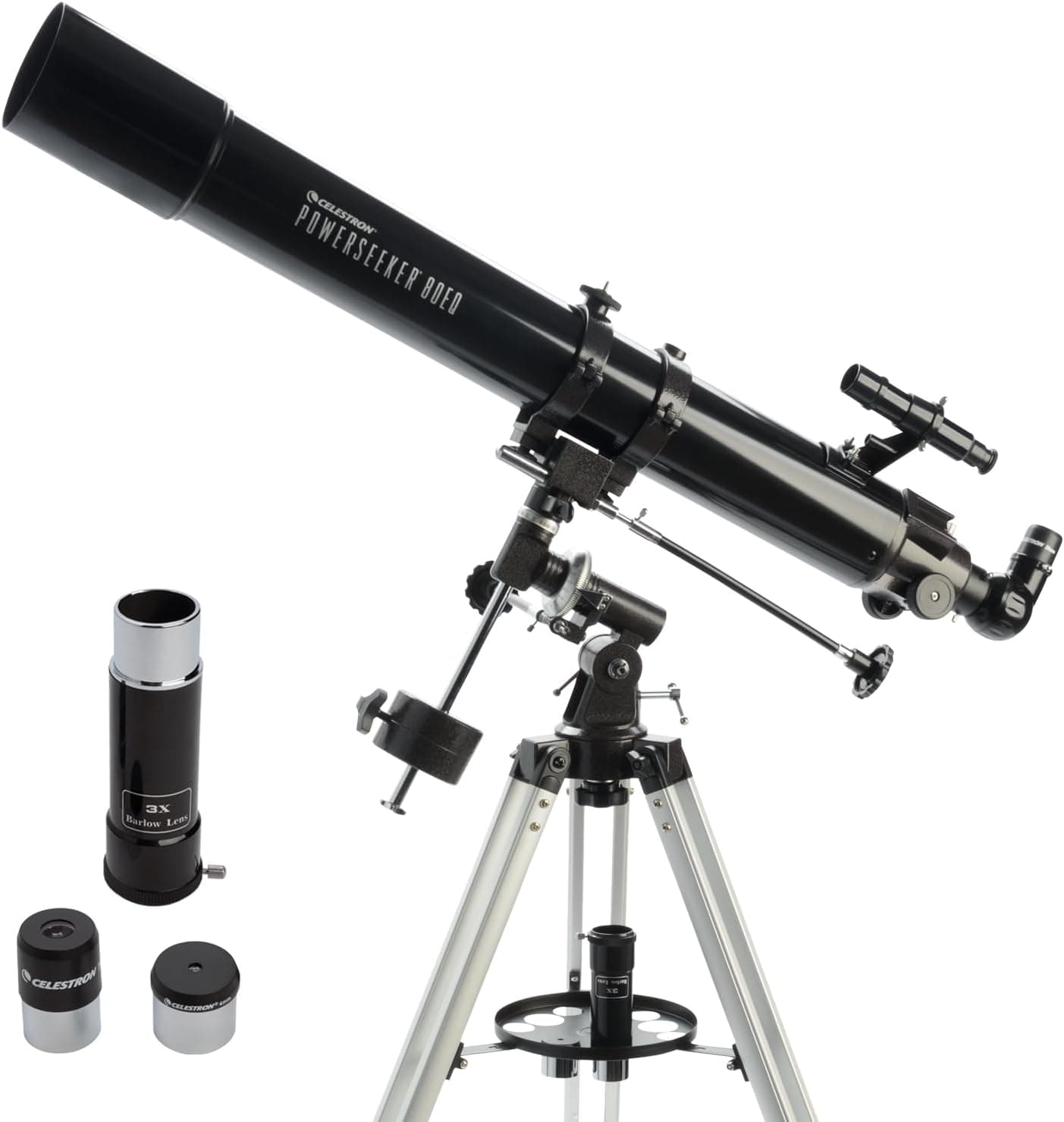
Celestron PowerSeeker 80EQ, an 80mm refractor on a manual German equatorial mount for beginner lunar and planetary views.
Price range: $ (Budget)
What we liked
- + 80mm refractor lens needs no collimation and is ready to use quickly
- + Equatorial mount allows smooth manual tracking of the Moon and planets
- + Budget-friendly way to try a traditional refractor setup
Trade-offs
- - Bundled eyepieces and Barlow lens are described as substandard by independent testing, so budget for upgrades
- - 5x24 finderscope is nearly useless for actually locating objects, per independent testing
The optical tube itself
The PowerSeeker 80EQ is an 80mm, f/11 achromatic refractor with a 900mm focal length, according to Celestron's own specifications. That is a fairly long, narrow tube typical of budget achromatic refractors, and independent testing from Telescopicwatch found the optics perform quite well on the Moon, planets and double stars, with only minimal color fringing despite the achromatic design, which is a genuinely positive result for a telescope at this price. Celestron rates the highest useful magnification at 189x and the light gathering power at 131 times that of the unaided human eye, numbers that fit an entry-level telescope aimed at bright, high-contrast targets rather than faint deep-sky objects.
The equatorial mount and tripod
The 80EQ uses Celestron's EQ-1 manual German equatorial mount with setting circles, mounted on an adjustable steel-legged tripod that Celestron lists as adjustable between about 32 and 51 inches, with a total kit weight around 10.6 pounds. Telescopicwatch's review describes the mount's motions as smooth and calls it quite adequate for the telescope, with a metal rack-and-pinion focuser the reviewer considered well made and sturdy. Equatorial mounts do take some getting used to for first-time owners, since tracking an object means turning the mount along an axis tilted toward the celestial pole rather than simply left, right, up or down, but once set up it allows smoother manual tracking than a basic alt-azimuth mount.
The accessories are the real weak point
Telescopicwatch's review is direct on this point: the two included eyepieces, a 20mm Kellner and a 4mm Ramsden, are described as substandard, the bundled 3x Barlow lens as cheap plastic, and the 5x24 finderscope as almost entirely useless for actually locating objects. The review also flags the included Amici diagonal as producing distracting diffraction spikes on bright objects. None of this is unusual for telescopes at this price tier, where the optical tube and mount get the bulk of the budget, but it does mean a new owner should expect to spend more, potentially close to the cost of the telescope itself, replacing the eyepieces and finderscope to get the most out of the optical tube.
What is included and warranty
The kit ships with the 80mm refractor tube, the EQ-1 mount and tripod, two eyepieces, a 3x Barlow lens, a 1.25 inch erect-image diagonal, a 5x24 finderscope, and Starry Night Basic planetarium software with a database Celestron lists at 36,000 objects. Celestron backs the telescope with a 2-year warranty. This is a complete beginner package in the sense that nothing extra is strictly required to start observing the same night it arrives, even if the included eyepieces and finder are the parts most likely to frustrate a new user once they start comparing views to what a better accessory would show.
Who should buy it
This telescope fits a buyer who wants an inexpensive first refractor for casual Moon and planet viewing and does not mind an equatorial mount's learning curve, or who is willing to budget for a better finderscope and eyepieces soon after purchase. It is a weaker choice for anyone focused on deep-sky targets like nebulae and galaxies, where the modest 80mm aperture and the narrow views from the stock eyepieces are limiting. Buyers who want a smoother out-of-box experience with less need for early upgrades may prefer a StarSense Explorer model or a larger tabletop Dobsonian instead.
Frequently asked questions
Are the included eyepieces on the PowerSeeker 80EQ any good?
Independent testing describes the stock 20mm and 4mm eyepieces, along with the bundled Barlow lens, as low quality, and most owners end up upgrading them fairly quickly for noticeably better views.
Is the equatorial mount hard to use for a first telescope?
It takes some learning since it tracks along a tilted axis rather than simple up-down-left-right motion, but reviewers describe this specific EQ-1 mount's motions as smooth and adequate once set up correctly.
Can the PowerSeeker 80EQ show planets and the Moon clearly?
Yes, independent review testing found the 80mm achromatic refractor performs well on the Moon, planets and double stars with only minimal color fringing, which is solid performance for this price range.
Is this telescope good for viewing nebulae and galaxies?
Not particularly. The 80mm aperture and narrow stock field of view are better suited to bright targets like the Moon and planets than to faint, extended deep-sky objects, which need more aperture and wider eyepieces.
Prices change often, so check the current price and availability on Amazon.
Check price on AmazonStargazer Nest may earn a commission from the link above.