The Night Sky 50 to 60 Degrees Large Star Finder Planisphere by David Chandler Company Review (2026)
Updated September 21, 2026 · Research-based review
Our verdict
A well designed planisphere for observers at 50 to 60 degrees north, including much of Canada and northern Europe, but the wrong latitude band for most of the continental United States. Its large, two sided format reads easily under a dim red light, at the cost of pocket portability.
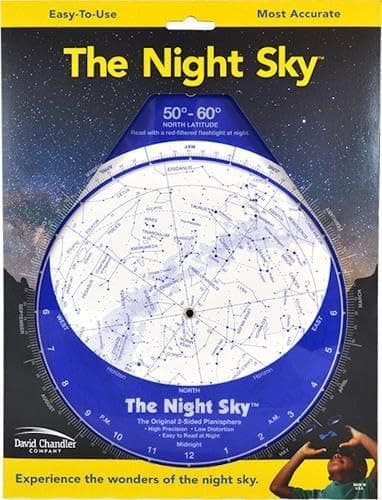
The Night Sky 50 to 60 Degrees Large Star Finder planisphere by David Chandler Company for far northern observers.
Price range: See on Amazon
What we liked
- + 50 to 60 degrees band suits Canada, northern Europe and similar high latitudes
- + Large dial keeps constellation names readable in dim red light
- + Helps plan which circumpolar and seasonal stars are up tonight
Trade-offs
- - Wrong latitude band for most of the continental US, where it misplaces the horizon
- - Large format is less pocketable than the small Chandler editions
What a planisphere does and who this one is for
A planisphere is a rotating star chart that shows which constellations and bright stars are above the horizon for any date and time once dialed in, and the David Chandler Company sells The Night Sky in several separate latitude bands rather than one chart meant to cover the whole globe. This particular edition covers the 50 to 60 degree north latitude range, which matches much of Canada, Alaska, England, and northern Europe, but sits north of nearly all of the continental United States, where latitudes mostly run in the 25 to 49 degree range covered by other editions in the same series. Picking the correct latitude edition matters, since using the wrong band shifts the horizon line and can mislead a beginner about what is actually visible.
Two sided design and accuracy
The Night Sky series uses a two sided design rather than the single sided layout common on many inexpensive planispheres, a choice the publisher says removes over 90 percent of the distortion that a conventional one sided star wheel introduces near the edges of its projection. That distortion in cheaper single sided charts tends to squash and stretch constellations near the horizon, which is exactly the part of the sky a beginner most needs to read accurately to orient themselves. The maps themselves are computer plotted for star positions and use a consistent brightness cutoff, so the pattern of visible stars on the chart should reasonably match what a naked eye observer sees on a clear night away from heavy light pollution.
Reading it in the dark
This edition prints dark stars on a light background rather than the reversed white on black scheme some planispheres use, a deliberate choice that the publisher says is easier to read under a dim, ideally red filtered flashlight without overwhelming night adapted eyes the way a brighter white background would. The constellation figures are drawn as simple patterns connecting only the brightest stars in each constellation, which keeps the chart uncluttered and easier to match against the actual night sky rather than trying to trace an elaborate mythological figure. Instructions for use are printed on the back of the chart itself, which is a practical touch for a first time buyer working it out under the stars without a manual in hand.
Size and portability
This is the large format edition, roughly 10 by 8.5 inches and made of plastic rather than paper or cardboard, which makes it noticeably sturdier and more weather resistant than a paper star chart but also considerably less pocketable than the small version of the same chart that Chandler also sells at a smaller diameter. Observers who want to tuck a planisphere into a jacket pocket for a casual walk outside will likely find the large edition a bit bulky for that use, while anyone setting a chart down on a table or observing station, or handing it to a group during an outreach event, will appreciate the larger, easier to read dial.
Choosing the right edition
Because this specific edition is built for the 50 to 60 degree north latitude band, it is the right choice for observers in Canada, Alaska, the British Isles, or northern Europe, but a poor choice for most people located across the continental United States, who should instead look for the David Chandler edition covering roughly 30 to 50 degrees depending on their specific location. Buying the wrong latitude band will not damage anything, but it will place the horizon line incorrectly and can genuinely confuse a beginner about which stars are actually visible from their location, so checking a rough latitude for home before ordering is worth the extra minute.
Frequently asked questions
Will this planisphere work for someone in the continental United States?
Generally no, this edition covers 50 to 60 degrees north latitude, which is north of most of the continental United States, so a lower latitude edition in the same series is usually the better fit.
What material is this large edition made from?
It is made of plastic, which is sturdier and more weather resistant than a paper star chart, though bulkier than the smaller edition.
Can this chart be read in the dark easily?
Yes, it prints dark stars on a light background, which the publisher designed to be readable under a dim, preferably red filtered flashlight.
How is this different from a cheaper, single sided planisphere?
It uses a two sided design that the publisher says removes over 90 percent of the distortion found in conventional one sided planispheres, especially near the horizon.
Prices change often, so check the current price and availability on Amazon.
Check price on AmazonStargazer Nest may earn a commission from the link above.