The Night Sky 40 to 50 Degrees Large Star Finder Planisphere by David Chandler Company Review (2026)
Updated September 20, 2026 · Research-based review
Our verdict
David Chandler's Night Sky planisphere in the large 40 to 50 degree edition covers the northern United States, most of Canada, and northern Europe with a two-sided design splitting north and south views across front and back. The 10 by 8.5 inch plastic build reads well outdoors, though it is bulkier than the small pocket edition.
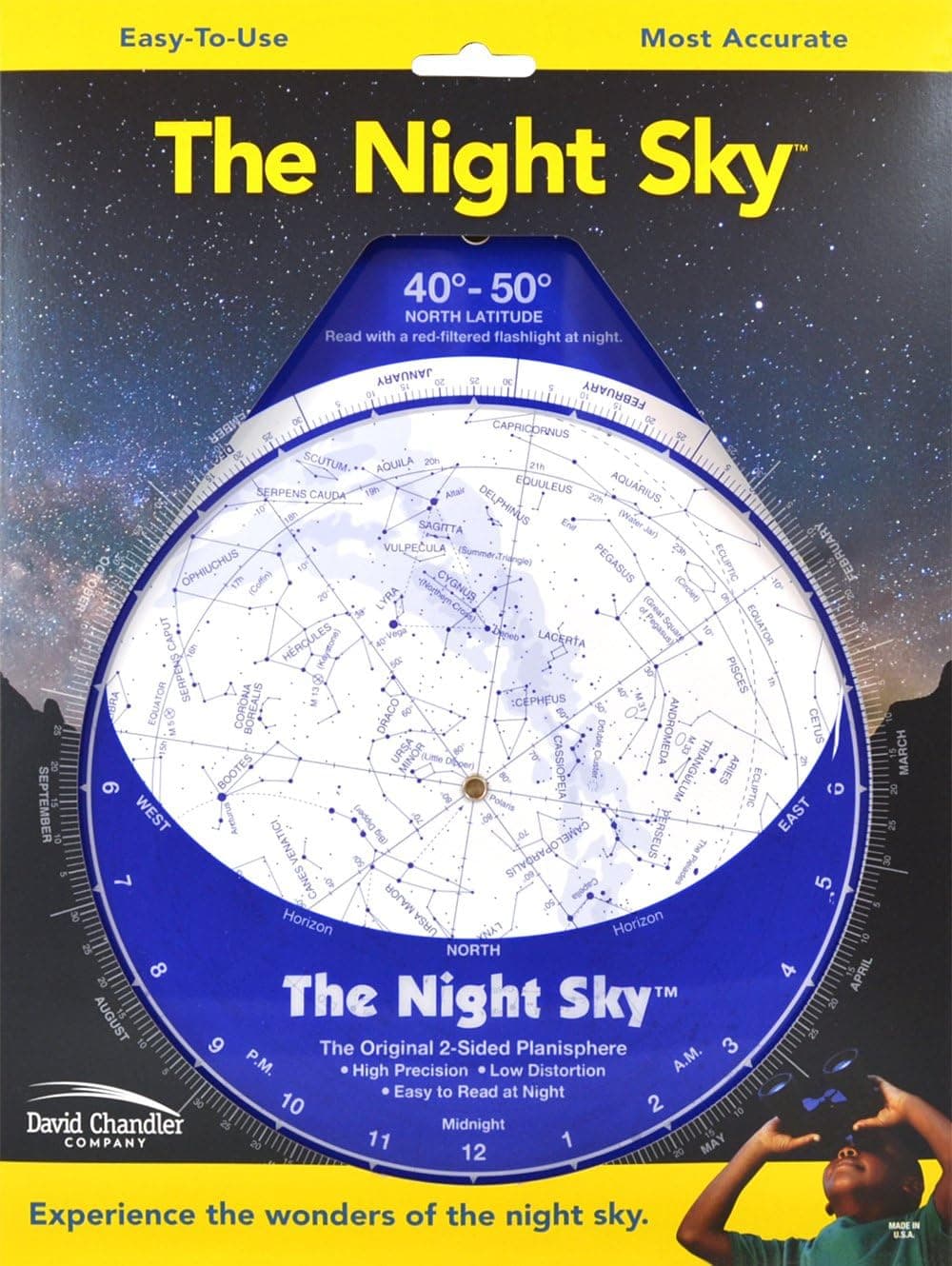
The Night Sky 40 to 50 Degrees Large Star Finder planisphere by David Chandler Company.
Price range: See on Amazon
What we liked
- + 40 to 50 degrees range suits much of the northern US and Europe
- + Large size makes labels easier to read at night
- + Latitude-specific design keeps constellation positions accurate for that band
Trade-offs
- - Large size is less convenient to carry in a pocket
- - Only accurate within the 40 to 50 degree latitude band
What region this edition is calibrated for
This large edition of David Chandler's Night Sky planisphere is built specifically for the 40 to 50 degree north latitude band, a range that covers much of the northern United States, the southern regions of Canada, and northern Europe, making it one of the more commonly needed versions for observers in those areas. Chandler's company sells the same Night Sky design across five separate latitude bands, from 20 to 30 degrees up through 50 to 60 degrees plus a southern hemisphere edition, so buyers need to match their own approximate latitude to the correct version rather than assuming a single planisphere works accurately everywhere on the globe.
The two-sided design and why it matters
Rather than cramming the entire sky onto one distorted circular map the way many simpler planispheres do, the Night Sky uses a two-sided layout that splits the sky into a north-facing chart on the front and a south-facing chart on the back, a design Chandler's company states eliminates over 90 percent of the distortion found in conventional single-sided planispheres. That distinction matters most for objects low on the horizon, where a one-sided map's distortion is at its worst and where beginners most often struggle to match what they see in the sky to what the chart shows. The charts are also printed with dark stars on a light background specifically for easier nighttime readability under a dim flashlight.
Size and build
This large version measures about 10 by 8.5 by 0.15 inches with an 8 inch diameter star map, built from durable plastic facing on both the front and back sides that is secured with no-corrosion brass rivets rather than a simpler cardboard construction. That plastic build holds up to repeated outdoor use and some dew exposure better than an uncoated paper chart would, though the larger size is naturally less pocketable than Chandler's smaller 5 inch diameter edition, which trades some readability for portability. Instructions for using the wheel are printed directly on the back, so no separate manual is needed to get started.
What's included beyond the star map
Beyond the core star chart, this edition includes a selection of deep sky objects suitable for binocular observation marked directly on the map, giving newer observers a few specific, findable targets to aim for rather than only the constellation outlines themselves. That inclusion nudges the planisphere toward being a practical observing tool rather than purely an educational reference, since a beginner can use it both to learn the constellations and to locate a first handful of binocular targets like star clusters once the basic star patterns are familiar. Instructions for lining up the date and time dial are printed directly on the back of the wheel, so no separate manual or leaflet is needed to start using it on the very first clear night.
How it compares to other planispheres on the site
In the site's Best Planispheres guide, this 40 to 50 degree edition ranks second of seven, just behind the Sky Publishing Night Sky Star Wheel calibrated for 40 degrees north with a roughly 35 to 45 degree usable range, and just ahead of Chandler's own 30 to 40 degree edition built for more southern latitudes. Buyers whose location sits closer to the middle of the Sky Publishing wheel's accurate band may prefer that top ranked option, while this Chandler edition is the more precisely matched choice for anyone further north within the 40 to 50 degree range specifically.
Frequently asked questions
What latitude range does this Night Sky planisphere cover?
It is built for 40 to 50 degrees north latitude, covering much of the northern United States, southern Canada, and northern Europe.
What size is the large edition?
It measures about 10 by 8.5 by 0.15 inches overall with an 8 inch diameter star map.
Why does the planisphere have charts on both sides?
The two-sided design splits north-facing and south-facing views across the front and back, which the maker states removes most of the distortion a single-sided planisphere would show.
Does this planisphere mark any specific objects to find?
Yes, it includes a selection of deep sky objects suitable for binocular observation marked on the map alongside the constellation outlines.
Prices change often, so check the current price and availability on Amazon.
Check price on AmazonStargazer Nest may earn a commission from the link above.