The Night Sky 30 to 40 Degrees Large North Latitude Star Finder Planisphere by David Chandler Review (2026)
Updated September 20, 2026 · Research-based review
Our verdict
This large 30 to 40 degree edition of David Chandler's Night Sky planisphere is built for the southern United States along with parts of North Africa and the Middle East, using the same two-sided plastic design as Chandler's other bands. It reads well outdoors and marks binocular targets, but is not accurate north of about 40 degrees.
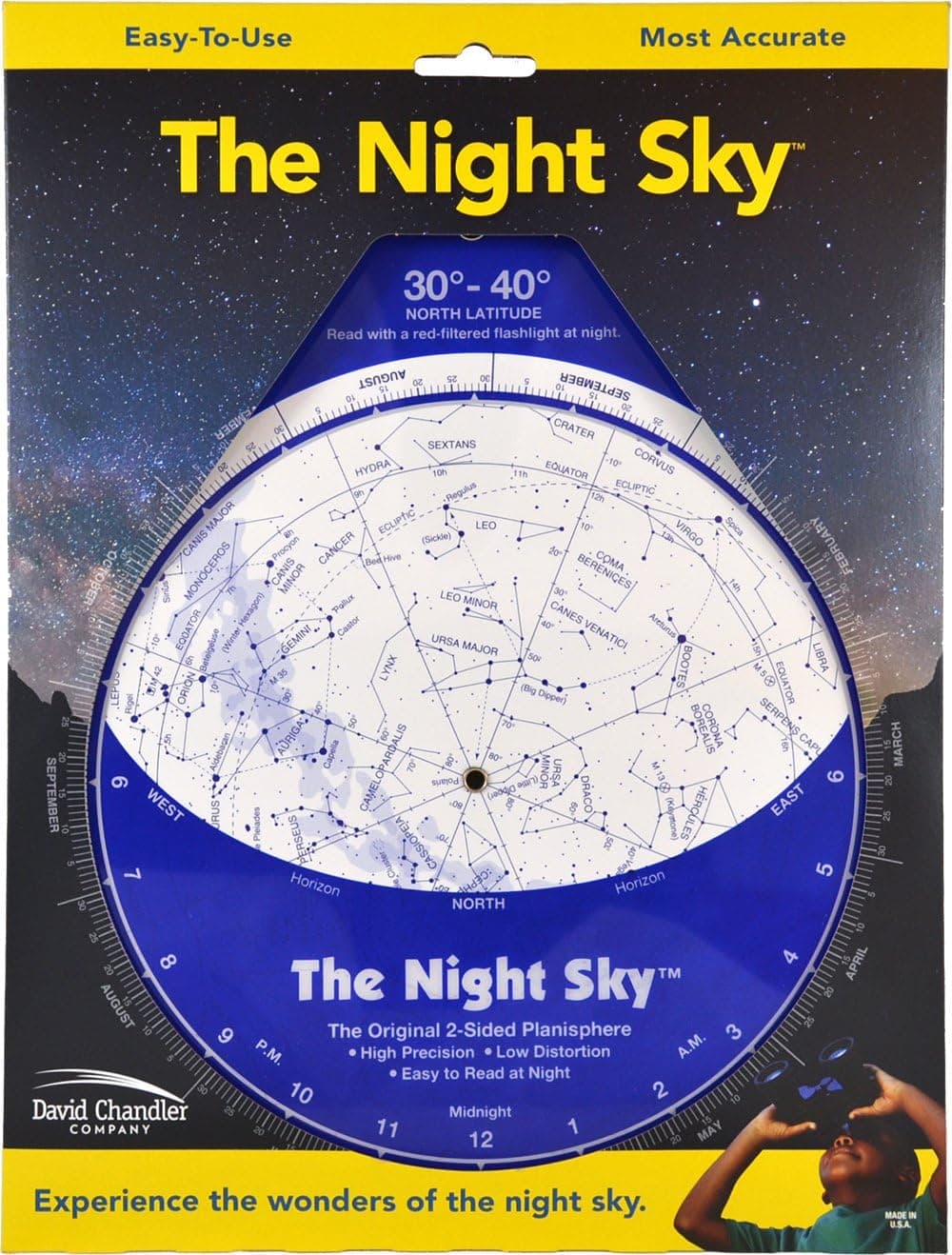
The Night Sky 30 to 40 Degrees Large North Latitude Star Finder planisphere by David Chandler.
Price range: See on Amazon
What we liked
- + 30 to 40 degrees range suits southern US and similar latitudes
- + Large format improves readability outdoors
- + Clear constellation outlines help beginners learn the sky
Trade-offs
- - Not accurate for northern regions above 40 degrees
- - Large size is bulkier to carry than the small pocket version
What region this edition covers
This edition of David Chandler's Night Sky planisphere is calibrated for the 30 to 40 degree north latitude band, which corresponds to the southern half of the United States along with parts of North Africa and the Middle East, placing it among the lower-latitude options in Chandler's five-version lineup that runs from 20 to 30 degrees up through 50 to 60 degrees plus a southern hemisphere edition. Observers should check their approximate latitude against that 30 to 40 degree range before buying, since a planisphere built for a different band will show growing inaccuracies the further a location sits from its calibrated range, particularly for objects near the horizon.
The two-sided layout shared across the line
Like the other latitude editions in Chandler's Night Sky line, this planisphere uses a two-sided design that puts a north-facing star chart on the front and a separate south-facing chart on the back, rather than trying to fit the whole sky onto one heavily distorted circular map. That approach is described as eliminating most of the distortion found in conventional single-sided planispheres, and it matters most for objects low on the horizon, which is exactly where beginners most often lose track of which chart marking corresponds to what they are actually seeing in the sky. Constellations are drawn simply on the chart, emphasizing the brighter stars over faint background stars that would clutter a nighttime read.
Build and readability
The large version measures roughly 10 by 8.5 inches overall with an 8 inch diameter star map, built from durable plastic facing on both sides and secured with no-corrosion brass rivets, a construction Chandler's company has used across its planisphere line for decades. Stars are printed dark on a light background specifically to make the chart easier to read outdoors under a dim red flashlight, and the plastic facing resists the light dew that can quickly soften an uncoated paper chart during a longer observing session. A smaller 5 inch diameter pocket edition is also available for observers who value portability over the easier readability of the larger size.
Who this latitude band suits best
Because it is calibrated for 30 to 40 degrees north, this edition is the better match for observers across the southern tier of the United States, from roughly the Carolinas and Georgia west through Texas, Arizona, and Southern California, as well as similar latitudes in North Africa and the Middle East, rather than for northern states or Canada where Chandler's 40 to 50 degree edition would be the closer fit. Picking the correctly matched version matters more than it might first seem, since a planisphere built for the wrong latitude band can leave a beginner confused about why a chart marking does not line up with what is actually visible above the horizon on a given night.
How it compares to other planispheres on the site
In the site's Best Planispheres guide, this 30 to 40 degree edition ranks third of seven, behind the Sky Publishing Night Sky Star Wheel built for 40 degrees north and Chandler's own 40 to 50 degree edition, both of which suit locations somewhat further north than this version is calibrated for. Southern-tier observers in the United States, or those in similarly positioned latitudes abroad, get a more precisely matched chart from this edition than from either of the higher-ranked options, since both of those are centered on latitudes closer to 40 to 50 degrees rather than the 30 to 40 degree band this planisphere targets.
Frequently asked questions
What latitude range is this Night Sky planisphere built for?
It is calibrated for 30 to 40 degrees north latitude, covering the southern United States along with parts of North Africa and the Middle East.
Will this planisphere work accurately in the northern United States?
No, accuracy declines outside the 30 to 40 degree band, so northern locations are better matched by Chandler's 40 to 50 degree edition instead.
What size is the large edition and what is it made of?
It measures roughly 10 by 8.5 inches with an 8 inch diameter map, built from plastic facing secured with brass rivets.
Does this planisphere show both northern and southern sky views?
Yes, it uses a two-sided design with a north-facing chart on the front and a south-facing chart on the back.
Prices change often, so check the current price and availability on Amazon.
Check price on AmazonStargazer Nest may earn a commission from the link above.