Celestron Night Vision Headlamp, Multiple Light Modes, SOS Setting, Astronomy Camping, 100 Hours Review (2026)
Updated September 21, 2026 · Research-based review
Our verdict
A red only LED headlamp built for astronomy, with two red brightness levels, a blinking mode and SOS, running on two AAA batteries for up to 100 hours on low beam. It frees both hands for eyepieces and star charts, and its main limit is a dim 4 lumen high setting for general camp chores.
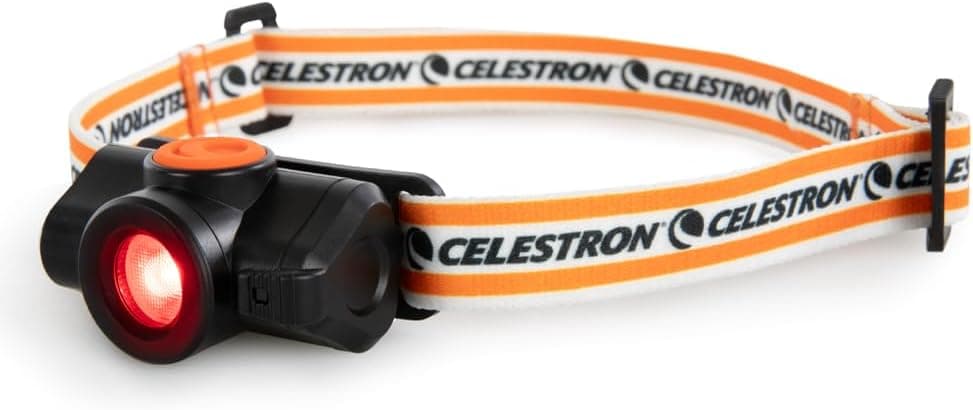
Celestron Night Vision headlamp with multiple light modes, SOS setting and 100 hours runtime for astronomy and camping.
Price range: See on Amazon
What we liked
- + Headlamp keeps both hands free for handling eyepieces and charts
- + 100 hours runtime covers many observing nights
- + Multiple modes and SOS setting add camping and safety value
Trade-offs
- - Low peak brightness makes it a poor substitute for a general purpose camping headlamp
- - Headlamp strap may feel tight over hats in cold weather
Why a hands free red light helps at the eyepiece
Setting up a telescope in the dark means juggling eyepieces, star charts, cables and tripod legs at the same time, and a handheld flashlight only has two hands to compete with. A headlamp solves that by staying pointed wherever the observer looks, leaving both hands free to thread an eyepiece into a focuser or trace a constellation on a paper atlas. Celestron built this headlamp specifically around red LEDs rather than a white light with a red filter, since red light preserves the eye's dark adaptation far better than white light, which can undo twenty to thirty minutes of adjustment in a single accidental glance. That makes it a purpose built tool for the observing field rather than a repurposed hiking headlamp, and it pairs naturally with a dedicated red flashlight for anyone who wants a spare light source at a dark site.
Light modes and how bright it actually gets
The headlamp offers four settings: a low red beam, a high red beam, a blinking mode and an SOS setting, all using red LEDs rather than switching to white light at any point. Manufacturer specifications list the low setting at roughly 1 lumen and the high setting at roughly 4 lumens, which is dim compared to general purpose headlamps but appropriate for an astronomy tool, since even a few lumens of white light would be far too disruptive at a dark site. The low setting suits reading a star chart or dialing in an eyepiece, while the higher setting helps with tasks like packing up gear or walking to a car. Because both settings stay in the red spectrum, there is no white light mode to accidentally trigger and ruin an observing session, which is a meaningful difference from headlamps that only dim a white LED or use a red lens cap.
Battery life and power source
Power comes from two user supplied AAA batteries, either alkaline or lithium, rather than a proprietary rechargeable cell, which makes replacements easy to find at any dark site or hotel gift shop during a multi night trip. Manufacturer runtime figures list 100 hours on the low beam, 25 hours on the high beam, and 100 hours in both blinking and SOS modes, giving an observer many sessions before batteries need to be swapped if the low setting is used most of the time. Lithium AAA batteries will extend that runtime further and perform better in freezing temperatures than alkaline cells, which is worth considering for winter observing sessions. Carrying a spare set of AAA batteries in a telescope case is a cheap, low effort backup for longer star parties or camping trips where recharging options are limited.
Fit, weight and adjustability
The headlamp weighs about 62 grams including its elastic headband, light enough to wear for a full night without noticeable strain, and measures roughly 58 by 35 by 30 millimeters at the lamp housing. The head itself tilts up to 45 degrees, letting the wearer angle the beam down toward a star chart on a table or a focuser knob without having to tip their whole head forward. The elastic headband uses adjusting clips to fit different head sizes, though anyone wearing a thick winter hat underneath may find the band feels tighter than expected and want to loosen it before a session rather than after. Celestron backs the headlamp with its standard two year warranty, and the package includes only the headlamp, headband and a quick setup guide, so no case or extra batteries are bundled in.
Verdict and how it compares
This headlamp earns a strong score as a dedicated, hands free astronomy light, ranking third of seven in its red flashlight comparison, just behind Celestron's own dedicated red flashlight and a Carson RedSight model, and narrowly ahead of Celestron's own PowerTank Glow power bank flashlight. Its main advantage over a handheld red flashlight is freeing both hands during setup and teardown, while its main limitation is a low peak brightness that makes it a poor substitute for a general purpose camping headlamp. Anyone who splits time between handling a telescope and reading charts in the dark will likely appreciate having a red light mounted on their head rather than balanced on a table or clenched in their teeth.
Frequently asked questions
Does this headlamp have a white light mode?
No, it uses red LEDs only across all four settings, so there is no white light mode to accidentally trigger and disrupt night vision.
What batteries does it use?
It runs on two AAA batteries, either alkaline or lithium, which are not included and are widely available for replacement.
How long does the battery last?
Manufacturer figures list 100 hours on low beam, 25 hours on high beam, and 100 hours in blinking or SOS mode.
Can the beam angle be adjusted?
Yes, the lamp head tilts up to 45 degrees so the beam can be aimed down at a chart or focuser without tilting the whole head.
Prices change often, so check the current price and availability on Amazon.
Check price on AmazonStargazer Nest may earn a commission from the link above.