Alstar Red Laser Collimator for Newtonian Telescopes 1.25 inch 7 Brightness Levels Review (2026)
Updated September 14, 2026 · Research-based review
Our verdict
A 1.25 inch laser collimator with 7 brightness levels and a removable 2 inch adapter, built to speed up routine alignment on Newtonian telescopes before an observing session. It is an affordable way to check collimation quickly, though the laser's own alignment is worth verifying against a Cheshire eyepiece on arrival.
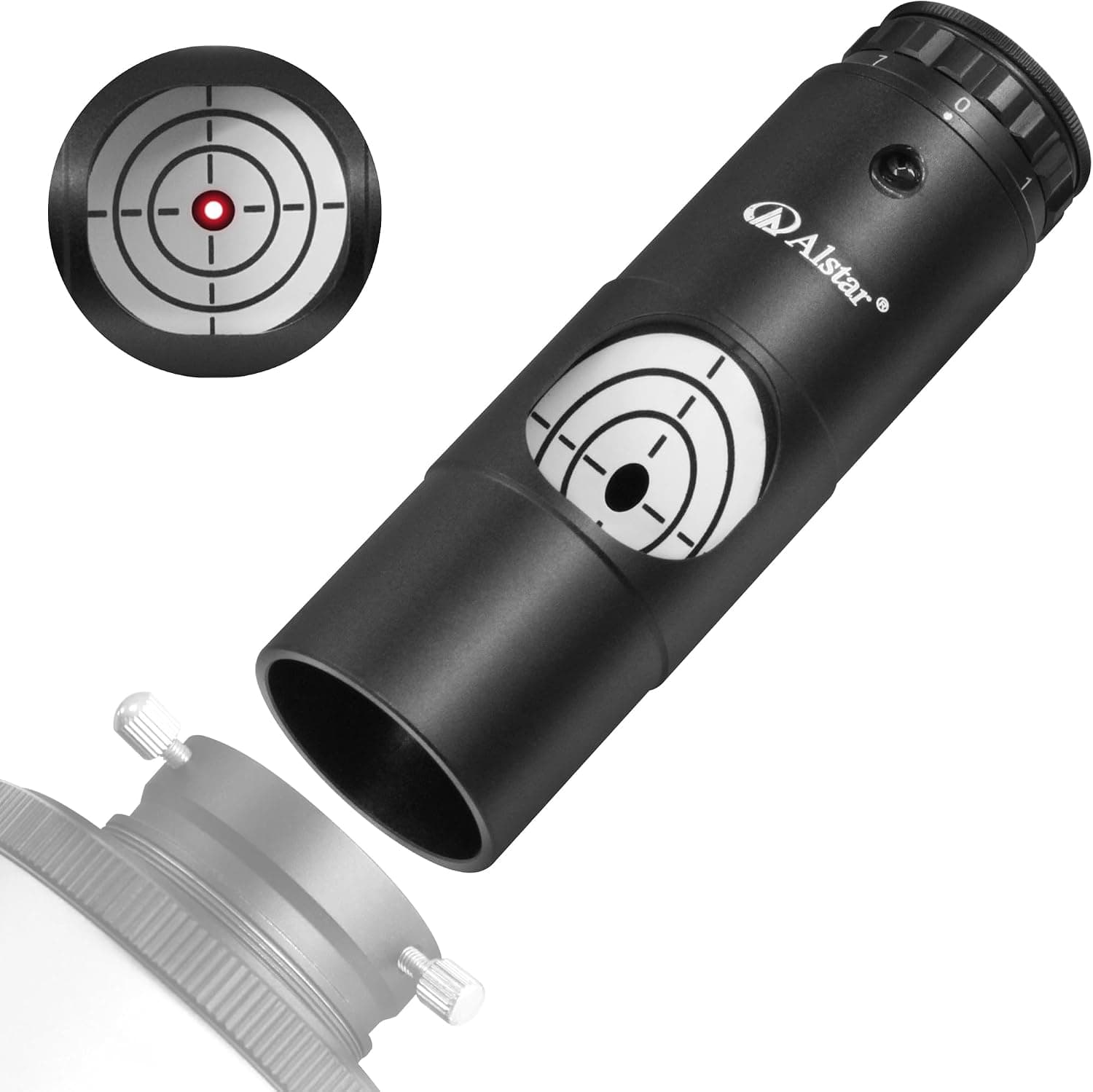
Alstar red laser collimator for Newtonian telescopes, 1.25 inch, with 7 brightness levels for easy alignment.
Price range: See on Amazon
What we liked
- + 7 brightness levels suit both indoor practice and dark observing sites
- + Standard 1.25 inch body fits most Newtonian focusers directly
- + Affordable way to speed up routine collimation before sessions
Trade-offs
- - Lesser-known brand, so laser self-alignment should be verified on arrival
- - Does not include a 2 inch adapter for larger focusers
Who needs a laser collimator like this
Anyone who owns a Newtonian or Dobsonian reflector telescope knows that mirror alignment, called collimation, drifts over time from transport, temperature changes and normal handling, and it directly affects how sharp the views look at the eyepiece. This laser collimator is built for reflector owners who want a fast way to check and correct that alignment before a session rather than relying only on a star test in the dark. It suits both new Dobsonian owners learning collimation for the first time and experienced users who want a quicker routine check than a Cheshire eyepiece alone provides, especially useful right before a planetary observing session when sharp focus matters most.
How the design and brightness levels work
The collimator fits the standard 1.25 inch focuser size found on most Newtonian telescopes and includes a removable 2 inch adapter, so it also works in larger focusers without needing a second tool. It projects a red laser beam in the 635 to 655 nanometer range at under 5 milliwatts of output, and offers 7 brightness levels to suit both a well-lit room for practice and a fully dark observing site where a dimmer beam is easier to read. A side window with a 45 degree disk lets the user check whether the laser reflects back on itself, which confirms proper alignment, and three adjustment screws set 120 degrees apart allow for recalibrating the unit itself if it ever drifts.
Using it and keeping it working
In practice, the collimator inserts into the focuser like an eyepiece, and the beam projects down onto the primary mirror and back up to a target on the collimator's face, guiding adjustments to the secondary and primary mirror screws until the beam lines up. It runs on a single CR2032 lithium coin cell battery, which is not included, so it is worth picking one up before the first session. Because it is a budget-priced laser tool from a lesser-known brand rather than a premium name, it is good practice to verify the laser itself is properly self-aligned against a Cheshire eyepiece or autocollimator when it first arrives, since a misaligned laser will give a false collimation reading.
How it compares with other collimation tools
Against other options in the same collimator comparison, this Alstar model ranks near the bottom of the group, behind the HoTech SCA-2C and the similarly specced SVBONY and Astromania laser collimators that also offer 7 brightness levels in a 1.25 inch body. Those alternatives are built to the same basic laser design but come from brands with a longer track record for factory self-alignment accuracy. The Celestron 94182 Cheshire eyepiece and the Astromania Cheshire without a laser, both further up the same list, use an entirely different non-laser method that some experienced users trust more since it has no battery or internal laser diode that can drift out of calibration.
Verdict and who should choose differently
This collimator earns our score of 7.6 out of 10 as a functional, budget-friendly way to speed up collimation checks on a Newtonian telescope, with a useful range of brightness levels and the flexibility of the included 2 inch adapter. It suits anyone who wants a quick laser-based routine tool and is willing to verify its factory alignment before trusting it fully. Buyers who want the most dependable long-term accuracy without worrying about laser drift or batteries should consider a Cheshire eyepiece instead, and anyone collimating a telescope with a 2 inch focuser as the primary size should double check the adapter fits their specific focuser drawtube.
Frequently asked questions
Does this collimator come with a battery?
No, it requires one CR2032 lithium coin cell battery which is not included, so buy one separately before first use.
Will it fit a 2 inch focuser as well as 1.25 inch?
Yes, it includes a removable 2 inch adapter, so it works in both standard 1.25 inch and larger 2 inch focusers.
Is the laser safe to use?
It outputs under 5 milliwatts, which is a low-power red laser, but users should still avoid pointing it at eyes and follow the manufacturer's included instructions for safe handling.
How do I know if the laser itself is properly aligned?
Rotate the collimator in the focuser while it projects onto a target; if the dot moves in a circle instead of staying fixed, the laser needs recalibration using the three adjustment screws.
Prices change often, so check the current price and availability on Amazon.
Check price on AmazonStargazer Nest may earn a commission from the link above.