HoTech 2 and 1.25 inch SCA Laser Collimator for Newtonian Telescope Crosshair SCA-2C Review (2026)
Updated September 20, 2026 · Research-based review
Our verdict
This crosshair laser collimator suits Newtonian and SCT owners who want more precise, repeatable collimation than a basic single-dot laser offers. The self-centering adapter removes focuser slop, but the crosshair reading method and higher price take some adjustment for first-time collimators.
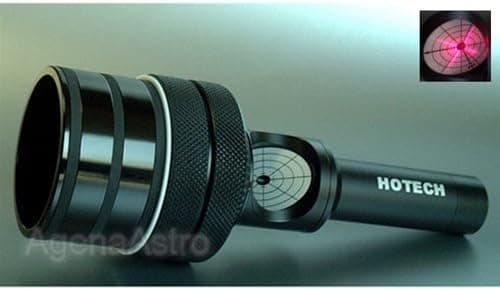
HoTech SCA-2C laser collimator with crosshair, fitting 2 and 1.25 inch focusers for precise Newtonian alignment.
Price range: See on Amazon
What we liked
- + Self-centering adapter design reduces errors caused by loose focuser fit
- + Fits both 2 and 1.25 inch focusers without a separate adapter
- + Crosshair pattern gives a clearer alignment reference than a single dot
Trade-offs
- - Considerably pricier than basic laser collimators
- - Crosshair method has a small learning curve for first-time collimators
Who this collimator is for
Newtonian reflector owners who have struggled with a basic single-dot laser sliding around in a loose focuser are the main audience for HoTech's SCA-2C. The collimator is built to work with both 1.25 inch and 2 inch focusers without needing a separate step-down adapter, so it covers most Newtonian and Schmidt-Cassegrain telescopes sold to hobbyists. Because the tool relies on a patented self-centering adapter rather than a simple friction fit, it is aimed at observers who want a repeatable, precise reference point every time they insert it, not just a rough alignment check. Anyone collimating a fast reflector, where small mirror errors show up quickly at the eyepiece, benefits most from the tighter centering this design provides over a loose-fitting laser.
How the self-centering adapter and crosshair work
The SCA mechanism uses expanding rings inside the barrel that press evenly against the focuser's inner wall, eliminating the wobble, or slop, that comes from focusers with slightly different manufacturing tolerances. Once centered, the collimator projects a crosshair pattern rather than a single dot, made up of a precision center dot with four extended laser lines radiating outward. That crosshair stays visible even when it falls near the edge of the primary mirror during early adjustment, which is easy to lose track of with a single dot. A 45 degree angled faceplate with a laser engraved targeting grid gives a second reference for aligning the return beam, useful for both classic Newtonian collimation and star testing.
What's included and telescope compatibility
The unit ships with the SCA laser collimator body, one CR123 battery to power it, and printed manuals covering three separate collimation methods, Newtonian, Schmidt-Cassegrain, and star collimation. Because the self-centering rings expand to fit a range of inside diameters, HoTech markets it as compatible with focusers from different telescope brands that do not always share identical tolerances, which is where cheaper fixed-diameter lasers tend to fit loosely. The 2 inch and 1.25 inch compatibility in one tool also means owners do not need to buy or carry a separate step-down adapter, reducing the number of parts that can introduce their own centering error during a collimation session.
Using it at the telescope
In practice, the collimator is inserted into the focuser like an eyepiece, where the expanding adapter centers it automatically before any adjustment begins. From there, the crosshair is aimed at the mirror's center mark and the primary and secondary mirror screws are adjusted until the returning beam lines up, following the included Newtonian or SCT instructions depending on the telescope type. Because the crosshair reads more like a targeting reticle than a single point, first-time users typically need a session or two to get comfortable interpreting it compared with simpler dot lasers. Basic care is straightforward: keep the laser window free of dust, store the unit in a padded case between uses, and swap in a fresh CR123 battery if the beam starts to dim.
Where it ranks against rival collimators
In the site's Best Collimators guide this HoTech model ranks first of eight, ahead of single-dot laser collimators from SVBONY and Astromania as well as Cheshire-style collimation eyepieces from Celestron and Astromania. Those single-dot lasers cost noticeably less and are simpler to read, while Cheshire eyepieces need no battery at all but demand more practice to use accurately in dim light. The SCA-2C's advantage is the combination of self-centering precision and a crosshair that is easier to track than a bare dot, which explains the price premium over basic laser collimators. For anyone who already owns a reflector and is frustrated by an imprecise adapter fit, that trade-off is reasonable; casual users happy with a cheaper dot laser may not need the extra cost.
Frequently asked questions
Does this collimator fit both 1.25 inch and 2 inch focusers?
Yes, the SCA-2C works with both sizes through its self-centering adapter, without needing a separate step-down adapter.
What makes the crosshair pattern different from a single-dot laser?
It projects a precision center dot with four extended laser lines instead of one dot, which stays easier to track during adjustment, especially near the mirror's edge.
What comes in the box?
The collimator body, one CR123 battery, and manuals covering Newtonian, SCT, and star collimation methods.
Can it be used on Schmidt-Cassegrain telescopes as well as Newtonians?
Yes, the included documentation covers both Newtonian and SCT collimation methods with the same tool.
Prices change often, so check the current price and availability on Amazon.
Check price on AmazonStargazer Nest may earn a commission from the link above.