Canon 12x36 Image Stabilization III Binoculars with Power-Saving IS for Wildlife and Sports Viewing Review (2026)
Updated September 21, 2026 · Research-based review
Our verdict
The Canon 12x36 IS III suits birders, sports fans, and casual stargazers who want steady 12x views without a tripod. The vari-angle prism stabilizer is the standout strength; the tradeoff is a 36mm objective that dims fast once the sky gets truly dark.
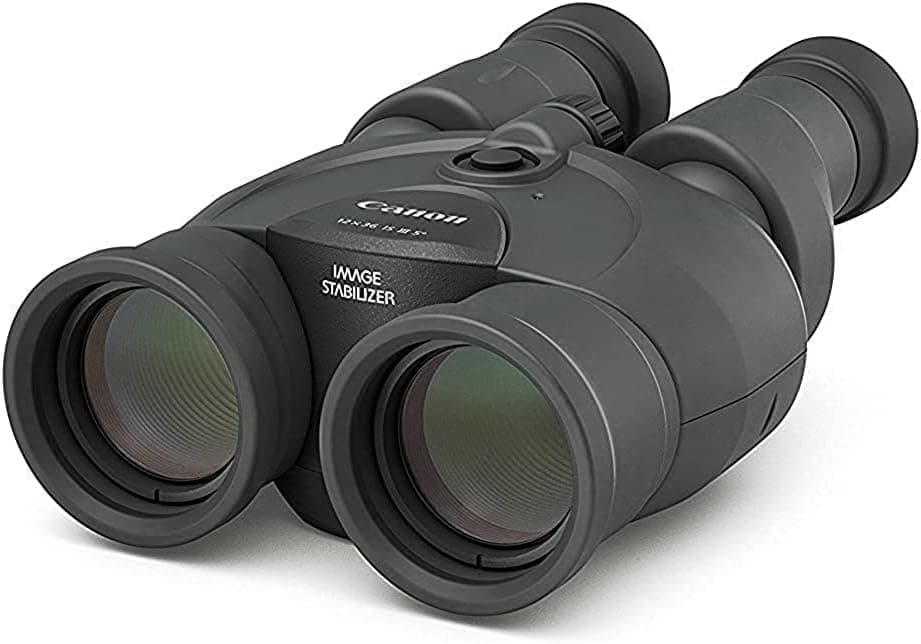
Canon 12x36 Image Stabilization III binoculars with power-saving IS, aimed at wildlife and sports viewing.
Price range: See on Amazon
What we liked
- + 12x power becomes usable handheld thanks to image stabilization
- + Power-saving IS extends battery life during long sessions
- + Compact body is easier to carry than larger stabilized models
Trade-offs
- - 36mm objectives limit brightness for faint deep-sky objects
- - Not waterproof according to the title, so protect it from dew
What this binocular is built for
Canon designs the 12x36 IS III around a simple idea: give handheld binoculars enough magnification to feel like a spotting scope while keeping the shake that normally comes with 12x power under control. The image stabilizer uses a vari-angle prism driven by two gyro sensors, correcting for hand tremor as you hold the binocular up to your eyes. That makes it a strong fit for wildlife watching, stadium sports, concerts, and casual sky watching where you want detail without hauling a tripod. Canon rates the correction angle at plus or minus 0.8 degrees, which covers ordinary handheld wobble rather than movement from a moving vehicle or boat. Porro II prisms and Super Spectra coatings are the same optical formula Canon uses across its IS binocular line, so the stabilizer is really the feature you are paying for here, not exotic glass.
Build, size, and handling
The 12x36 IS III weighs about 660 grams and measures roughly 127 by 174 by 70 millimeters, noticeably lighter and more compact than Canon's larger 10x42 and 18x50 IS models. That makes it comfortable to carry on a neck strap for a full day of birding or a long evening outdoors. Eye relief is 14.5 millimeters and the exit pupil is 3.0 millimeters, both typical figures for a compact 12x binocular rather than a low-light specialist. Canon lists the closest focusing distance at about 6 meters, which is longer than many general-purpose binoculars, so this is not the pair to reach for when you want to study something a few feet away. The body has a water-resistant coating for light rain and dew, but it is not a sealed, fully waterproof design, so it still needs reasonable care around moisture.
Power and running the stabilizer
Stabilization only works while the IS button is held or locked on, and that draws from two AA batteries rather than a rechargeable pack. Canon's own figures put runtime at roughly 9 hours on fresh alkaline AAs at room temperature, dropping sharply in cold weather, to around an hour at minus 10 degrees Celsius, while lithium AA batteries extend continuous use to about 12 hours. That cold-weather drop matters for anyone planning to use this under a clear winter sky, since battery life is the main limiting factor on how long a stargazing session can run. Packing spare AA or lithium batteries is a sensible habit for this binocular, especially compared with binoculars that need no batteries at all. The power-saving IS mode referenced in the product name is Canon's way of stretching that runtime rather than a separate feature to configure.
Where it fits against astronomy binoculars
For dedicated stargazing, the 36mm objective lens is the binocular's clearest limitation. Bigger astronomy binoculars in the 50mm to 80mm range gather far more light and reveal fainter deep-sky targets, and this Canon is not designed to compete with them on raw aperture. What it offers instead is a level of handheld steadiness that a 50mm or 80mm binocular cannot match without a tripod, since those larger designs are heavy enough to need support for a sharp, comfortable view. That makes the 12x36 IS III a better match for the Moon, bright planets, star clusters, and general terrestrial use than for faint nebulae or galaxies. Anyone whose main goal is deep-sky observing will likely get more out of a larger, non-stabilized binocular on a tripod, while anyone who wants one grab-and-go pair for sky and daytime use will appreciate what the stabilizer adds.
Who should buy it
This binocular makes the most sense for someone who wants a single, portable pair of binoculars for wildlife, sports, travel, and the occasional look at the Moon or a planet, and who values a steady image over raw light-gathering power. The image stabilizer genuinely changes what 12x magnification feels like handheld, turning a normally shaky view into something closer to what a heavier tripod-mounted binocular delivers. Buyers should budget for AA or lithium batteries and expect to replace or recharge them more often in cold conditions. Those focused purely on deep-sky astronomy, where aperture and light gathering matter more than portability, are better served by a larger 50mm or bigger astronomy binocular. For everyone else who wants one do-it-all pair that also handles casual stargazing, the 12x36 IS III is a reasonable, well-established choice from a major optics maker.
Frequently asked questions
Is the Canon 12x36 IS III waterproof?
No. It has a water-resistant coating that helps with light rain and dew, but it is not a sealed, fully waterproof design, so it should not be submerged or used in heavy, sustained rain.
What batteries does it use and how long do they last?
It runs on two AA batteries. Canon rates alkaline AAs at roughly 9 hours of continuous stabilizer use at room temperature, dropping to about an hour in very cold weather, while lithium AAs extend runtime to around 12 hours.
Is 36mm objective lens big enough for astronomy?
It works for the Moon, bright planets, and general sky watching, but a 36mm objective gathers much less light than dedicated astronomy binoculars with 50mm to 80mm objectives, which will show fainter deep-sky objects more clearly.
How much does it weigh compared to Canon's other IS binoculars?
At about 660 grams, it is significantly lighter and more compact than Canon's 10x42 and 18x50 IS models, making it easier to carry for a full day of birding or travel.
Prices change often, so check the current price and availability on Amazon.
Check price on AmazonStargazer Nest may earn a commission from the link above.