Sky-Watcher S20150 AllView Computerized Multi-Purpose Mount for Telescopes and Cameras Review (2026)
Updated September 14, 2026 · Research-based review
Our verdict
The AllView suits someone who wants one motorized mount for both a small telescope at night and daytime panorama or timelapse photography. Its multi-purpose design and dual-encoder positioning are the strengths, and limited payload rules out larger telescopes or heavy camera rigs.
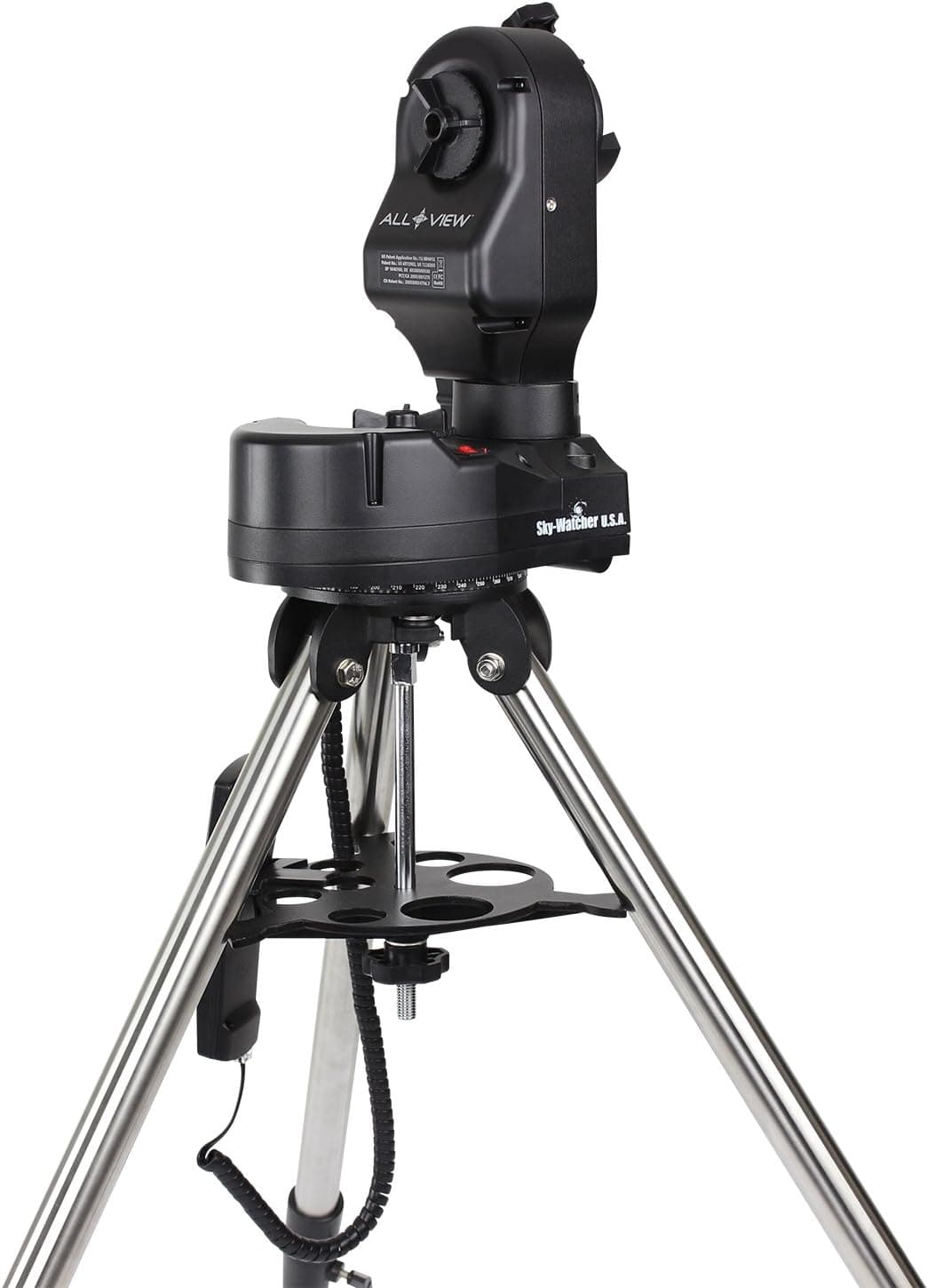
Sky-Watcher S20150 AllView computerized multi-purpose mount for telescopes and cameras, including panorama use.
Price range: See on Amazon
What we liked
- + Multi-purpose design handles telescopes, cameras and timelapse panoramas
- + Computerized control automates slewing and target finding
- + Versatile for both day photography and night astronomy
Trade-offs
- - Payload is limited, so large telescopes are not suitable
- - Jack-of-all-trades design is less precise than dedicated equatorial mounts
Who the AllView mount is for
The Sky-Watcher AllView is a computerized altazimuth mount designed to do more than one job: it can carry a small telescope optical tube for GoTo astronomy, or swap to a camera head for motorized panorama photography and smooth timelapse video panning. This makes it a fit for a hobbyist who splits time between casual night sky viewing and daytime photography, rather than someone focused purely on deep astrophotography. The mount's database covers the full Messier, NGC, IC, and SAO catalogs plus room for user-defined objects, totaling tens of thousands of targets, which is a genuinely large catalog for a mount in this multi-purpose category. Anyone who wants a dedicated astronomy-only mount with maximum payload and tracking precision for a specific telescope will likely be better served by a mount built solely for that purpose.
Specs and the dual-encoder design explained
A defining feature of the AllView is its dual-encoder design on both axes, which means the mount keeps track of where it is pointed even if it gets bumped or repositioned by hand, without losing its GoTo alignment the way many simpler motorized mounts do. The adjustable steel tripod uses 1.25 inch diameter legs, lighter duty than mounts built exclusively for larger telescopes, which keeps the whole kit easier to carry for photography outings as well as astronomy sessions. For photography, the mount offers three distinct modes: an Easy Pano mode for quick automated panoramas, a Preset Pano mode for more controlled sequences, and a Time Lapse mode for smooth video panning, features not found on typical dedicated telescope mounts. This breadth of function is the trade-off against raw telescope-carrying capacity, since the mount's engineering budget is split between astronomy and photography use cases rather than optimized purely for one.
Using it for astronomy and for photography
For night use, the AllView pairs with a compatible small telescope optical tube, uses its GoTo hand control or app to align and locate catalog objects, and tracks them across the sky on its altazimuth axes, which is straightforward for visual observing but introduces field rotation over time that limits long-exposure deep-sky photography compared with an equatorial mount. Switching to daytime use, the same motorized head becomes a panorama and timelapse platform for a camera, letting a single piece of equipment serve two very different hobbies rather than owning separate gear for each. The lighter steel tripod legs mean this is not the mount to leave loaded with a heavy telescope in windy conditions, and care should go into keeping the mount and its electronics dry and stored properly between the switch from night astronomy sessions to daytime photography outings.
How it compares with dedicated GoTo mounts
Against the Celestron Advanced VX, which is rated for roughly 30 pounds of telescope payload on a dedicated equatorial design, the AllView carries less telescope but adds photography modes the Advanced VX does not offer at all. Compared with the iOptron SkyHunter, a compact GoTo mount rated around 11 pounds payload built specifically for portable astronomy, the AllView trades some of that focused astronomy performance for its dual-purpose photography capability. For a buyer who has already decided they only care about astronomy and want the most telescope-carrying capacity for the money, a dedicated equatorial or altazimuth astronomy mount will generally out-perform this multi-purpose design.
Verdict and who should pick a different mount
The AllView earns its recommendation specifically for someone who wants a single motorized mount that can point a small telescope at the sky one night and shoot a panorama or timelapse the next day, backed by a genuinely useful dual-encoder design that tolerates being bumped without losing alignment. Anyone planning to mount a mid-size or larger telescope, or who wants maximum payload for astrophotography with a dedicated astronomy camera and guide scope, should choose a purpose-built equatorial mount like the Advanced VX or HEQ5 instead. Photography-only users who never plan to attach a telescope may also find a simpler dedicated pano head lighter and less expensive. Within its intended dual-purpose niche, the AllView remains a distinctive option rather than a direct competitor to single-purpose telescope mounts.
Frequently asked questions
Can the Sky-Watcher AllView mount both a telescope and a camera?
Yes, the mount is designed as a multi-purpose platform that can carry a compatible small telescope optical tube for GoTo astronomy or a camera for motorized panorama and timelapse photography, though it is not meant for large telescopes or heavy camera rigs.
Does the AllView lose its alignment if it gets bumped?
The dual-encoder design on both axes tracks the mount's actual position even after being moved by hand, which helps it avoid losing GoTo alignment in situations that would confuse simpler motorized mounts.
Is the AllView good for long-exposure astrophotography?
It works as an altazimuth GoTo mount for visual observing and short exposures, but like other altazimuth designs it introduces field rotation over longer exposures, making it less suited to serious deep-sky astrophotography than an equatorial mount.
What photography modes does the AllView include?
It offers an Easy Pano mode for quick automated panoramas, a Preset Pano mode for more controlled photo sequences, and a Time Lapse mode for smooth motorized video panning.
Prices change often, so check the current price and availability on Amazon.
Check price on AmazonStargazer Nest may earn a commission from the link above.