iOptron SkyHunter Portable EQ/AZ GoTo System Compact Computerized Mount 11 lb Payload Review (2026)
Updated September 14, 2026 · Research-based review
Our verdict
The iOptron SkyHunter is a compact GoTo mount switching between equatorial and altazimuth modes, built for travelers and backyard observers who want computerized tracking without a full-size mount. Its 11 pound payload and 2.9 pound weight are the appeal, though that limit rules out larger telescopes and heavy imaging setups.
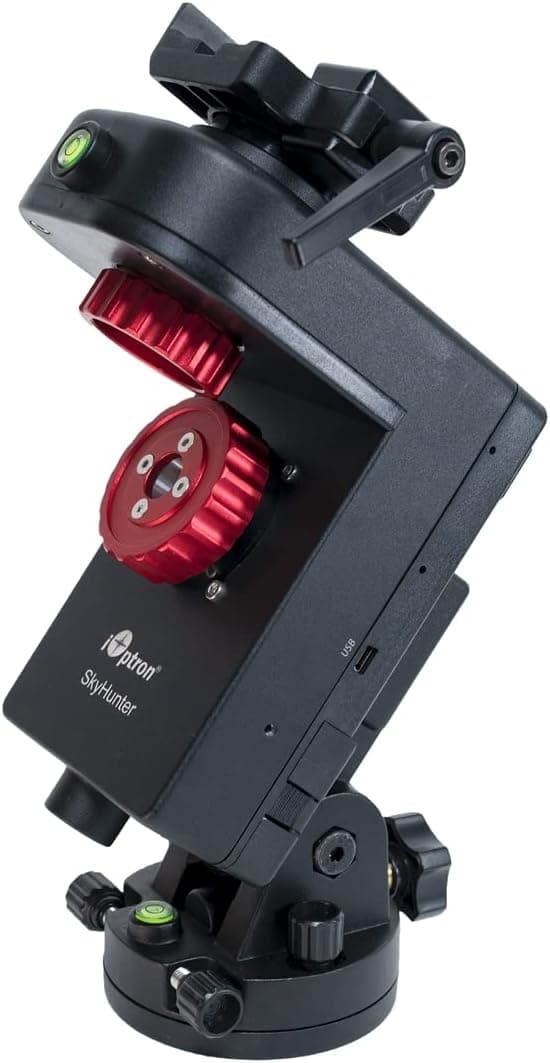
iOptron SkyHunter portable EQ/AZ GoTo system, a compact computerized mount with 11 lb payload.
Price range: See on Amazon
What we liked
- + Switches between EQ and AZ modes for visual or photographic use
- + 11 lb payload handles small refractors and camera setups
- + Compact size is ideal for travel and quick backyard sessions
Trade-offs
- - 11 lb limit rules out larger telescopes and heavy imaging rigs
- - Small mount can be sensitive to wind when fully loaded
Who this mount fits
The SkyHunter targets observers who want GoTo convenience in a package small enough to pack in carry-on luggage or store in a closet between sessions. Because it switches between equatorial mode for tracking and astrophotography and altazimuth mode for straightforward visual use, it appeals to people who want one mount that covers both casual planet-and-Moon viewing and light wide-field imaging with a small refractor or camera lens. It is a strong fit for travelers heading to dark-sky sites without checked luggage room for a full tripod-and-head combo, and for backyard users who value quick setup over raw carrying capacity. Anyone planning to mount a mid-size telescope, a DSLR with a long lens, or serious deep-sky imaging gear should look elsewhere, since the SkyHunter's whole design trades payload for portability.
Specs and design explained
The mount head itself weighs about 2.9 pounds including its internal battery and supports up to 11 pounds, 5 kilograms, when properly balanced, in either equatorial or altazimuth mode. It offers four selectable tracking rates, sidereal, half-sidereal for combined sky-and-landscape shots, solar and lunar, covering both nighttime deep-sky targets and daytime or twilight solar and lunar imaging. Dual-axis DC servo motors with optical encoders drive the tracking, and the built-in rechargeable lithium battery is rated for up to about 10 hours of continuous operation before needing a recharge. Control options include a smartphone or tablet app over built-in Wi-Fi compatible with iOptron Commander and SkySafari, an optional Go2Nova 8410 hand controller, or a computer connection using ASCOM or INDI drivers. The mount attaches to any sturdy photo tripod through a standard 3/8 inch threaded stud and includes a Vixen-style dovetail saddle for the optical tube.
Living with it day to day
Setup revolves around threading the mount onto a compatible tripod, balancing the payload within the 11 pound limit, and running through the app or hand controller's alignment routine before GoTo slewing becomes accurate. Because the battery is built in rather than swappable, owners plan sessions around the roughly 10-hour runtime and recharge between outings rather than carrying spare battery packs, which simplifies the kit but means a dead battery ends the session. Switching between equatorial and altazimuth modes is part of the mount's core design, so users moving between casual visual nights and occasional imaging sessions do not need a second mount, just a different physical orientation and alignment procedure. Care is straightforward: keep the mount's Wi-Fi module and connectors dry, avoid loading it near its 11 pound ceiling in windy conditions since a lightweight mount is more sensitive to gusts, and store it in a padded case for travel given how much its portability depends on avoiding drops.
Trade-offs and how it compares
The defining trade-off is the 11 pound payload limit, which is generous for a mount this light but firmly rules out mid-size refractors, most reflectors, and heavier astrophotography rigs with guide scopes and full-frame cameras attached. Against the Sky-Watcher HEQ5, which carries up to 30 pounds but weighs roughly 33 pounds assembled before counterweights, the SkyHunter is a completely different category built for grab-and-go use rather than serious imaging payload, so the two are not really interchangeable for the same buyer. Within its own class of ultra-portable mounts, the dual equatorial-and-altazimuth switching and four tracking rates give it more flexibility than a fixed single-mode travel mount, which is the SkyHunter's real differentiator rather than raw carrying capacity. Wind sensitivity at the payload limit is the practical downside owners report, so keeping the load comfortably under the rated maximum improves stability.
Verdict and who should choose differently
For a traveler or casual backyard observer who wants computerized tracking and the flexibility to shoot light astrophotography without hauling heavy gear, the SkyHunter's blend of portability and dual-mode operation supports our score of 8.4 out of 10 for fit and features. Anyone planning to mount a telescope heavier than a small refractor, or building toward serious deep-sky imaging with guide scopes and larger cameras, should choose a higher-payload mount like the HEQ5 instead, since pushing the SkyHunter near its 11 pound limit compromises tracking steadiness. Observers who mainly want a no-tracking, purely manual setup for the lowest cost and simplest operation may also find the SkyHunter's GoTo features and app-based alignment more than they actually need for casual Moon-and-planet viewing.
Frequently asked questions
Can the SkyHunter be used for astrophotography?
Yes, its equatorial mode with sidereal tracking supports light astrophotography with small refractors or camera lenses within its 11 pound payload limit, though it is not built for heavy deep-sky imaging rigs.
How long does the battery last?
The built-in rechargeable battery is rated for up to about 10 hours of continuous operation at room temperature before it needs recharging.
Does it need a special tripod?
No, it attaches to any sturdy photo tripod with a standard 3/8 inch threaded stud, so many owners use their existing camera tripod.
How do you control the mount for GoTo pointing?
It connects over built-in Wi-Fi to a smartphone or tablet app such as iOptron Commander or SkySafari, or it can use an optional Go2Nova 8410 hand controller or a computer via ASCOM or INDI.
Prices change often, so check the current price and availability on Amazon.
Check price on AmazonStargazer Nest may earn a commission from the link above.