Sky-Watcher EvoStar 80 APO Doublet Refractor - Compact Portable Optical Tube for Astrophotography (S11100) Review (2026)
Updated September 21, 2026 · Research-based review
Our verdict
An 80mm f/7.5 apochromatic doublet refractor with a 600mm focal length, positioned as an entry point into deep sky astrophotography at a friendlier price than larger EvoStar models. It includes a diagonal, eyepieces and a finderscope for visual use, but like other tubes here, it needs a mount and imaging accessories bought separately.
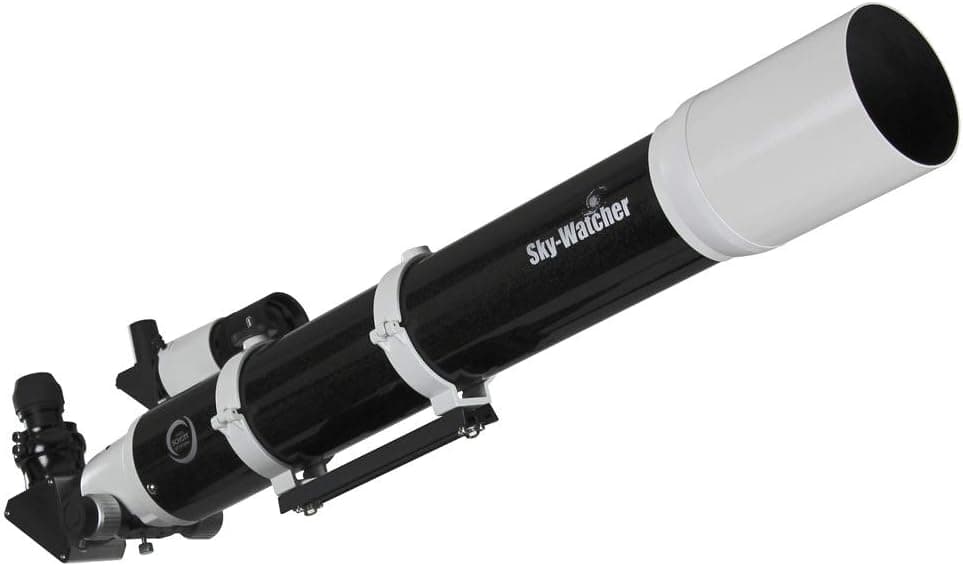
Sky-Watcher EvoStar 80 APO doublet OTA, a compact refractor aimed at entry-level deep-sky astrophotography.
Price range: See on Amazon
What we liked
- + Popular focal length for first imaging setups on modest mounts
- + APO doublet optics give crisp stars at a friendly entry price
- + Compact size stores easily and is quick to cool down outdoors
Trade-offs
- - Sold as an optical tube, so a mount and imaging accessories add to the cost
- - Stock focuser may need care with heavy cameras and filter wheels
A middle ground focal length for first imaging setups
The EvoStar 80, sold under part number S11100, is an 80mm apochromatic doublet refractor with a 600mm focal length and an f/7.5 focal ratio, sitting between the wider field EvoStar 72 and the longer focal length EvoStar 100 in Sky-Watcher's APO lineup. That middle ground focal length makes it a popular choice for observers moving into deep sky astrophotography for the first time, since 600mm is long enough to resolve meaningful detail in medium sized nebulae and galaxies while still being forgiving of small mount tracking errors compared with longer focal length scopes. The doublet objective uses Schott BK-7 glass paired with FPL-53 ED glass, an air spaced two element design intended to minimize false color.
What is included for visual use
Unlike a bare optical tube, this EvoStar 80 kit includes a 2 inch dual speed Crayford style focuser, a 2 inch dielectric diagonal, two 1.25 inch eyepieces at 5mm and 25mm focal lengths, an 8x50mm right angle finderscope, tube rings and a V-style dovetail plate, giving a buyer everything needed for visual observing straight out of the case aside from a mount. The tube itself uses an aluminum housing with a glossy black diamond metal flake finish and ships in a foam lined aluminum case, matching the presentation of the larger EvoStar 100. Metallic High-Transmission Coatings on the optics are intended to virtually eliminate false color across the included eyepiece range.
Moving from visual to imaging
For observers planning to add a camera later, the 600mm focal length at f/7.5 works well with common astronomy camera sensor sizes without needing as aggressive a field flattener correction as faster, shorter focal length scopes sometimes require, though a flattener is still recommended for pinpoint stars across a full frame. The dual speed focuser's fine adjustment ring becomes especially useful once a camera replaces an eyepiece, since achieving critical focus by eye through a viewfinder or live view screen benefits from smaller, more controlled focus movements than a single speed focuser allows.
Mount and accessory considerations
At 80mm aperture, this scope needs a mount with more carrying capacity than the smaller EvoStar 72 but less than the larger EvoStar 100, making a mid size equatorial mount a reasonable match for either visual or light imaging use. Buyers should budget for a field flattener if they plan to image, since one is not included with the optical tube, and a sturdy mount remains the single biggest factor in how satisfying an experience this scope delivers, since even excellent optics will show star trailing or blur on an undersized or poorly polar aligned mount.
Verdict and how it compares
The EvoStar 80 ranks fifth among apochromatic telescopes in this comparison, trailing the larger EvoStar 100 and 72 as well as two SVBONY triplet models, reflecting a more modest aperture relative to its stablemates even as it remains a capable, well rounded choice. Its blend of a complete visual accessory kit, a friendly entry level price and a versatile 600mm focal length make it a sensible first apochromatic refractor for someone stepping up from a basic achromatic scope, while more experienced imagers chasing maximum resolving power will likely outgrow it in favor of a larger aperture or a triplet design.
Frequently asked questions
What is the aperture and focal length?
It is an 80mm aperture refractor with a 600mm focal length and an f/7.5 focal ratio.
Does it include eyepieces and a finderscope?
Yes, it includes two 1.25 inch eyepieces, a 2 inch dielectric diagonal and an 8x50mm right angle finderscope.
Is this a good first telescope for astrophotography?
Its 600mm focal length is a common entry point for deep sky imaging, though a field flattener and a suitable mount are needed separately.
What glass does the objective use?
It uses a doublet of Schott BK-7 glass and FPL-53 ED glass with Metallic High-Transmission Coatings to reduce false color.
Prices change often, so check the current price and availability on Amazon.
Check price on AmazonStargazer Nest may earn a commission from the link above.