SVBONY SV550 Telescope - 80ED F6 Triplet Apochromatic Refractor OTA, 2.5in Focuser for Deep Sky Astrophotography Review (2026)
Updated September 20, 2026 · Research-based review
Our verdict
The SVBONY SV550 pairs an 80mm FPL51 triplet apo lens with an f/6 ratio and a 2.5 inch dual-speed focuser rated to carry 5 kilograms of gear. Its 480mm focal length and 180mm dovetail suit deep-sky astrophotography, though a triplet needs longer to reach thermal balance and a field flattener still helps on full-frame sensors.
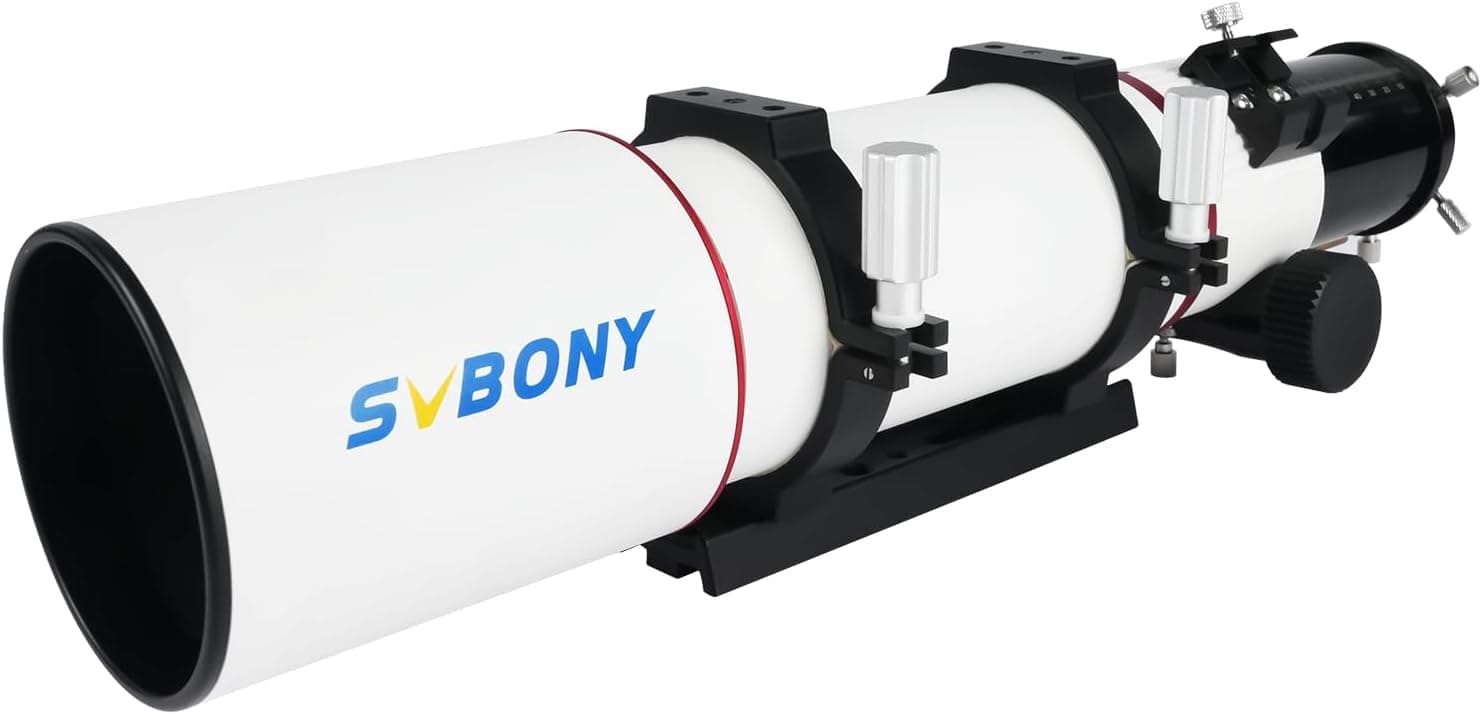
SVBONY SV550 80ED F6 triplet apochromatic refractor OTA with 2.5in focuser, built for deep-sky astrophotography.
Price range: $ (Budget)
What we liked
- + Triplet apochromatic optics give excellent color correction for imaging
- + F6 focal ratio balances field of view and exposure speed for deep-sky work
- + 2.5in focuser supports heavy cameras and accessories securely
Trade-offs
- - Triplet glass needs longer to reach thermal balance on cold nights
- - Field flattener is still recommended for full-frame or large sensors
Optical design and what triplet apochromatic means
The SV550 uses an 80mm objective built from three lens elements, including FPL51 extra-low dispersion glass, arranged in a triplet apochromatic design that corrects chromatic aberration more thoroughly than the simpler doublet refractors common at this aperture. SVBONY lists a 480mm focal length, giving an f/6 focal ratio, along with a resolving power of about 1.45 arcseconds and a limiting stellar magnitude near 11.6, figures aimed squarely at deep-sky imaging rather than lunar and planetary work where a longer focal length would be more useful. Fully multi-coated optics and internal light baffles are built in to reduce stray light and improve contrast on faint extended targets like nebulae and galaxies.
The 2.5 inch dual-speed focuser
A 2.5 inch rack-and-pinion focuser with a 1 to 10 dual-speed reduction handles fine focus adjustments, an important feature for astrophotography where even a slightly soft focus is far more visible on a camera sensor than at the eyepiece. SVBONY rates the focuser's load capacity at 5 kilograms, enough to carry a dedicated astronomy camera, filter wheel, and off-axis guider without the focuser drawtube sagging under the weight, a common failure point on cheaper focusers pushed beyond their rated capacity. Total focuser travel runs about 80 millimeters, giving enough range to reach focus across different camera and adapter combinations.
Tube construction and mounting hardware
The optical tube is built from aluminum with a 103 millimeter outer diameter, finished with a retractable dew shield that extends to protect the front lens element from dew and stray light during a session and slides back for compact storage afterward. A standard 180 millimeter dovetail plate is included for mounting to most equatorial and alt-azimuth mounts without needing a separate dovetail purchase, and an M63x1 female thread on the rear of the focuser accepts photographic adapters for cameras and other imaging accessories. SVBONY lists the OTA's net weight at about 3.75 kilograms, or roughly 8.3 pounds, a figure worth checking against a mount's total payload rating before adding a full imaging train of camera, filter wheel, and guide scope on top of the bare tube.
Where thermal balance and field flattening still matter
Triplet apochromatic refractors like the SV550 use thicker glass elements than a simple doublet design, and that extra glass mass typically takes longer to reach thermal equilibrium with the outside air on a cold night, a process during which star images can appear slightly softer until the tube's internal temperature stabilizes. For imagers using larger APS-C or full-frame sensors, SVBONY and most refractor makers still recommend adding a matched field flattener, since even a well-corrected triplet objective can show some field curvature toward the edges of a large sensor that a flattener specifically corrects for.
How it compares to other apochromatic telescopes on the site
In the site's Best Apochromatic Telescopes guide, the SV550 80ED ranks first of seven, ahead of SVBONY's own larger 122mm triplet APO and doublet refractors from Sky-Watcher and William Optics at similar or slightly smaller apertures. Its top ranking reflects a combination of triplet optics, a heavy-duty dual-speed focuser, and a 5 kilogram load rating at a price point below several of the doublet alternatives ranked just behind it, though buyers wanting a larger aperture for fainter targets may prefer SVBONY's own 122mm sibling model higher up the same lineup instead.
Frequently asked questions
What is the focal length and focal ratio of the SVBONY SV550?
It has an 80mm aperture with a 480mm focal length, giving an f/6 focal ratio.
How much weight can the SV550's focuser carry?
SVBONY rates the 2.5 inch dual-speed focuser's load capacity at 5 kilograms, enough for a dedicated astro camera, filter wheel, and off-axis guider.
Do I need a field flattener with this telescope?
SVBONY still recommends a matched field flattener for larger APS-C or full-frame sensors, since some field curvature remains toward the edges of a large sensor without one.
How much does the SV550 optical tube weigh?
SVBONY lists the net weight at about 3.75 kilograms, or roughly 8.3 pounds, for the tube alone.
Prices change often, so check the current price and availability on Amazon.
Check price on AmazonStargazer Nest may earn a commission from the link above.