Sky-Watcher EvoStar 100 APO Doublet Refractor - Compact Portable Optical Tube for Astrophotography & Visual Review (2026)
Updated September 21, 2026 · Research-based review
Our verdict
A 100mm f/9 ED doublet refractor tube with a 900mm focal length and a 2.8 inch dual speed Crayford focuser, sold with eyepieces and a diagonal but no mount. Its ED glass keeps color fringing well controlled for visual and imaging use, though it needs a sturdy mount and a field flattener for the best astrophotography results.
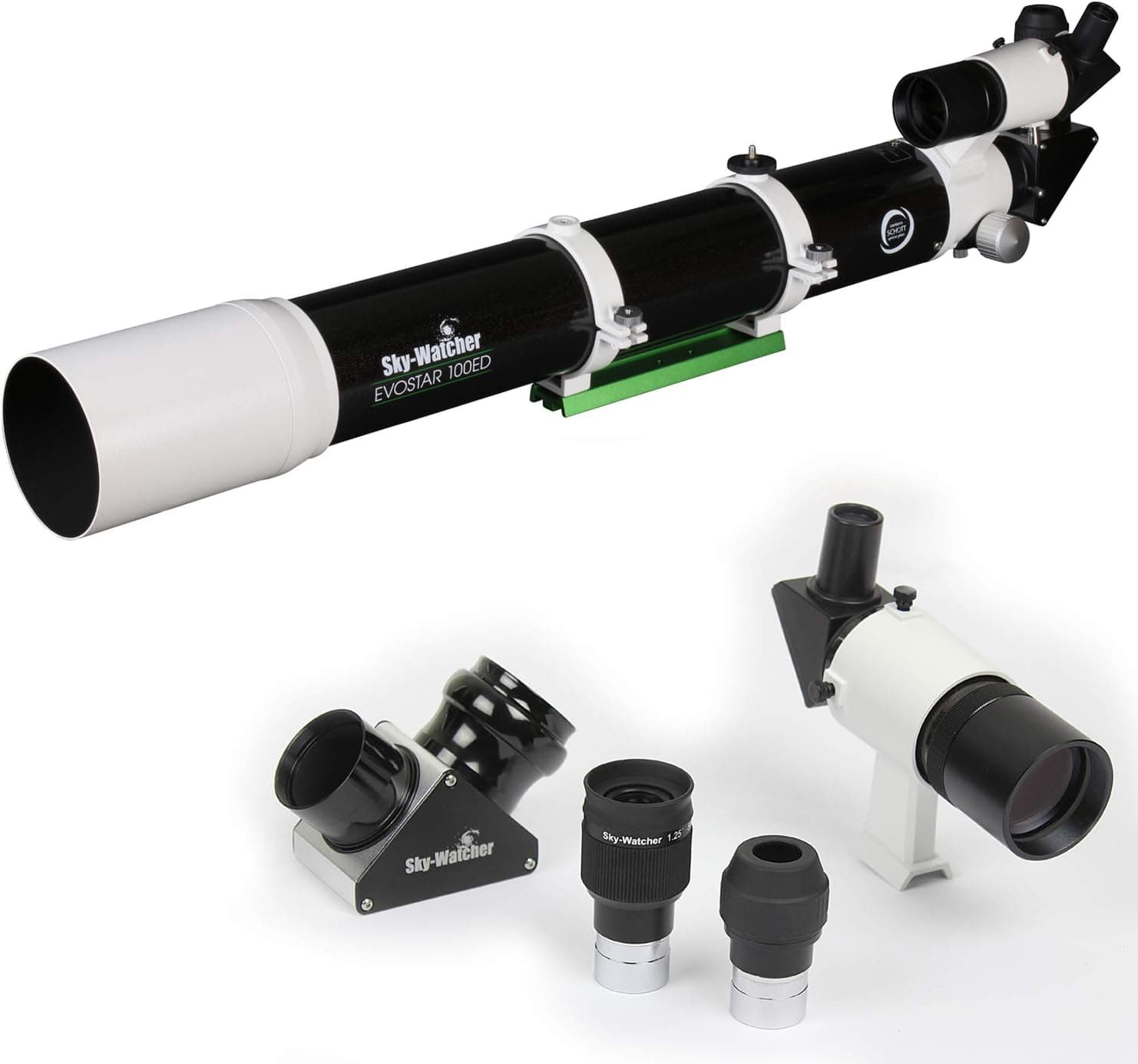
Sky-Watcher EvoStar 100 APO doublet, a compact portable refractor OTA suited to both astrophotography and visual use.
Price range: See on Amazon
What we liked
- + ED doublet optics give sharp, well-corrected views for visual and imaging
- + Compact tube works on mid-size mounts for portable imaging rigs
- + Versatile focal length handles star clusters, the Moon and bright nebulae
Trade-offs
- - Doublet design shows slightly more residual color than premium triplets
- - Needs a field flattener for flat stars across larger camera sensors
What the EvoStar 100 is built for
This EvoStar model, sold under part number S11120, is a 100mm apochromatic doublet refractor optical tube with a 900mm focal length and an f/9 focal ratio, positioning it as a versatile scope for both visual observing and astrophotography rather than one optimized purely for either task. The doublet objective combines a crown glass element with an ED glass element, using multicoated air spaced construction intended to reduce false color compared to cheaper achromatic refractors of similar aperture. At f/9 it has a longer focal ratio than faster imaging focused refractors, which suits planetary and lunar detail and close double stars well, while still working for wider deep sky targets with the right camera and reducer combination.
Optical performance and included accessories
The tube ships as a complete optical assembly including a right angle 8x50mm finderscope with bracket, a 2 inch dielectric diagonal, two 1.25 inch long eye relief eyepieces at 25mm and 5mm focal lengths, a 1.25 inch focuser adaptor, and tube ring hardware compatible with standard dovetail mounting systems. That accessory bundle means a buyer does not need to source a diagonal or starter eyepieces separately to begin visual observing, though anyone planning to image will still want to add a field flattener and a dedicated astronomy camera. The 2.8 inch dual speed Crayford style focuser uses roller bearings for smooth, precise focus adjustments, which matters more at longer focal lengths like this scope's 900mm where small focus errors are more visible.
Build quality and portability
The optical tube uses an aluminum housing with a glossy black diamond finish, and it ships in a foam lined aluminum case designed to protect the tube during transport to a dark site or star party. At 100mm aperture and 900mm focal length, the tube is compact enough to travel in a car trunk without dominating the space, though it still needs a mid size equatorial or alt-az mount capable of comfortably carrying its weight along with a diagonal, eyepiece or camera and any imaging accessories. Buyers moving up from a smaller aperture scope should budget for a mount upgrade if their existing mount was sized for a lighter optical tube.
Visual and imaging use
For visual use, the 100mm aperture and ED doublet design deliver noticeably sharper, higher contrast views than a comparable achromatic refractor, particularly on the Moon, planets and bright double stars where color fringing is most obvious in lesser optics. For imaging, the 900mm focal length and f/9 ratio work well for smaller targets like planetary nebulae and galaxies but require a field flattener to keep stars sharp across a full frame camera sensor, since without one, stars toward the edges of an image will show some distortion. As with most doublet designs at this price point, a small amount of residual color fringing remains visible on very bright stars compared with premium triplet apochromats, though it stays well controlled for the vast majority of visual and imaging targets.
Verdict and how it compares
This EvoStar 100 ranks third among apochromatic telescopes in this comparison, behind two SVBONY SV550 models that use a triplet design at a similar or larger aperture, and just ahead of Sky-Watcher's own smaller EvoStar 72 and 80 models. Its combination of included eyepieces, diagonal and finderscope makes it a more complete visual package out of the box than some rival optical tubes, while its longer 900mm focal length suits smaller, more detailed targets better than the shorter focal length EvoStar 72. Buyers deciding between EvoStar sizes should weigh this scope's slightly heavier mount requirements against its larger aperture and correspondingly better resolving power.
Frequently asked questions
What is the aperture and focal length?
It is a 100mm aperture refractor with a 900mm focal length and an f/9 focal ratio.
Does it come with eyepieces?
Yes, it includes two 1.25 inch long eye relief eyepieces at 25mm and 5mm, along with a diagonal and an 8x50mm finderscope.
Do I need a field flattener for astrophotography?
Yes, a field flattener is recommended to keep stars sharp across a full camera frame, since the scope does not include one.
What kind of mount does it need?
It needs a mid size equatorial or alt-az mount rated to comfortably carry the optical tube along with a diagonal, eyepiece or camera and accessories.
Prices change often, so check the current price and availability on Amazon.
Check price on AmazonStargazer Nest may earn a commission from the link above.