Steiner Commander 7x50 Marine Binoculars with HD-Stabilized Compass, Waterproof Boating Optics, Auto-Focus Review (2026)
Updated September 20, 2026 · Research-based review
Our verdict
Steiner's Commander 7x50 is a premium marine binocular with a built-in bearing compass and an auto-focus system tuned for a moving deck rather than a tripod. Stargazers get durable, waterproof optics and a wide field of view, but the auto-focus trades away the fine close focus a dedicated astronomy binocular offers.
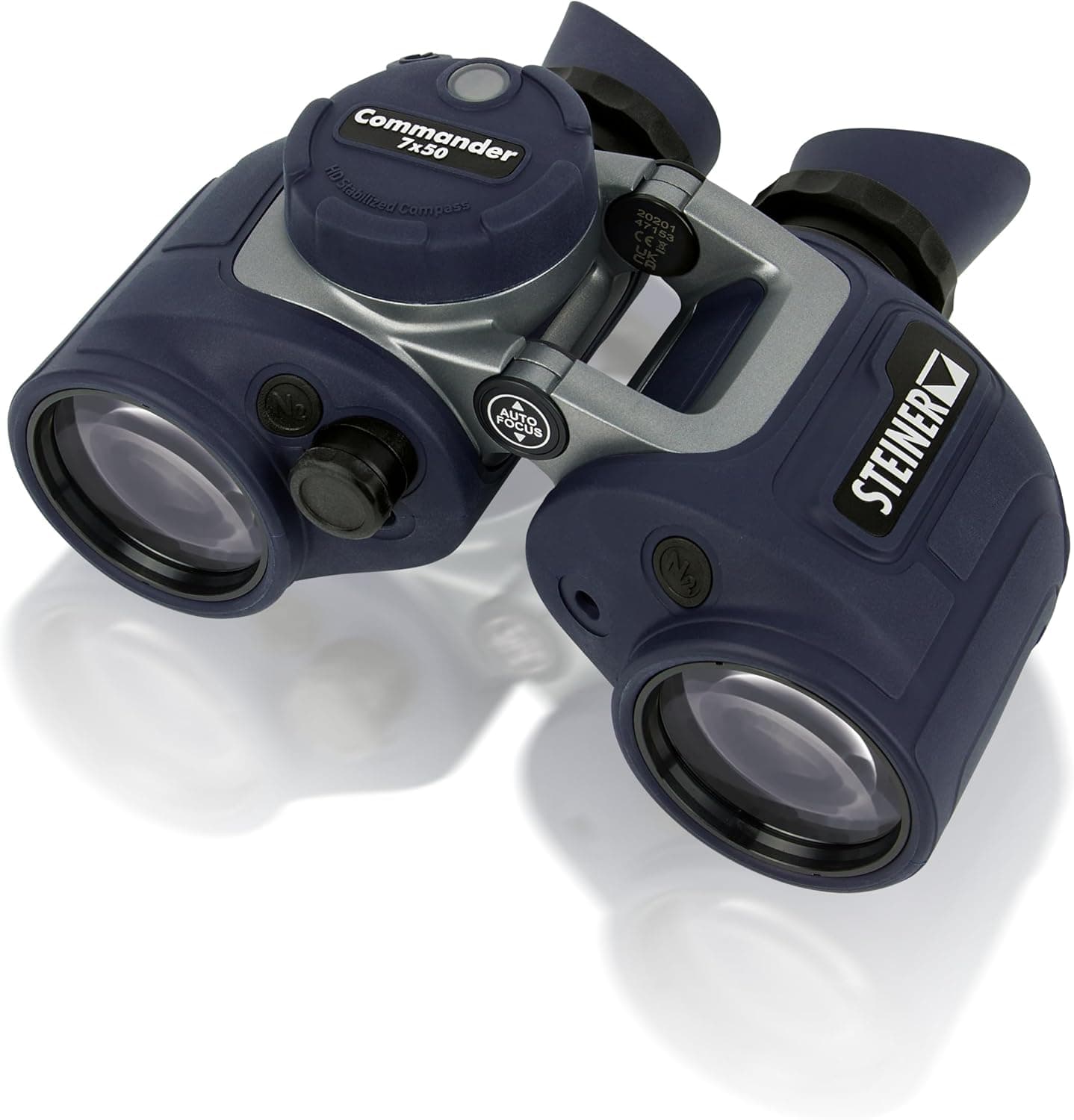
Steiner Commander 7x50 marine binoculars with HD-stabilized compass and auto-focus, a premium waterproof boating pair.
Price range: See on Amazon
What we liked
- + HD-stabilized compass holds steady bearings even on a moving boat
- + Auto-focus design keeps objects sharp from mid-range to the horizon
- + Commander line is built for professional-level marine use
Trade-offs
- - Auto-focus approach is less precise for close objects and star points
- - High price is aimed at serious sailors rather than casual users
What the Commander line is built for
Steiner designs the Commander 7x50 primarily as a boating and navigation binocular, pairing 7x magnification with 50mm objective lenses for a bright, wide view suited to scanning open water, shorelines, and night skies alike. The 7x50 combination is a long-standing favorite for handheld astronomy because it gathers enough light for star clusters and the Milky Way while staying steady enough to hold without a tripod for extended periods, unlike higher-power giant binoculars that all but require one. Steiner's nitrogen-filled, O-ring-sealed housing makes it fog-proof and waterproof, a durability level built for a marine environment that comfortably exceeds what casual stargazing from a backyard or dark-sky site normally demands.
The HD-stabilized compass
A compass reticle is built into the binocular's field of view, superimposed at the edge of the image along with a graticule for estimating distance to an object, letting a boater read a bearing without lowering the binoculars. Steiner markets this as an HD-stabilized design intended to stay steady and readable even when the boat is moving, which is the feature's main selling point over a basic fixed compass. For stargazing, the compass has no real function beyond a rough sense of direction when scanning the sky, but it does not get in the way of the view either, sitting at the frame's edge rather than the center.
Auto-focus versus manual focus for astronomy
Rather than a center focus wheel, the Commander uses Steiner's Sports-Auto-Focus system, where each eyepiece is focused individually once and then holds a sharp image from roughly 20 yards out to infinity without further adjustment. That works well for scanning distant objects on water or in the sky, since stars are effectively at infinity and need no refocusing between targets. It is less convenient than a manual center-focus binocular for anyone who also wants to use the same pair for closer subjects, such as reading a chart or watching wildlife nearby, where a quick manual focus adjustment would normally be faster than resetting the auto-focus eyepieces.
Build quality and handling
The open-bridge body design is meant to be easy to grip with one hand, and Steiner's nano-protection coatings on the outer lens surfaces are intended to shed water and resist scratching in a marine environment, both useful traits for a binocular that may end up outside on damp, dewy nights. Steiner backs the Commander with its Heritage warranty, reflecting the brand's positioning at the higher end of the marine optics market. That build quality and price point are aimed at buyers who want one serious, rugged binocular for boating, hunting, and stargazing, rather than a budget pair used for astronomy alone.
Where it ranks and who should buy it
In the site's Best Marine Binoculars guide this Commander ranks first of eight, ahead of Bushnell's Marine 7x50 with internal rangefinder, Steiner's own lower-tier Marine 7x50, and several other Bushnell 7x50 models with digital or standard compasses. Its combination of auto-focus, an HD-stabilized compass, and Steiner's marine-grade waterproofing explains the top spot in that comparison, though the high price positions it toward serious sailors and dual-purpose buyers rather than anyone shopping purely for casual stargazing. Astronomy-first buyers on a tighter budget may find a simpler, cheaper 7x50 with manual focus a better fit if boating features are not needed.
Frequently asked questions
Is this binocular useful for astronomy?
Yes, the 7x50 combination is a common handheld astronomy specification, gathering enough light for star clusters and wide sky views without needing a tripod.
Does the auto-focus work well for looking at stars?
Yes, since stars sit effectively at infinity, the auto-focus eyepieces hold a sharp view once set, though closer subjects need a manual center-focus binocular instead.
Is it waterproof?
Steiner's nitrogen-filled, O-ring-sealed housing makes it fog-proof and waterproof, built for a marine environment.
What does the built-in compass do?
It overlays a bearing reticle and distance graticule at the edge of the view, designed to stay stable and readable even on a moving boat.
Prices change often, so check the current price and availability on Amazon.
Check price on AmazonStargazer Nest may earn a commission from the link above.