ZWO Seestar S50 Astronomical All-in-One Smart Telescope - App-Controlled Autofocus Astrophotography Review (2026)
Updated September 14, 2026 · Research-based review
Our verdict
The ZWO Seestar S50 turns astrophotography into a phone app experience, combining a 50mm refractor, focuser, camera, and mount into one unit that finds and stacks images of galaxies and nebulae on its own. It suits beginners and light polluted city dwellers, though there is no eyepiece to look through and planetary detail stays basic.
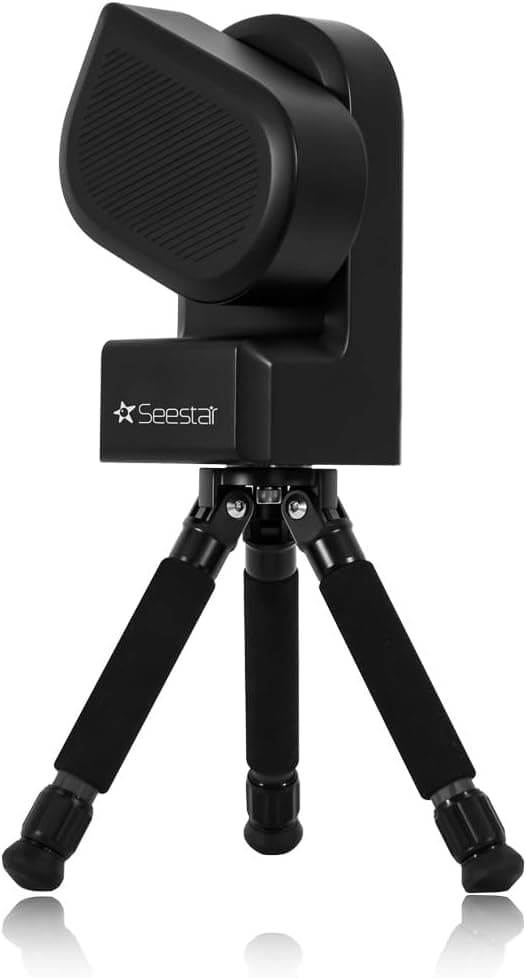
ZWO Seestar S50, an all-in-one smart telescope with app control and autofocus for easy deep-sky astrophotography.
Price range: $ (Budget)
What we liked
- + Autofocus and app control handle the technical steps that stop most imaging beginners
- + All-in-one design combines optics, camera and mount in a single small unit
- + Live stacking reveals nebulae and galaxies even from light-polluted suburbs
Trade-offs
- - Small aperture gives modest resolution on planets compared with traditional scopes
- - Viewing is on a screen only, so there is no eyepiece for visual observing
Who the all in one design is really for
The Seestar S50 is aimed squarely at people who want deep sky astrophotography results without first learning polar alignment, guiding, and stacking software, which is normally the steep on ramp into the hobby. ZWO built the telescope, mount, camera, focuser, and light pollution filters into one sealed unit that sets up on its included tripod and connects to a phone over Wi-Fi. That makes it a strong fit for apartment dwellers and suburban backyards under light polluted skies, since the built in dual band filter helps cut through sky glow that would otherwise wash out faint targets. Traditional visual observers who want to look through an eyepiece at the Moon in real time will find this is not that instrument, since every view happens on a phone or tablet screen instead. It suits the growing group of hobbyists who care more about the final image than the observing ritual itself.
What the 50mm apochromatic optics and sensor deliver
Inside the compact 2.5kg body sits a 50mm aperture apochromatic triplet refractor with a 250mm focal length and f/5 focal ratio, paired with a Sony IMX462 sensor producing 1920 by 1080 resolution images. Built in filters include a UV and IR cut filter plus a dual band OIII and Hydrogen alpha filter that boosts contrast on emission nebulae under city skies. The alt azimuth mount uses software to emulate equatorial tracking during long exposures, a workaround that keeps the unit compact but can introduce slight field rotation and slightly noisier corners on longer stacked exposures. A 6000mAh internal battery powers around six hours of continuous use, though cold weather and active dew heating shorten that runtime noticeably. The whole package ships with a carbon fiber tripod, carrying case, solar filter for daytime Sun viewing, and a USB-C charging cable.
What a session actually looks like
Setup means unfolding the included tripod, powering on the unit, and connecting through the ZWO app, after which the telescope can automatically identify and slew to a chosen deep sky target and begin stacking exposures live on screen. Results build visibly over several minutes, with galaxies and nebulae like the Whirlpool Galaxy or Orion Nebula becoming clearer as more subframes stack, which is genuinely satisfying for a first time user watching a nebula emerge from a plain city sky. The narrow 1080p sensor frames some larger targets awkwardly since it is oriented in portrait rather than landscape, occasionally cutting off wide objects at the edges. Manual centering adjustments are possible through the app when auto plate solving needs a nudge, though this takes a little practice to do smoothly. Because everything runs through the app, there is no traditional eyepiece to align your eye to, which is either a non issue or a dealbreaker depending on why you got into astronomy.
Where it comes up short against rivals
Planetary views stay basic since the 50mm aperture and fixed sensor cannot resolve fine detail the way a longer focal length dedicated planetary setup can, so Jupiter appears as a small, simple disc rather than a richly detailed target. The Vaonis Vespera 3 offers a longer battery life and larger internal storage at a higher price point, appealing to users who want to shoot longer sessions without recharging. ZWO's own Seestar S30 Pro trims aperture further but adds a dual camera and higher resolution imaging chip, which may suit users prioritizing image detail over light gathering. Compared with a traditional manual telescope and separate camera setup, the Seestar S50 trades ultimate image quality and customization for dramatically simpler operation, a trade most beginners will happily accept.
The bottom line on this smart telescope
For anyone who has wanted to try astrophotography but found polar alignment, guiding, and post processing intimidating, the Seestar S50 removes nearly all of that friction while still producing genuinely pleasing images of nebulae, galaxies, and star clusters from a backyard or balcony. Our score of 9.2 out of 10 reflects how well it delivers on that specific promise, even though it is not a replacement for a traditional telescope if visual observing through an eyepiece matters to you, and it will not out resolve dedicated planetary imaging rigs on Jupiter or Saturn. Buyers who mainly want deep sky images with minimal setup effort, especially from light polluted areas, are the ideal audience, while visual purists and serious planetary imagers should look elsewhere.
Frequently asked questions
Can you look through the Seestar S50 like a normal telescope?
No, there is no traditional eyepiece. All viewing happens through the live image on the connected phone or tablet app, which is by design since the unit combines a camera, mount, and filters into one automated system.
How long does the battery last?
ZWO rates the built in 6000mAh battery at about six hours of continuous use, though cold temperatures and features like an active dew heater will reduce that runtime.
Is it good for viewing planets?
Planetary detail is limited by the 50mm aperture and fixed sensor, so Jupiter and Saturn appear as small, fairly basic views rather than the detailed images the unit can produce on nebulae and galaxies.
Does it work well under city light pollution?
Yes, the built in dual band filter is specifically designed to cut through sky glow, and reviewers have reported usable images of targets like the Orion Nebula from light polluted locations.
Prices change often, so check the current price and availability on Amazon.
Check price on AmazonStargazer Nest may earn a commission from the link above.