SVBONY SV194 T-Ring Adapter 48mm Compatible with Nikon SLR DSLR Cameras Telescope Photography Review (2026)
Updated September 14, 2026 · Research-based review
Our verdict
The SVBONY SV194 is a 48mm T-ring adapter that connects Nikon SLR and DSLR bodies to telescopes using the wider M48 thread instead of standard T2. It is a precise, well-made accessory for anyone running M48 adapters and flatteners, but the wrong part for Nikon mirrorless cameras or a T2 setup.
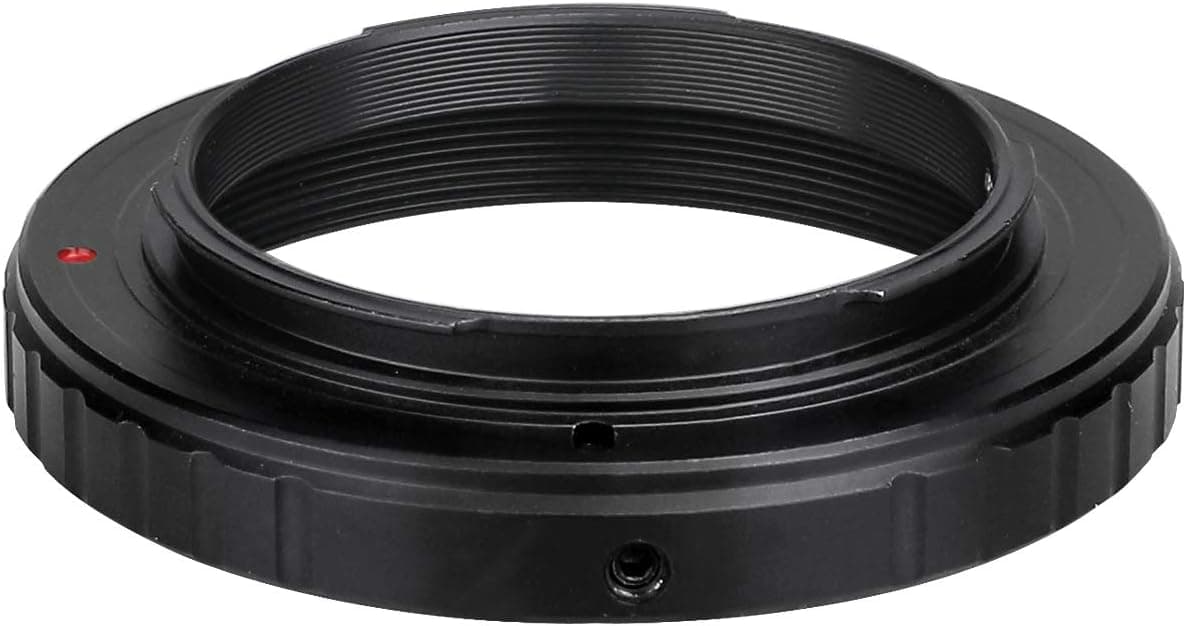
SVBONY SV194 48mm T-ring adapter compatible with Nikon SLR and DSLR cameras for telescope photography.
Price range: See on Amazon
What we liked
- + 48mm wide thread reduces vignetting on large sensors
- + Nikon compatibility covers many SLR and DSLR bodies
- + Ideal for pairing with 2 inch telescope adapters and flatteners
Trade-offs
- - 48mm threads need matching accessories, unlike standard T2
- - Not suitable for Nikon mirrorless cameras without an adapter
Who this camera adapter is for
This is a part for an astrophotographer who owns a Nikon SLR or DSLR body and is building a telescope imaging train around wider M48 threaded accessories rather than the older, narrower T2 standard. Because it uses the M48 by 0.75 thread instead of the common 42mm T2 thread, it specifically suits owners of field flatteners, extension tubes or reducers that were designed around the larger M48 opening, which is common on many modern refractors sold for astrophotography. It is not the right choice for someone shooting with a Nikon mirrorless body, since those cameras use a different mount and need their own adapter rather than an SLR or DSLR T-ring. Buyers should confirm their telescope-side adapter and flattener also use M48 threads before ordering, since mixing M48 and T2 parts without a step-down ring will not connect.
Specs and design explained
The SV194 is machined from aluminum with a CNC-cut, black anodized finish, listed at a compact 26.3 grams, so it adds negligible weight to a camera and telescope combination. The Nikon side uses an F-mount bayonet fitting that locks onto the camera body the same way a Nikon lens would, while the telescope side presents a 48mm by 0.75 female thread that threads directly onto matching M48 male accessories such as extension tubes or a Barlow lens. Grub screws set around the ring's perimeter let an owner fine-tune the rotational position of the camera before locking it down, which matters for framing a target correctly in a fixed imaging train. Because it is a purely mechanical adapter, there is no electrical contact between the camera and the telescope, so aperture and focus still have to be set manually on the lens or telescope side.
Setting it up and living with it
Fitting the adapter is a one-time task, twisting it onto the Nikon body like a lens and then threading the telescope-side M48 opening onto a matching accessory, after which the whole assembly should stay together for a session rather than being removed and reattached repeatedly. Because the wider 48mm opening is a known way to reduce vignetting on larger APS-C and full-frame Nikon sensors compared with a narrower T2 adapter, owners doing wide-field astrophotography tend to prefer it specifically for that reason. There is essentially no maintenance beyond keeping the threads free of grit, since cross-threading a metal adapter under dust or sand can damage the fine 0.75 pitch threads over time. Owners who swap between a DSLR and a dedicated astro camera on the same scope often keep this adapter permanently mounted to the camera body so the telescope-side thread is always ready to connect.
Trade-offs and how it compares with rivals
Against SVBONY's own T2 adapters for Canon EOS bodies, which the site's own guide ranks higher in this camera T-ring category, the SV194 fills a narrower niche since it serves Nikon SLR and DSLR shooters specifically working with M48 rather than T2 accessories. Compared with a standard Celestron T-ring for Nikon, which uses the common 42mm T2 thread, the SV194's wider 48mm opening is the better pick for anyone whose flattener or reducer was designed around M48, but the wrong pick for anyone with an existing T2 imaging train, since the two thread sizes are not interchangeable without a step ring. Buyers should check their exact accessory chain before ordering rather than assuming M48 and T2 parts are equivalent.
Verdict and who should pick something else
For a Nikon SLR or DSLR owner building an M48 imaging train, this adapter is a solid, precisely made connector, and our score of 8.4/10 reflects strong build quality for a simple mechanical part. Buyers with a Nikon mirrorless body should skip this adapter entirely and look for a mirrorless-specific T-ring instead, since the F-mount bayonet will not fit those camera bodies. Buyers whose telescope-side accessories use the standard 42mm T2 thread rather than M48 should choose a matching T2 Nikon adapter instead, or add a T2-to-M48 step ring if they specifically need to bridge the two standards.
Frequently asked questions
What is the difference between a 48mm T-ring and a standard T2 adapter?
The 48mm M48 thread is wider than the classic 42mm T2 thread, which reduces vignetting on larger camera sensors but requires the rest of the imaging train to use matching M48 threaded accessories.
Does the SVBONY SV194 work with Nikon mirrorless cameras?
No, it uses an F-mount bayonet built for Nikon SLR and DSLR bodies, so Nikon mirrorless cameras need a different, mount-specific T-ring adapter instead.
Does this adapter let the camera control aperture or autofocus through the telescope?
No, it is a purely mechanical connector with no electrical contacts, so aperture and focus are set manually rather than through the camera's electronics.
Can I attach a Barlow lens to this adapter?
Yes, as long as the Barlow lens uses a matching 48mm male thread, since the SV194's telescope-side opening is a 48mm by 0.75 female thread designed to accept M48 accessories.
Prices change often, so check the current price and availability on Amazon.
Check price on AmazonStargazer Nest may earn a commission from the link above.