Sky-Watcher Heritage 130mm Tabletop Dobsonian 5-inch Aperture Telescope - Collapsible Design (S11705) Review (2026)
Updated September 14, 2026 · Research-based review
Our verdict
The Sky-Watcher Heritage 130 is a collapsible tabletop Dobsonian balancing a useful 5.1 inch mirror with a package light enough for kids or casual grab-and-go sessions. It shows Saturn's rings and bright deep-sky targets clearly, though it needs a stable table and the folding tube can shift collimation slightly.
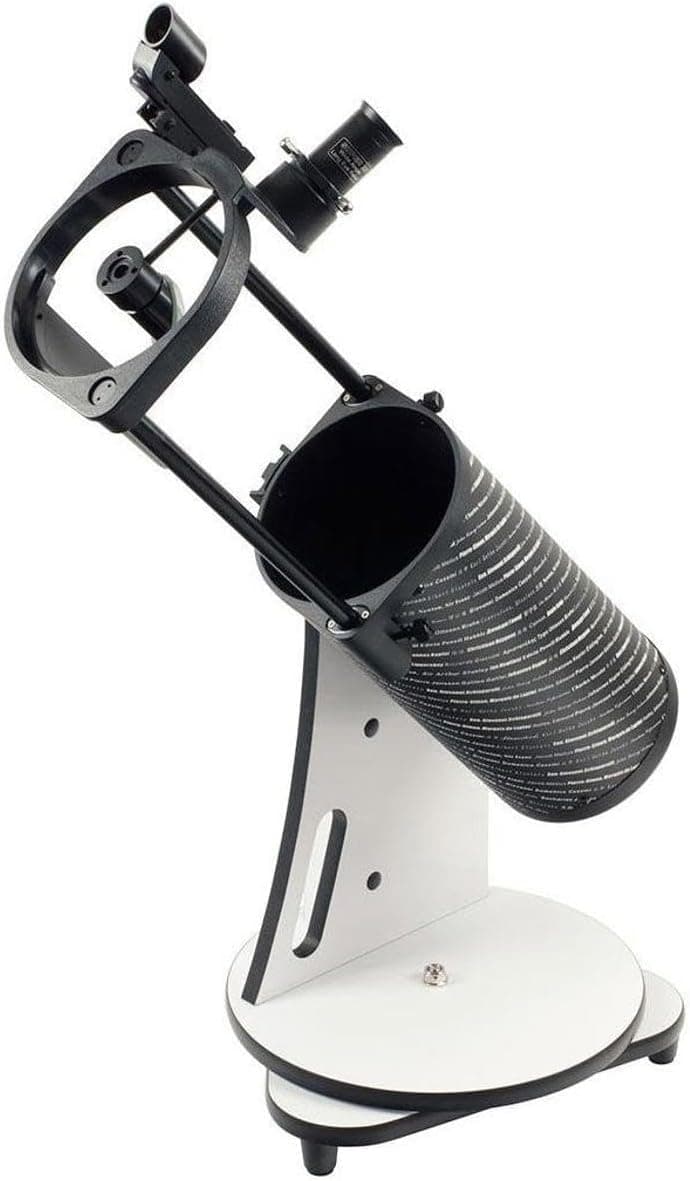
Sky-Watcher Heritage 130mm, a 5-inch collapsible tabletop Dobsonian that balances aperture with easy portability.
Price range: See on Amazon
What we liked
- + 5-inch aperture shows Saturn's rings, Jupiter's moons and bright deep-sky targets
- + Collapsible tube design makes it one of the easier Dobsonians to store and transport
- + Lighter than the larger Heritage model, so it suits kids and casual backyard sessions
Trade-offs
- - Needs a table or stable surface outdoors, which not every observing site provides
- - Collapsing tube can shift collimation slightly, so a quick check before viewing helps
Who this telescope fits
The Heritage 130 targets beginners and casual observers who want more light-gathering power than a small refractor without the bulk of a floor-standing Dobsonian. Its 130mm parabolic mirror is large enough to show Saturn's rings clearly, resolve Jupiter's cloud bands and moons, and pull in brighter deep-sky targets like star clusters and some nebulae under reasonably dark skies, while still packing down small enough for a car trunk or closet shelf. Because it sits on a table rather than needing its own tripod, it is a lighter and less expensive path to real aperture than an equatorial or GoTo system, and the collapsible truss tube makes it noticeably easier to transport than a fixed-tube telescope of similar size. It suits families with children who want to carry and set up the scope themselves, and observers who value simplicity over motorized tracking or GoTo pointing.
Specs and design explained
The telescope uses a 130mm, about 5.1 inch, parabolic primary mirror with a 650mm focal length, an f/5 system that favors bright, wide views suited to both casual sweeping and moderate planetary magnification. Supplier listings put total weight at less than 14 pounds, and the collapsible truss design folds the tube down to about 14.5 inches for storage, considerably smaller than its roughly 3.5 foot extended length. It ships with a 10mm and a 25mm eyepiece, giving both a wider, lower-power view and a closer, higher-power view of the Moon and planets, along with a red dot finder for aiming and a 1.25 inch helical focuser for fine adjustment. The primary mirror uses Sky-Watcher's Radiant Aluminum Quartz coating rated at up to 94 percent reflectivity, and the simple tabletop Dobsonian base needs no polar alignment or electronics to begin observing.
Living with it day to day
Setup is meant to take only a couple of minutes: unfold and lock the collapsible truss struts, place the base on a sturdy table, porch railing or similar stable surface, and start observing without any star-alignment routine. The Dobsonian base moves smoothly by hand in both directions, and observers nudge the tube periodically to keep a target centered as the sky drifts, since there is no motorized tracking. Because the tube collapses rather than staying rigid, the folding action can shift the mirror's alignment slightly between sessions, so a quick collimation check, especially after transport, helps keep images sharp; this is a normal part of owning this design rather than a defect. Basic care includes keeping the mirrors free of dust with a blower rather than direct wiping, storing the folded telescope somewhere dry, and finding a genuinely stable table or stand, since a wobbly surface undermines the view more than almost any other factor with a tabletop scope.
Trade-offs and how it compares
Against the larger Heritage 150, the 130 gives up some light-gathering power and resolved detail on fainter deep-sky targets, but it is lighter and easier for a child or single adult to carry fully assembled, making it the better pick when portability matters more than maximum aperture. Compared with fixed-tube tabletop reflectors like the Orion SkyScanner or Zhumell Z130 in similar aperture classes, the Heritage's collapsible truss folds down smaller for storage, though the open truss structure exposes the optical path to more stray light and dew than a closed tube, which some owners address with an add-on shroud. The need for a stable table is a trade-off shared by every tabletop Dobsonian design, not unique to this model, but it is worth planning for since an unstable surface will show up as image shake regardless of how good the optics are.
Verdict and who should pick something else
For a beginner or family wanting real aperture in the smallest, lightest package that still folds down for storage, the Heritage 130 is a strong choice, consistent with our score of 8.6 out of 10 for fit and portability. Buyers who want the largest possible mirror and are willing to carry more weight for it should compare against the Heritage 150 instead, since it gathers meaningfully more light in a similarly collapsible design. Observers who mainly want the least maintenance and best protection from dew and stray light should also consider a closed-tube tabletop reflector, and anyone wanting motorized GoTo tracking should look outside the manual Dobsonian category entirely, since neither Heritage model includes tracking or a computerized mount.
Frequently asked questions
Does the Heritage 130 need a special table or stand?
It needs a sturdy, stable surface such as a strong table, bench or railing, since the base itself has no legs, and a wobbly surface will noticeably affect the view.
What comes included with the telescope?
Listings describe a 10mm and 25mm 1.25 inch eyepiece, a red dot finder, a helical focuser and the collapsible truss tube on its tabletop Dobsonian base.
Does the folding tube need to be recollimated every time?
Not every time, but the collapsible design can shift alignment slightly during transport, so a quick collimation check before an important viewing session is a sensible habit.
How does it compare to the Heritage 150?
The Heritage 130 is lighter and easier to carry, while the Heritage 150 has a larger mirror that gathers more light, so the choice comes down to prioritizing portability or aperture.
Prices change often, so check the current price and availability on Amazon.
Check price on AmazonStargazer Nest may earn a commission from the link above.