JJC Intervalometer Timer Remote Shutter Release Time Lapse for Nikon D750 D780 Z7 Z6 D7200 D5600 D610 Review (2026)
Updated September 14, 2026 · Research-based review
Our verdict
This JJC wired intervalometer suits Nikon owners who want dependable time lapse, night-sky trail and bulb timing across both older DSLRs and newer Z-series mirrorless bodies. The main strength is broad Nikon compatibility in one compact remote, and the trade-off is a small button-and-LCD interface with no wireless or app control.
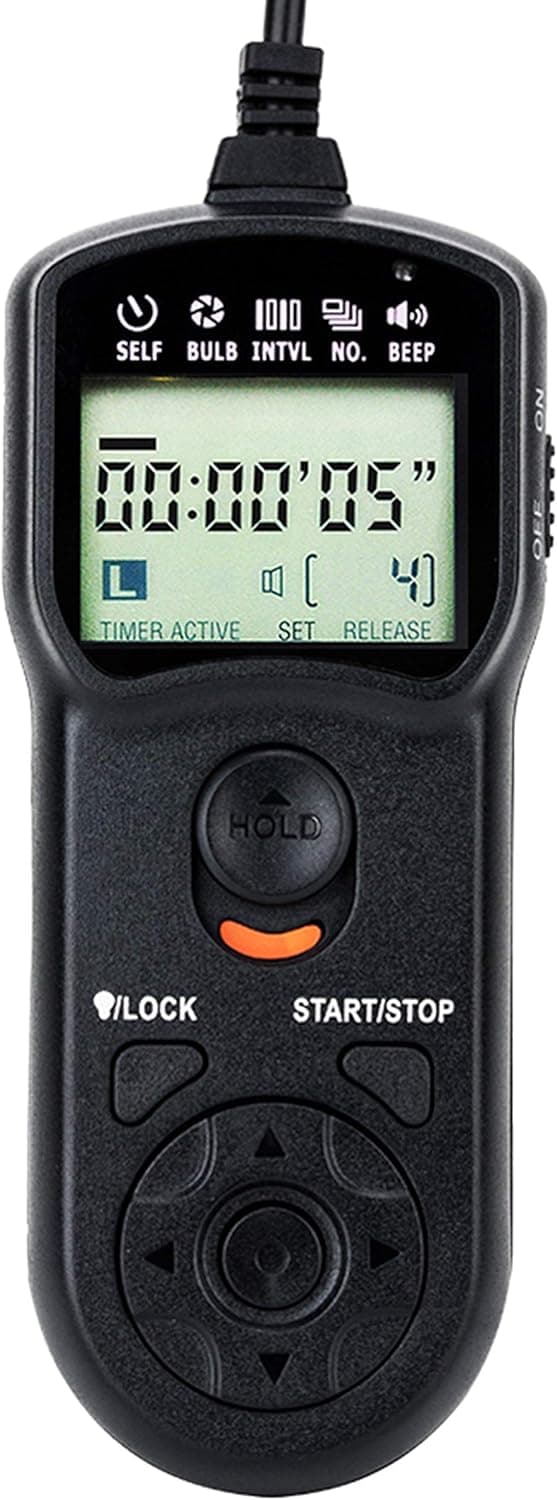
JJC intervalometer timer remote shutter release for time lapse on Nikon D750, D780, Z7, Z6, D7200, D5600 and D610.
Price range: $ (Budget)
What we liked
- + Supports newer Nikon mirrorless Z7 and Z6 as well as DSLRs like the D750
- + Time lapse and bulb timing suit star trails and meteor shower sessions
- + JJC is a well-known maker of camera remote accessories
Trade-offs
- - Nikon only, so switching camera brands means buying another remote
- - Button-based programming is fiddly with gloves on cold nights
Who This Remote Is Built For
This is a dedicated Nikon accessory aimed at astrophotographers who already own a Nikon DSLR or one of the newer Z-series mirrorless bodies and need automated exposures the camera cannot do on its own. Time lapse sequences of the Milky Way rising, trail-exposure stacks that need dozens of identical long exposures, and meteor shower sessions where the shutter has to fire every few seconds all call for this kind of interval timer. Because it plugs into a standard Nikon remote port, it covers a long list of bodies from the D750 and D780 through the D7200, D5600, D610 and the Z6 and Z7 mirrorless line. Anyone shooting a single Nikon body for the long haul gets more value from this than from a universal remote that has to compromise on connector fit.
What Is In The Box And How It Works
The controller itself measures about 12.1 by 4.0 by 2.1 centimeters and connects to the camera through a wired cable roughly 90 centimeters long, so there is no pairing or signal drop to worry about. It runs on two AAA batteries and keeps a backlit LCD screen that stays readable once the sky goes fully dark. Four core functions cover most astro use cases: a plain self-timer, an interval timer for time lapse, a long-exposure bulb timer for shots beyond the camera's own 30-second ceiling, and an exposure-count setting. Delays, exposure times and intervals can be dialed in from one second up to 99 hours, 59 minutes and 59 seconds in one-second steps, and the remote can also fire the shutter manually with no batteries installed at all.
Living With It Through A Night Of Shooting
Setup is straightforward: plug the cable into the camera's remote port, set the mode with the mode button, then dial in delay, exposure length and shot count with the up and down buttons before locking the settings in. Because every setting is entered through small physical buttons rather than a touchscreen or phone app, programming a long trail-exposure sequence takes a bit of practice, and doing it with thick winter gloves on is genuinely fiddly, which matches what buyers of this style of remote commonly report. The backlit screen helps at a dark site since you are not fumbling with a headlamp to read tiny digits. Because it is wired rather than wireless, there is no battery drain on the camera side from a receiver and no risk of radio interference from other gear at a crowded astronomy meetup.
Where It Falls Short Against Rival Remotes
The clearest limitation is that this is a Nikon-only accessory, so switching to a Canon or Pentax body later means buying an entirely different remote rather than reusing this one. Several rival intervalometers in this category, including multiple Neewer models, are sold in Canon and Pentax versions as well as older Nikon DSLR versions, which gives shooters with mixed camera bags more flexibility even if none of them cover the newer Nikon Z mirrorless line the way this one does. JJC is a long-established maker of camera remotes and cables, which is reassuring for build quality, but the feature set here is intentionally basic: no wireless link, no smartphone app, and no HDR bracketing automation that some higher-end intervalometers now include.
Final Verdict For Nikon Astro Shooters
For a Nikon shooter who wants a reliable, no-frills way to run time lapse, trail-exposure or bulb sequences overnight, this intervalometer does the core job well and covers an unusually wide span of Nikon bodies in one product. It earns our score of 8.4 out of 10 mainly on fit for the job, since compatibility with both DSLRs and Z-series mirrorless is rare in a single budget remote. Buyers who shoot with more than one camera brand, or who want wireless triggering and phone-based control, should look at a higher-tier wireless intervalometer instead, accepting the extra cost for that flexibility.
Frequently asked questions
Does this intervalometer work with Nikon Z mirrorless cameras?
Yes, it is listed as compatible with Nikon Z6 and Z7 series mirrorless bodies as well as a long list of Nikon DSLRs such as the D750, D780, D7200 and D610.
Is the remote wired or wireless?
It is a wired remote with roughly a 90 centimeter cable that plugs directly into the camera's remote port, so there is no wireless pairing involved.
What power does it need?
It runs on two AAA batteries, and it can still fire the shutter manually as a basic remote release even without batteries installed.
Can it be used for rotating night-sky trail exposures and meteor showers, not just daytime time lapse?
Yes, its interval and bulb timer functions are suited to long-exposure night sequences like rotating trail shots and meteor shower captures, in addition to standard time lapse.
Prices change often, so check the current price and availability on Amazon.
Check price on AmazonStargazer Nest may earn a commission from the link above.