Baader 1.25 inch and 2 inch 8-24mm Hyperion Universal Mark IV Zoom Eyepiece HYP-Zoom Review (2026)
Updated September 14, 2026 · Research-based review
Our verdict
The Baader Hyperion Universal Mark IV zoom eyepiece covers 8mm to 24mm in one barrel that fits both 1.25 inch and 2 inch focusers, letting an observer swap magnification with a twist. It suits observers who value flexibility and a fine tuned parfocal zoom, though it costs several times more than a budget zoom eyepiece.
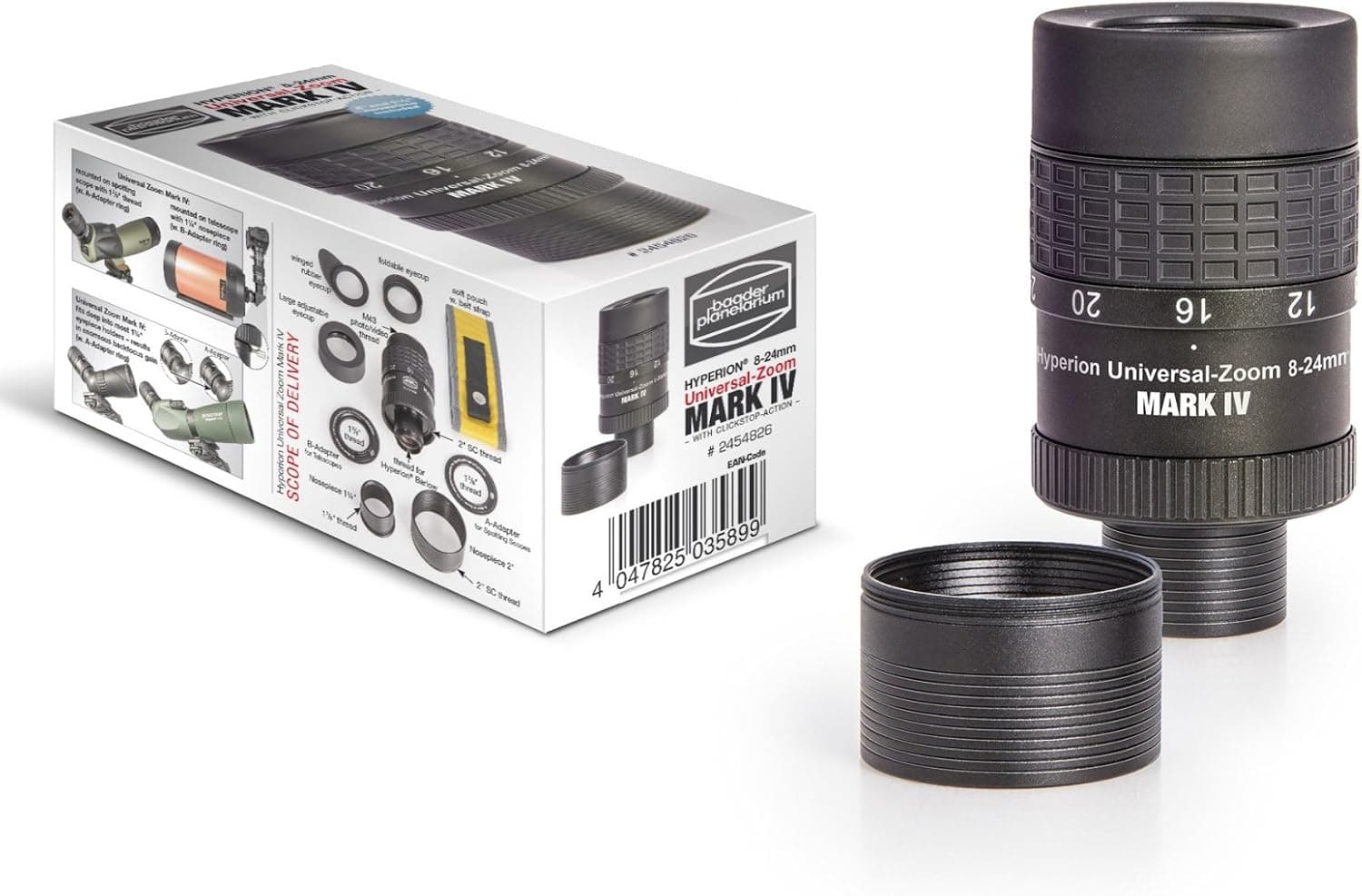
Baader Hyperion Universal Mark IV 8-24mm zoom eyepiece, HYP-Zoom, usable with both 1.25 inch and 2 inch focusers.
Price range: See on Amazon
What we liked
- + Fits 1.25 inch and 2 inch focusers, so it moves between small and large telescopes
- + Baader Hyperion zoom is widely regarded as one of the best zoom eyepieces for astronomy
- + Universal design supports adapters for camera projection and binoviewer use
Trade-offs
- - Premium price is several times that of budget zoom eyepieces
- - Heavier and taller than simple zooms, which can shift balance on small scopes
Who a premium universal zoom eyepiece suits
The Hyperion Mark IV zoom is built for observers who want the convenience of adjusting magnification on the fly, useful when seeing conditions change through a session or when quickly comparing views of a planet at different powers without swapping eyepieces and losing focus each time. Its universal 1.25 inch and 2 inch barrel design means the same eyepiece moves between a small grab and go telescope and a larger 2 inch focuser equipped scope, appealing to observers who own more than one telescope or who travel between setups. Astrophotographers also use it for camera projection and binoviewer work thanks to its adapter compatible design, extending its usefulness beyond simple visual observing. Budget conscious beginners building a first eyepiece collection will likely find better value starting with a few fixed focal length eyepieces before investing in a premium zoom like this one.
How the zoom range and optical design work
Click stop detents land at 8mm, 12mm, 16mm, 20mm, and 24mm, with continuously variable focal length available between those stops, so fine tuning magnification does not require jumping between fixed increments. The apparent field of view varies across the zoom range, running about 68 degrees at the 8mm setting and narrowing to around 50 degrees at 24mm, a genuine trade-off compared with fixed wide field eyepieces that hold a constant field width. Baader's seven element optical design aims for sharpness and color correction across that zoom range, and the Mark IV revision specifically improved parfocal tuning, meaning the image stays close to in focus as you twist between focal lengths rather than needing a refocus at every step. Eye relief runs 12 to 15mm depending on setting, and the eyepiece weighs 290 grams, noticeably heavier than a simple fixed focal length eyepiece given its internal zoom mechanism.
What using the zoom feels like at the telescope
Twisting through the zoom range while observing a planet or the Moon lets an observer dial in the sharpest, steadiest magnification for the current seeing conditions in real time, which is a genuinely different experience from swapping physical eyepieces and losing your place in the field. The near parfocal behavior of the Mark IV means most twists between adjacent click stops need only a small focus touch up rather than a full refocus, saving time during a session focused on planetary or lunar detail. The included large adjustable eyecup, small rigid eyecup, and winged eyecup for eyeglass wearers let observers match eye relief comfort to their own viewing style, and the soft carrying pouch with belt strap keeps the eyepiece protected and accessible in the field. At 290 grams plus whichever barrel and adapters are attached, it does add noticeable weight to a focuser, worth checking against a telescope's focuser tension and counterweight needs.
Weighing it against budget zoom eyepieces
Budget options like the SVBONY SV191 or SV171 zoom eyepieces cover similar 7 to 24mm ranges at a fraction of the price, making them attractive for observers wanting to try a zoom eyepiece without a major investment, though they generally do not match the Hyperion's parfocal tuning or field width consistency across the range. The Celestron 93230 8mm to 24mm zoom and Orion's Pro Lanthanum zoom sit in a similar mid tier price bracket, offering a middle ground between budget zooms and the Hyperion's premium build and optical refinement. Orion's 7.2 to 21.5mm zoom offers slightly more eye relief at 15mm across its range, appealing to eyeglass wearers who prioritize comfort. The core decision for most buyers comes down to whether the Hyperion's smoother parfocal zoom and universal barrel compatibility justify its considerably higher price over these alternatives.
The bottom line on this zoom eyepiece
For observers who want one eyepiece that adapts to changing seeing conditions, works across both 1.25 inch and 2 inch telescopes, and holds focus reasonably well while zooming, the Hyperion Universal Mark IV remains one of the most respected zoom eyepieces in amateur astronomy, reflected in our score of 9.2 out of 10. Its price sits well above basic zoom eyepieces, so it makes most sense for observers who already understand the convenience a zoom offers and are ready to pay for a more refined version of that experience. Buyers on a tighter budget who just want to try the zoom eyepiece concept should start with a less expensive option before considering this premium universal design.
Frequently asked questions
Does the Hyperion Mark IV zoom fit both 1.25 inch and 2 inch focusers?
Yes, it includes both barrel sizes, with the 2 inch barrel attaching through an included adapter ring using standard 2 inch by 24tpi SCT threads, so it moves between smaller and larger telescopes.
Do you need to refocus every time you zoom?
The Mark IV revision improved parfocal tuning so the image stays close to in focus across most of the zoom range, meaning only a small focus touch up is usually needed rather than a full refocus at each click stop.
How much does the field of view change across the zoom range?
The apparent field of view runs about 68 degrees at the 8mm setting and narrows to around 50 degrees at 24mm, so wider views are available at lower power settings.
Is it worth the price over a budget zoom eyepiece?
It costs several times more than budget zoom eyepieces from brands like SVBONY, and the premium goes toward smoother parfocal performance and build quality, which matters most to observers who already value what a zoom eyepiece offers.
Prices change often, so check the current price and availability on Amazon.
Check price on AmazonStargazer Nest may earn a commission from the link above.