Neewer Digital Timer Remote Shutter Release Intervalometer for Nikon D90 D600 D3200 D5300 D7000 DSLR Review (2026)
Updated September 14, 2026 · Research-based review
Our verdict
Sold as a replacement for Nikon's own MC-DC2 cord, this digital timer remote covers a specific range of consumer and midrange Nikon DSLRs from the D90 through the D7000, making it an affordable dedicated intervalometer for Nikon-only shooters. Canon, Pentax and pro-body Nikon owners need a different Neewer model.
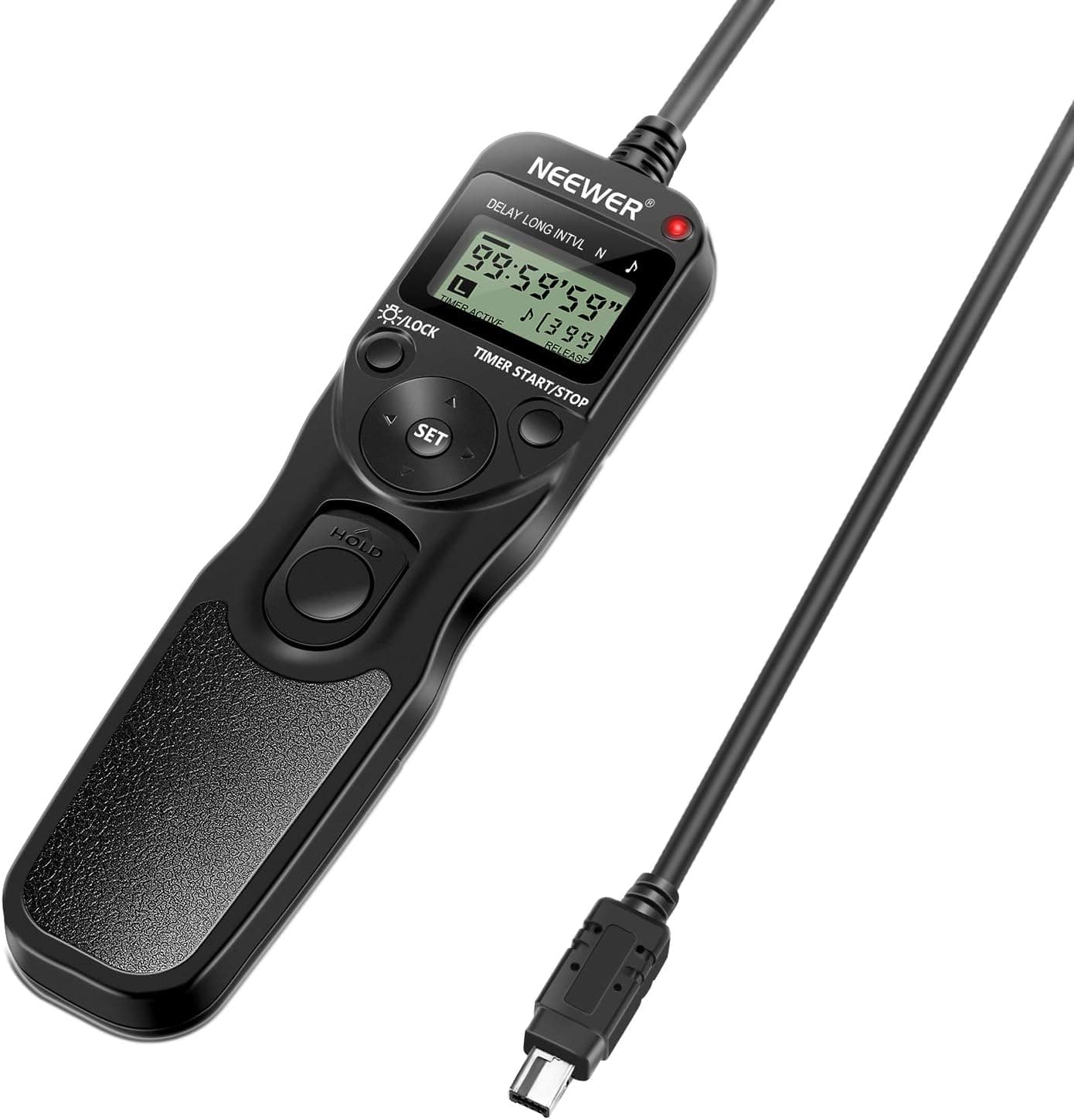
Neewer digital timer remote shutter release intervalometer for Nikon D90, D600, D3200, D5300 and D7000 DSLRs.
Price range: $ (Budget)
What we liked
- + Compatible with many popular Nikon DSLRs
- + Digital timer enables long exposures and timelapse sequences
- + Affordable remote for night sky photography
Trade-offs
- - Nikon only, so other brands need a different model
- - Cable connection can be fragile if bent frequently
Who this Nikon remote is built for
This digital timer remote is built specifically for consumer and midrange Nikon DSLRs, listed by Neewer as compatible with the D90, D600, D610, D3100, D3200, D3300, D5000, D5100, D5200, D5300 and D7000, and it is sold as a replacement for Nikon's own MC-DC2 remote cord. It suits Nikon shooters doing night-sky trails, timelapses or long bulb exposures who want a dedicated cord rather than a multi-brand kit with unused plugs. Because it mirrors the MC-DC2 connector, owners upgrading from an older Nikon body within this range can often keep using the same remote. Canon or Pentax shooters, or Nikon owners with a pro body like the D800 or D810, need a different Neewer model since this cord only fits the consumer-level round connector used across this specific Nikon lineup.
Specs and design in plain English
The remote is a cord-connected controller with a digital LCD screen, powered by two AAA batteries, and like the rest of this Neewer timer family it can be programmed from 1 second up to 99 hours, 59 minutes and 59 seconds. The screen shows delay, exposure time, interval and number of shots together so a full sequence can be set up in one pass rather than menu diving. The shutter button on the remote is two-stage, a half press focuses the camera and a full press fires the shutter, matching the behavior of the camera's own button. Neewer states battery life of roughly two months of regular interval shooting under typical settings, which is a reasonable benchmark for occasional weekend astrophotography rather than daily continuous use.
Living with it after dark
Because this remote replaces the MC-DC2 cord, setup is a simple plug-in with no pairing or app required, which suits a dark site where fumbling with a phone screen ruins night vision. For a night-sky trail or Milky Way timelapse, the delay setting lets the camera settle after touching the tripod, the exposure and interval fields control frame spacing, and the shot count field decides how long the whole sequence runs unattended. Being wired rather than wireless means there is no signal to lose partway through a long sequence, though the cord does tie the controller to a fixed distance from the camera. Owners moving between a few different Nikon bodies within the compatible range, say a D90 and a D7000, can share one remote rather than buying a new cord for each camera.
Trade-offs and how it compares
Set against Neewer's Canon-focused LCD remote, this is effectively the Nikon counterpart, same interval timer logic on a different connector, so the choice between them comes down purely to camera brand rather than capability. Compared with the brand's pro-level interval meter built for Nikon D700, D800 and D810 bodies, this consumer cord is not interchangeable, the round MC-DC2-style port on D90 through D7000 bodies differs from the connector used on professional Nikon bodies. Build quality is consistent with the rest of the lineup, a plastic-bodied cord remote rather than a metal one, so it should be coiled loosely and stored away from sharp bends in a camera bag. Shooters wanting a backlit multi-line LCD with more shot capacity may want to compare against Neewer's higher-end wired remotes before settling on this one.
Verdict and who should look elsewhere
For Nikon owners with a D90, D600, D3200, D5300, D7000 or similar body in this range, this remote is a straightforward and affordable way to add interval shooting and long bulb exposures, reflected in our score of 8.4 out of 10 for fit and value. It is the wrong choice for Canon or Pentax shooters, and for Nikon owners with a professional body like the D800 or D810, both groups need a different connector entirely. Anyone who already owns a working MC-DC2 style remote from Nikon does not need to duplicate the function, but as a lower-cost replacement or backup this cord does the job. Pair it with a sturdy tripod and a full set of spare AAA batteries for the best results on long overnight sequences.
Frequently asked questions
Is this a genuine Nikon remote?
No, it is a third-party Neewer remote built to work as a replacement for Nikon's MC-DC2 cord, matching the same connector and core functions rather than being an official Nikon accessory.
Which Nikon cameras does it fit?
Neewer lists it as compatible with the D90, D600, D610, D3100, D3200, D3300, D5000, D5100, D5200, D5300 and D7000, so confirm your exact model uses the same round connector before ordering.
How long do the batteries last?
Neewer estimates roughly two months of regular interval shooting on two AAA batteries under typical delay, exposure and interval settings, though heavy use or cold weather will shorten that.
Does it work with professional Nikon bodies like the D800?
No, professional Nikon bodies use a different port, so a D800 or D810 owner needs Neewer's dedicated pro-level interval meter remote instead of this consumer cord.
Prices change often, so check the current price and availability on Amazon.
Check price on AmazonStargazer Nest may earn a commission from the link above.