Baader 2 inch Mark III MPCC Multi Purpose Coma Corrector Photographic Version MPCC 2458400 Review (2026)
Updated September 20, 2026 · Research-based review
Our verdict
Baader's 2 inch MPCC Mark III photographic coma corrector removes coma from fast Newtonian reflectors, delivering round stars across a full 35mm sensor from f/3.5 to f/6. It threads into any 2 inch focuser without changing focal length, but correct back focus spacing takes care, and this version favors imaging over visual use.
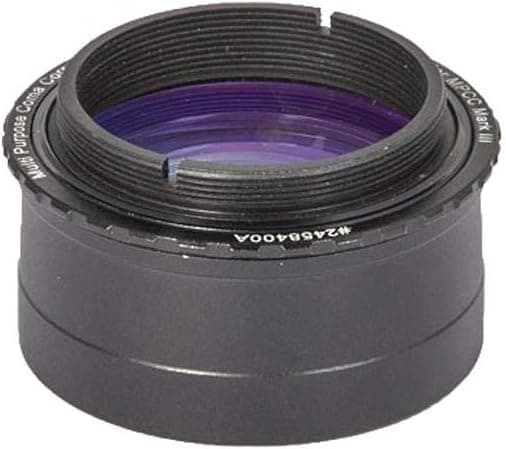
Baader 2 inch Mark III MPCC multi purpose coma corrector, photographic version 2458400.
Price range: $ (Budget)
What we liked
- + MPCC Mark III is a popular choice for Newtonian astrophotography
- + Removes coma to deliver round stars across camera sensors
- + 2 inch format fits most Newtonian focusers
Trade-offs
- - Photographic version is not ideal for visual use
- - T-ring spacing must be set correctly for best results
What a coma corrector fixes
Fast Newtonian reflectors, especially those at f/6 or faster, produce a well known optical flaw called coma, where stars near the edge of the field appear stretched into small comet-like shapes rather than sharp points, an effect that becomes much more visible on a camera sensor than it typically is at the eyepiece. The MPCC Mark III corrects that distortion across the field without altering the telescope's native focal length, so the same focal ratio and image scale calculations still apply once the corrector is installed. Baader's independent lab testing, cited by resellers, found the MPCC delivers stars as small as about 12 microns across a full 35mm sensor, a meaningful claim for anyone shooting with a full frame astro camera on a Newtonian.
Focal ratio range and mounting
This Mark III version is optimized for Newtonians in the f/3.5 to f/6 range, an improvement over the original MPCC design, which was rated only down to f/4, so it now covers a wider range of fast imaging Newtonians without vignetting even at f/3.5. The corrector mounts in any standard 2 inch focuser and offers a 44 millimeter clear aperture through its M48 filter thread, accepting both T-2 threaded photographic adapters at M42x0.75 and 2 inch M48x0.75 threaded adapters depending on the camera setup being used. Baader also includes a removable 2 inch stopping collar, which can be taken off to increase back focus slightly when a particular camera train needs the extra spacing.
Getting the back focus distance right
Because a coma corrector's performance depends on the sensor sitting at a specific distance behind the lens assembly, Baader specifies a back focus of 55 millimeters when using the T-2 M42 thread and 57.7 millimeters with the M48 adapter, and getting that spacing wrong is one of the more common mistakes that leads to disappointing results with any coma corrector, not just this one. An optional adapter is available for direct coupling to a Baader Canon EOS protective T-ring, simplifying the spacing calculation for DSLR imagers using that specific camera mount. Imagers switching between cameras or adding filter wheels and other train components need to recheck the total spacing each time something changes in the optical train.
Photographic version versus visual use
As the name on this listing states, this is the photographic version of the MPCC Mark III, a designation Baader also sells alongside a photo-visual variant intended to perform well for both eyepiece and camera use. Buyers who intend to split time between visual observing and imaging with the same Newtonian should confirm which version fits their needs before ordering, since choosing the imaging-optimized variant for a visual-heavy setup may leave some performance on the table at the eyepiece compared with the dual purpose version. For a telescope used primarily or exclusively for astrophotography, the photographic version is the more straightforward choice.
How it compares to other coma correctors on the site
In the site's Best Coma Correctors guide, this photographic MPCC ranks second of seven, just behind Baader's own photo-visual MPCC V-1 Mark III set, which adds visual-use flexibility to essentially the same optical corrector. Other options in the guide include Explore Scientific's variable coma corrector, Baader's own Rowe Coma Corrector for a narrower focal ratio range, and 2 inch correctors from GSO and Sky-Watcher aimed at similar fast Newtonian astrographs. Buyers who want the option to also observe visually through the same corrector may prefer the photo-visual set ranked just above this one, while dedicated imagers can save a little by choosing this photographic-only version instead.
Frequently asked questions
What focal ratio range does the Baader MPCC Mark III work with?
This Mark III version is optimized for Newtonian reflectors from f/3.5 to f/6, without vignetting even at the fast end of that range.
Does the MPCC change my telescope's focal length?
No, Baader states the corrector introduces no change to the telescope's focal length or field size.
What back focus distance does the MPCC Mark III need?
Baader specifies 55mm with a T-2 M42 thread adapter and 57.7mm with the M48 2 inch adapter.
Is this version suitable for visual observing as well as imaging?
This particular listing is the photographic version; Baader also sells a photo-visual MPCC set for buyers who split time between imaging and eyepiece observing.
Prices change often, so check the current price and availability on Amazon.
Check price on AmazonStargazer Nest may earn a commission from the link above.