Zhumell 10-inch Dobsonian Reflector Telescope, Large Aperture, Solid Base with Handle for Easy Transport Review (2026)
Updated September 14, 2026 · Research-based review
Our verdict
This 10-inch Dobsonian suits an observer ready to move past a starter scope and chase deep-sky detail, with a base built for two-piece transport. The large mirror and simple design are the strengths, and the bulky tube and lack of tracking are the trade-offs.
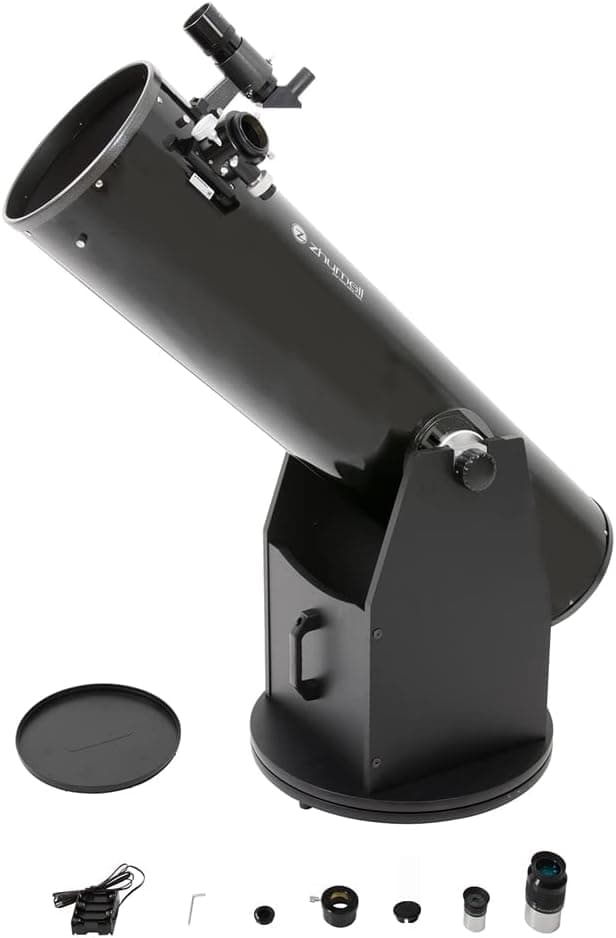
Zhumell 10-inch Dobsonian, a large-aperture reflector on a solid base with handle for serious deep-sky hunting.
Price range: See on Amazon
What we liked
- + 10-inch aperture reveals globular clusters as stars and shows galaxy structure
- + Solid base with handle makes moving the mount between rooms and car less awkward
- + Dobsonian design puts big-mirror power in a simple, low-maintenance package
Trade-offs
- - Tube and base are bulky, so it needs a car with space and a storage corner at home
- - No tracking, so high-power planetary views drift and need frequent nudging
Who this Dobsonian is for
The Zhumell 10-inch Dobsonian pairs a 254mm parabolic primary mirror with a focal length around 1250mm on a classic Dobsonian rocker base, a design built to put maximum light-gathering power into a mechanically simple, low-maintenance package. It is aimed at an observer who has outgrown a small starter telescope and wants to see real structure in galaxies, globular clusters resolved into individual stars, and brighter nebulae, rather than dim smudges. The solid base with a carry handle is meant to make moving a large-aperture instrument between a storage spot and the backyard, or into a car for a dark-sky trip, more manageable than it sounds for a 10-inch mirror. Buyers who mainly want to look at the Moon and planets from a small balcony, or who need something one person can set up in under a minute, will find this telescope heavier and larger than necessary for that job.
Specs and the Dobsonian design explained
At 10 inches of aperture, the parabolic primary mirror gathers far more light than a typical beginner refractor or small reflector, which is what lets a Dobsonian this size show galaxy structure and resolve globular clusters that stay as fuzzy blobs in smaller scopes. A 2-inch dual-speed Crayford focuser accepts both 2-inch and 1.25-inch eyepieces, giving flexibility to use wide-field eyepieces for scanning star fields as well as higher-power eyepieces for planetary detail. A built-in cooling fan on the primary mirror helps the glass reach ambient outdoor temperature faster, which matters because a mirror that is still cooling distorts the image with heat currents until it settles. The optical tube alone weighs around 33 pounds, and the Dobsonian base adds substantial additional weight, so this is a two-hands, sometimes two-trip telescope rather than a single light carry.
Living with a large Dobsonian
Dobsonian motion is intentionally simple: the tube swivels left and right on the base and tilts up and down by hand, with no motors, computer alignment, or polar setup required, which keeps the learning curve low despite the large mirror. Because there is no tracking, an object drifts out of the eyepiece within a minute or two at higher magnification and needs a small manual nudge to recenter, a rhythm most owners get used to quickly but which does interrupt sustained high-power viewing sessions. The included 8x50 finderscope and a moon filter round out a kit that is ready to observe out of the box once collimation is checked. Storage and transport are the main practical considerations owners raise, since a 10-inch Dobsonian needs a dry corner at home and enough trunk space in a car, and the mirror can need occasional collimation adjustment after bumps or long drives.
How it compares with similar-size Dobsonians
Against the Orion SkyQuest XT10, a similarly specced 10-inch Dobsonian from a well-known competing brand, the two are close in aperture and general performance, with differences mostly in accessory bundles, focuser design, and base finish rather than optical fundamentals. Stepping down to Zhumell's own 8-inch DOB-8 trades some light-gathering power for a notably lighter, more portable package, which suits an observer prioritizing ease of transport over maximum aperture. Moving up to Zhumell's 12-inch Dobsonian gains further light grasp for the deepest targets at the cost of even more bulk and a higher price, a step usually reserved for observers who are certain they want to commit to a larger instrument.
Bottom line and who should choose differently
For a hobbyist ready to commit to a real deep-sky instrument and willing to manage its size, this 10-inch Dobsonian delivers meaningful aperture at a straightforward price with a simple, dependable mechanical design and a base built for handle-assisted carrying. Anyone short on storage space, without a car that fits the assembled tube and base, or who wants a lighter grab-and-go scope for quick sessions should look at a smaller Dobsonian or a tabletop model instead. Observers who want to track objects automatically for extended high-power viewing or basic astrophotography should also consider a computerized or equatorial mount, since this Dobsonian has no tracking motor at all. Within its role as a manual, large-aperture deep-sky telescope, it remains a solid, uncomplicated choice.
Frequently asked questions
How heavy is the Zhumell 10-inch Dobsonian to move and store?
The optical tube alone weighs around 33 pounds, and the base adds significant additional weight, though the tube detaches from the base and the base includes a carry handle to make two-piece transport more manageable than carrying it fully assembled.
Does this telescope track objects automatically?
No, it uses a manual Dobsonian mount with no motor or computer control, so objects need to be nudged back into view by hand every minute or two at higher magnification as Earth's rotation carries them out of frame.
What can you see with a 10-inch Dobsonian that a smaller telescope cannot?
The larger 254mm mirror resolves globular star clusters into individual points of light and reveals structure in brighter galaxies and nebulae that stay as faint, featureless smudges in typical 70mm to 130mm beginner telescopes.
Does the mirror need regular maintenance?
Like any reflector, the primary mirror can shift out of collimation after bumps or long drives and should be checked periodically, and the built-in cooling fan helps the mirror reach outdoor temperature faster for sharper views early in a session.
Prices change often, so check the current price and availability on Amazon.
Check price on AmazonStargazer Nest may earn a commission from the link above.