Celestron NexStar 8SE Computerized Telescope, 8-Inch Schmidt-Cassegrain, Automated GoTo Mount with SkyAlign Review (2026)
Updated September 21, 2026 · Research-based review
Our verdict
An 8-inch Schmidt-Cassegrain on a GoTo mount that finds and tracks objects with a three-star SkyAlign routine, making it a strong pick for beginners who want real aperture without a manual star-hop learning curve. The single fork-arm mount can wobble at full tripod extension, so budget for vibration pads if you observe at high power.
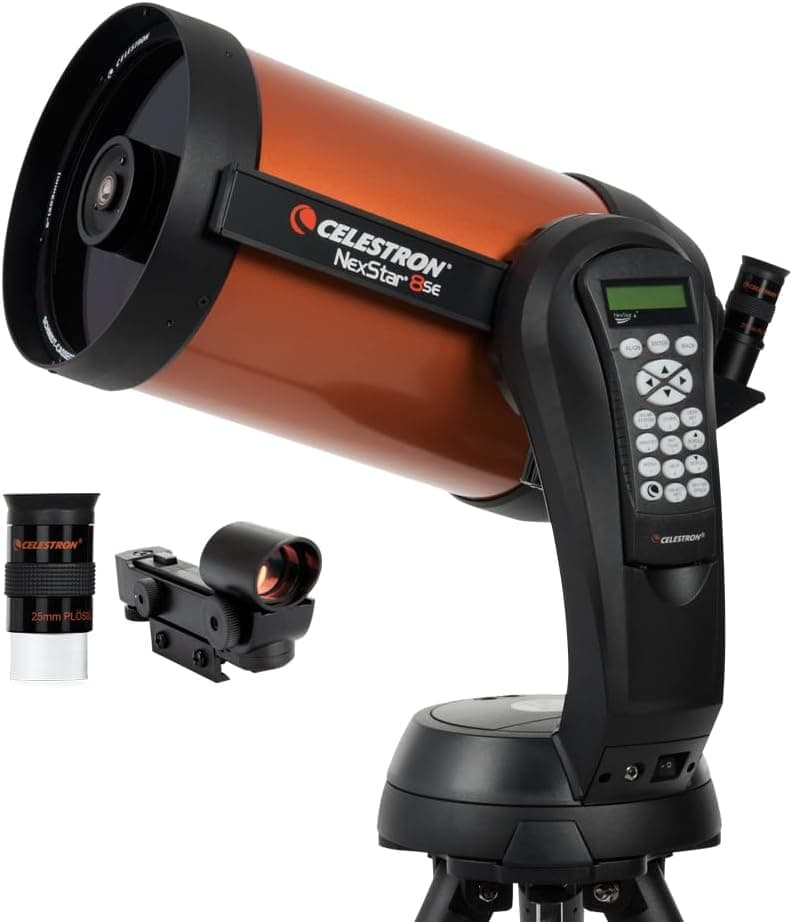
Celestron NexStar 8SE, an 8-inch Schmidt-Cassegrain on an automated GoTo mount with SkyAlign for guided observing.
Price range: See on Amazon
What we liked
- + 8-inch Schmidt-Cassegrain gives big-aperture views in a compact, portable tube
- + SkyAlign GoTo finds and tracks objects, so sessions focus on viewing not searching
- + Iconic orange tube with broad accessory support for imaging and visual use
Trade-offs
- - Single-arm mount can feel shaky at high power with this larger tube
- - Power supply and dew protection are extras many owners end up adding
An 8-inch aperture in a compact, portable tube
The NexStar 8SE uses an 8 inch, 203mm Schmidt-Cassegrain optical tube with a 2032mm focal length at f/10, according to Celestron's own specifications. The Schmidt-Cassegrain design folds that long focal length into a tube only about 17 inches long, which is why an 8-inch telescope can still be reasonably portable. Celestron lists the total kit weight, including optical tube, single fork-arm mount and tripod, at 32 pounds, broken into roughly 12 pounds for the tube, 11 for the mount head and 9 for the tripod. Because the kit separates into those pieces for transport, one reviewer at Astro Backyard notes it is genuinely easier to carry in stages than an equivalent-aperture Dobsonian, even though the total weight is similar.
SkyAlign and the GoTo experience
The defining feature of the 8SE is its computerized GoTo mount with Celestron's SkyAlign system, which the manufacturer says can align on any three bright celestial objects without needing to know their names or find them in a specific order. Astro Backyard's review calls the alignment process dead simple and describes the mount successfully keeping Saturn centered in the eyepiece for close to 20 minutes of continuous tracking. Celestron's database holds more than 40,000 objects according to the product listing, which removes the need to manually star-hop to find faint targets. The mount runs on 8 AA batteries or a 12V DC power supply, both sold separately from the telescope itself.
Mount stability at higher power
The single-arm fork mount is a common point of criticism in independent reviews. Astro Backyard describes it as feeling under-mounted for the telescope's weight, with noticeable wobble that becomes more pronounced when the tripod legs are extended to their full height, and reports the slewing response can feel laggy at the slowest speeds. Vibration suppression pads, sold as a separate accessory, help settle the image faster after a slew but do not eliminate the wobble entirely. This is worth planning for if you intend to observe at high magnification on the Moon or planets, where any vibration is more visible, though it is less of an issue for lower-power deep-sky viewing.
What is included and imaging limitations
The 8SE ships with the optical tube, fork arm mount and tripod, an accessory tray, a StarPointer red dot finderscope, the NexStar+ hand control, a 25mm eyepiece and a star diagonal, backed by a 2-year Celestron warranty. Astro Backyard's review notes the alt-azimuth tracking design is not well suited to traditional long-exposure deep-sky astrophotography, since it does not compensate for field rotation the way an equatorial mount does; the telescope is built primarily for visual observing and shorter-exposure imaging of the Moon and planets. The included red dot finder is functional but basic, and many owners eventually add a magnified finderscope for precise centering on fainter targets.
Who should buy the NexStar 8SE
This telescope suits a beginner or intermediate observer who wants meaningful 8-inch aperture and the convenience of computerized object-finding without learning manual star charts or investing in a full equatorial mount. It is a strong grab-and-go telescope for planets, the Moon, and brighter deep-sky objects. Buyers focused on serious long-exposure astrophotography should look at an equatorial mount instead, since the alt-azimuth GoTo design here is not built for that. Anyone planning frequent high-power planetary viewing should factor in the cost of vibration suppression pads and a spare power source alongside the telescope's own price.
Frequently asked questions
How heavy is the NexStar 8SE and can one person carry it?
The full kit is about 32 pounds, but it separates into the optical tube, mount head and tripod, each a manageable weight, so most people carry it out in two or three trips rather than as one heavy piece.
Does the NexStar 8SE need batteries or a power cord?
Yes. It runs on 8 AA batteries or a 12V DC power adapter, and neither is included in the box, so plan to buy one before your first night out.
Can the NexStar 8SE be used for astrophotography?
It can capture the Moon and planets reasonably well, but its alt-azimuth GoTo mount does not compensate for field rotation, so it is not well suited to long-exposure deep-sky astrophotography the way an equatorial mount is.
Is the mount stable at high magnification?
It is usable but not rock solid. Independent reviews note noticeable wobble when the tripod is fully extended, which is more visible at high planetary magnifications; vibration suppression pads, sold separately, help settle the view faster.
Prices change often, so check the current price and availability on Amazon.
Check price on AmazonStargazer Nest may earn a commission from the link above.