Sky and Telescope's Pocket Sky Atlas by Roger W. Sinnott Spiral-Bound 80 Charts 1500 Deep-Sky Objects Review (2026)
Updated September 20, 2026 · Research-based review
Our verdict
This spiral-bound pocket atlas packs 80 charts and roughly 1,500 deep-sky objects into a compact book built to sit open at the eyepiece. It is a favorite for star-hopping with small and mid-sized telescopes, though the small print asks more of red-light reading than a larger desk atlas.
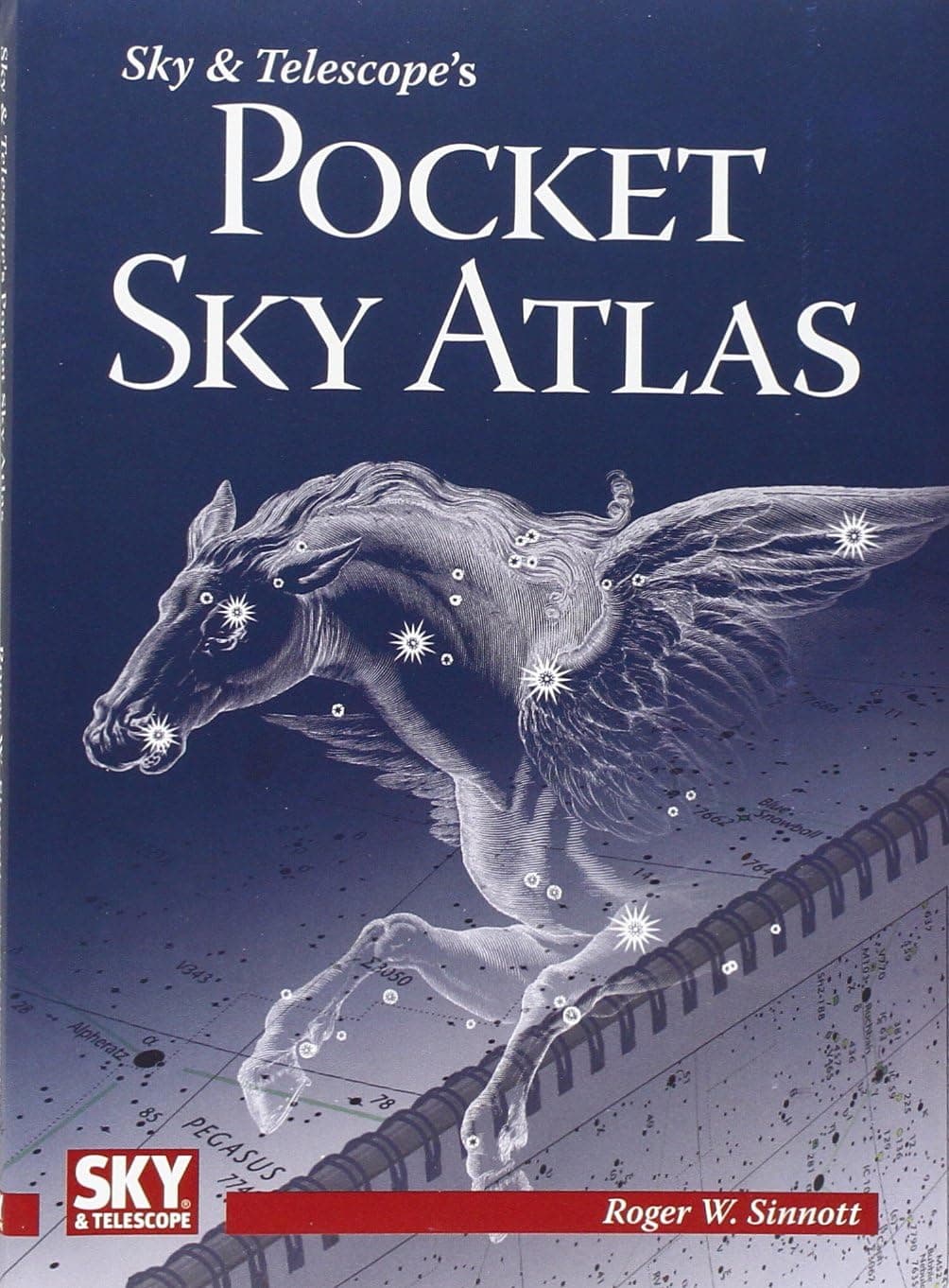
Sky and Telescope's Pocket Sky Atlas by Roger W. Sinnott, spiral-bound with 80 charts and 1500 deep-sky objects.
Price range: See on Amazon
What we liked
- + 80 charts with 1500 deep-sky objects give plenty of targets for small and mid telescopes
- + Spiral binding lies flat on a table or eyepiece tray at the telescope
- + Compact size is a favorite for star-hopping at the eyepiece
Trade-offs
- - Small print can be hard to read for older eyes under red light
- - Charts show fewer faint stars than larger desk atlases
What the atlas covers
Roger Sinnott's Pocket Sky Atlas maps more than 30,000 stars down to magnitude 7.6 across its 80 charts, along with about 1,500 deep-sky objects including roughly 675 galaxies to magnitude 11.5. That density puts it well above naked-eye planispheres while staying far more portable than a full desk atlas, making it suited to finding star clusters, nebulae and brighter galaxies with binoculars or a telescope rather than mapping the faintest possible targets. The atlas also names the best double stars and marks three dozen notable red, or carbon, stars, giving observers extra targets beyond the standard deep-sky object list.
Chart layout and finding aids
Each chart shows constellation boundaries and simple stick figures to help translate what is overhead into a position on the page, which is useful for observers still learning their way around the sky. Close-up charts are included for a handful of dense or popular regions, among them the Orion Nebula area, the Pleiades, the Virgo Galaxy Cluster and the Large Magellanic Cloud, giving extra detail exactly where crowded fields make a standard-scale chart hard to read. This mix of wide charts for star-hopping and close-up insets for busy regions is part of why the atlas remains a common recommendation for observers moving beyond a basic planisphere.
Build and portability
The atlas runs 110 pages at a 6 by 9 inch trim size, small enough to fit in a jacket pocket or an eyepiece case rather than needing a table of its own. Spiral binding is the atlas's defining physical feature: it lets the book lie flat when opened to any chart, which matters at a dark telescope where holding a book open with one hand while adjusting eyepieces with the other is impractical. The softcover construction keeps weight down for carrying to a dark site, though like any paper atlas it benefits from a protective sleeve or case if it is going to live in an observing bag long term.
Reading it under red light
Because the charts pack a large number of stars and objects into a compact page, the print runs small, which some observers find harder to read under dim red observing light, particularly compared with larger-format desk atlases that spread the same regions across bigger pages. Sinnott's own Jumbo Edition of this same atlas exists specifically to address that, reprinting the identical 80 charts at a larger page size for observers who want easier reading without giving up the pocket edition's chart selection. Anyone who already struggles with fine print under red light is worth pointing toward that larger edition instead of, or alongside, this original pocket version.
How it compares and who should buy it
In the site's Best Star Atlases guide this original spiral-bound edition ranks first of seven, ahead of its own Jumbo Edition, Erich Karkoschka's Observer's Sky Atlas titles, the Night Sky Atlas by Scagell and Tirion, and Philip's Pocket Star Atlas. Its combination of chart density, sensible finding aids and a binding built to survive real use at the eyepiece explains the ranking, and it remains a standard recommendation for anyone moving from a planisphere to serious star-hopping with binoculars or a small to mid-sized telescope. Observers who mainly need naked-eye constellation charts, or who prioritize large print over portability, are better served by a simpler atlas or this book's own Jumbo Edition.
Frequently asked questions
How many stars and deep-sky objects does the atlas show?
It maps more than 30,000 stars to magnitude 7.6 and roughly 1,500 deep-sky objects, including about 675 galaxies to magnitude 11.5.
Does the atlas lie flat when open?
Yes, the spiral binding is designed to let it lie flat on a table or eyepiece tray at any chart.
Is the print easy to read under red light?
The print is small given how much detail is packed onto each chart, and some observers prefer the larger-format Jumbo Edition of the same atlas for easier reading.
What size is the book?
It is a compact 6 by 9 inch, 110-page spiral-bound softcover, sized to carry in a pocket or eyepiece case.
Prices change often, so check the current price and availability on Amazon.
Check price on AmazonStargazer Nest may earn a commission from the link above.